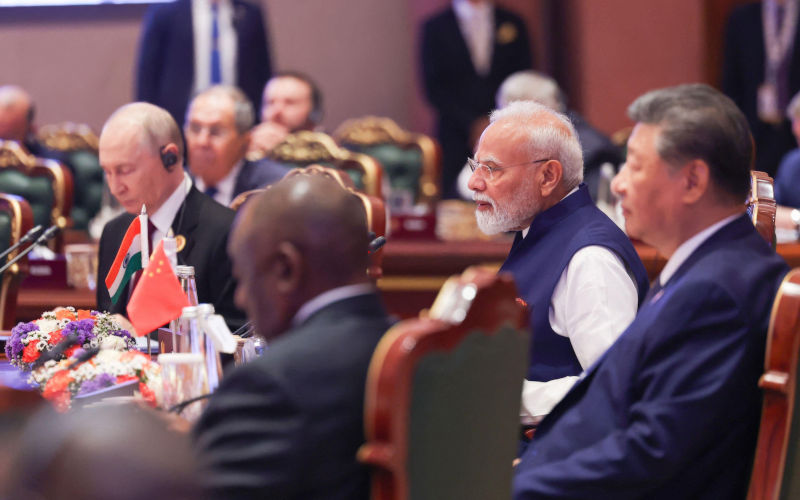
BRICS emerged from New Delhi with plans to deepen financial and technological cooperation, as US tariffs and sanctions push the expanded bloc towards practical alternatives to Western-dominated systems.
The 18th BRICS summit closed in New Delhi with a 45‑page declaration under India’s theme ‘Building for Resilience, Innovation, Cooperation and Sustainability’. Born of necessity, it came as Washington threatened massive tariffs on any bloc challenging dollar dominance. The expanded group faced two choices – fracture under US pressure or quietly build alternatives. It chose the latter.
With Xi Jinping in India for his first visit in seven years, Putin present, Iranian President Pezeshkian attending, and wars in Ukraine, the Middle East and the Red Sea pressing, could the bloc agree on mechanisms rather than slogans? Yes – a rebuke to Washington’s assumption that BRICS would collapse under its contradictions. BRICS chose minimum consensus and technical plumbing over confrontation. In an era of US‑led economic warfare, that is not weakness; it is statecraft.
The declaration’s standout section covers cross‑border payments. The Payment Task Force will pursue interoperability and local-currency settlements, seeking “fast, low‑cost, accessible, efficient, transparent, and safe” solutions. India championed links between UPI, Pix, CIPS and similar systems, advancing invoice discounting for small firms and New Development Bank (NDB) local‑currency lending. On day two, Xi offered open‑source AI and smart‑manufacturing support; Modi warned against weaponising technology and critical minerals. This is the architecture of a post‑hegemonic financial system – and a glimpse of the bloc’s next fault line.
Every new payment corridor or SWIFT alternative erodes Washington’s power to weaponise finance; every AI partnership chips at US tech hegemony. For sanctioned nations, options beat rhetoric. The weakness is the timetable: the text ‘encourages’ and ‘welcomes’ more than it commits. US tariffs, sanctions and chip export controls act as external stimuli pushing BRICS together. Yet slow dedollarisation beats a system where one country can cut dollar access overnight.
Without naming the US, the declaration condemns unilateral tariffs and secondary sanctions as illegal. This reflects BRICS members’ lived experience under US sanctions. Modi said BRICS was “not against anyone”. Yet Washington treats BRICS’ existence as defiance. Trump threatened 100 per cent tariffs if the bloc “plays games with the dollar”. That is not diplomacy; it is economic gunpoint. The language reflects India’s tightrope – strategic autonomy, not bullying into anti‑China or anti‑Russia camps.
Xi’s meeting with Modi was the summit’s centrepiece. Both sides agreed “differences should not become disputes” and committed to a fair boundary settlement. Xi framed China and India as “partners rather than rivals”; Modi thanked China for supporting India’s chairship and pledged full support for China’s presidency next year. If Washington hoped border tensions would keep Asia divided, New Delhi and Beijing have other ideas.
The shift to ‘partners rather than rivals’ is a geopolitical earthquake. The summit showed a working division of labour: India chairs; China supplies payment systems, industrial capacity and development finance without dominating the text. That is not Chinese hegemony; it is investment in a multilateral order that includes the Global South.
On security, the declaration trades blame for procedure. On the Middle East, it calls for maximum restraint and a two‑state solution. On Ukraine, no ceasefire language – only general principles. Critics call this weak; they miss the point. In a bloc including Iran, the UAE, Russia and Ukraine’s neighbours, consensus itself resists US demands for blanket condemnation.
The limitation is obvious after a week in which Houthi forces seized Mocha and Perim Island, tightened control of Bab el‑Mandeb, and pushed oil above $100. Saudi Arabia shut its key East‑West pipeline after drone attacks. Yet Washington’s response has been more weapons, more sanctions, more escalation. BRICS at least offers space for de‑escalation – as when Pezeshkian and Abu Dhabi’s crown prince met, the highest‑level Iran–UAE engagement since the war began.
China’s presidency next year will shift the bloc’s centre of gravity. Beijing has the capital to accelerate payment interoperability, NDB local-currency lending and alternative supply-chain financing. It can build on Xi’s AI offer, turning open‑source models into an alternative to US‑controlled chips. The test is whether China can deliver without triggering the US backlash that Modi carefully avoided. If China learns from India’s playbook – quiet competence over grand declarations – BRICS could consolidate as a counterweight to a US‑led order that conflates its own interests with the world’s.
Expanded BRICS will never agree on every war or ideological line. It can, however, agree on minimum deliverables: payment links, NDB lending in local currencies, a contingency reserve, MSME finance, and quiet channels on Iran, Yemen and Ukraine. This is not a super‑bloc; it is a loose coalition keeping options open in a world where Washington demands absolute loyalty. China is best placed to coordinate – and unlike the US, it does not condition cooperation on regime change.
New Delhi showed it can broker such a text. For the Global South, that is a usable result: financial and diplomatic alternatives that reduce dependence on any single power. In an age of US exceptionalism and unilateral coercion, that is not just resilience – it is resistance. The question now is whether China’s chairmanship will deepen that resistance. Given the momentum in New Delhi, the smart money is on yes.

Wenran Jiang
Wenran Jiang, founding director of the China Institute and Mactaggart Research Chair Emeritus at the University of Alberta, is president of the Canada-China Energy & Environment Forum and an advisor at the Institute of Peace and Diplomacy.