Young Palestinians offered a place by Irish universities shouldn’t lose that future because the mechanisms of a visa system can’t accommodate the reality of the place from from which they are applying.
Ahmed Abuhassan approached me because he knew I had some connections in Ireland and believed, perhaps generously, that I might carry some influence or have some special weight there. I don’t. I’m simply someone, like thousands, who has written and spoken about these issues and has been committed to keep putting Palestinian voices in front of people who might listen as they should.
However, there is something particularly painful about what I am now seeing in relation to Ireland because my family came from Kilkee in County Clare and Ireland has always been part of my family’s story. I grew up knowing that my parents, like so many Irish people of their generation, left Ireland and were accepted in another country and I have always understood that history as part of what shaped the Irish character – a people who knew what it meant to leave home, to be displaced, to seek a future elsewhere and to have their own history marked by conflict, political violence and the struggle for self-determination. That history is part of why I find what is happening particularly painful.
Ahmed isn’t alone. By August 2026, 31 of 59 Palestinian students who had secured fully or partially funded places at Irish universities had reportedly been refused study visas, according to RTÉ, Ireland’s national public-service broadcaster. However, for a significant proportion of them, the opportunity appears to stop at the visa office. Irish university teachers and politicians have now publicly raised concerns about the refusal rate and the grounds on which some of these applications have been rejected.
Ahmed’s story began with something that sounds completely ordinary; he needed to complete an English proficiency test. The test is the Duolingo English Test, which is recognised for Irish study visa purposes and there is nothing unreasonable about a university or immigration authority wanting an international student to demonstrate sufficient English to undertake higher education. Ahmed understood that formal evidence was required and set about providing it. He writes extensively and fluently in English, including for LinkedIn, but knew that his own ability was no substitute for the required test.
The Duolingo test requires a quiet and private space, a reliable internet connection and sufficient uninterrupted power not only to complete the test but to upload the required recordings.
Ahmed had to create his own small power system using two damaged solar panels, a battery that was already near the end of its useful life, a power unit, an internet connection and a router.
He estimates that the equipment and installation cost approximately US$6,650. He wasn’t building a solar system for comfort or business; he was trying to create enough stability to sit an English examination. His first attempt failed and on another attempt the process took approximately seven hours because of the instability of the internet connection. On his successful attempt, he began at around 10am in the morning when there was enough sunlight to provide the necessary power, finished the test shortly after 11am and then waited until approximately three in the afternoon for the recording to upload. Four hours simply to transmit the evidence that he had completed the examination. He had to arrange his day around the sun, the battery and the internet, knowing that another failure could mean losing yet another attempt.
Of course there must be standards. Universities need to know that students can communicate in English and immigration authorities have their own requirements. However, a requirement that takes a student in another country an hour or two to complete can become a seven-hour ordeal for somebody in Gaza, where electricity, communications, banking, educational institutions and ordinary government services have been devastated.
The requirement may be the same; the circumstances in which the student is expected to satisfy it aren’t.
Then there is the visa. Ahmed and many other Palestinian students have told me that their refusals have included reasons such as gaps in their education, failure to demonstrate that they will return home after their studies and the failure to provide an original paper bank statement rather than a digital document.
The Irish Federation of University Teachers has publicly expressed concern about Gazan students being asked to explain interruptions to their education, demonstrate an intention to return home and produce documents that may no longer exist where universities, banks and other institutions have been destroyed or severely disrupted.
Irish Labour has also called on the Minister for Justice Jim O’Callaghan TD to intervene, raising concerns about original bank statements and evidence of return.
Ahmed says that the students whose visas were approved aren’t fundamentally different from those who were refused. They are Palestinians from Gaza and they are students who have been offered university places. The distinction, he says, is that some are funded by the Irish Government while others are funded directly by Irish universities.
In July 2025, an Irish parliamentary question explicitly asked the Minister for Justice whether Palestinian students were being refused student visas because their scholarships, although funded by public universities, were not regarded as “official Government scholarships.”
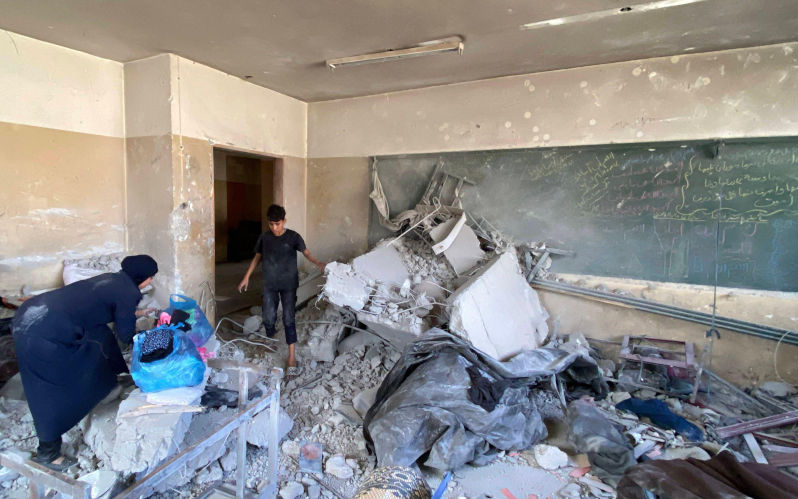
If students who have been selected and funded by Irish universities are being treated differently from students whose scholarships come directly from the Irish Government, that must deserve a clear explanation. Ahmed’s own circumstances make the idea of requiring him to demonstrate that he will return home after his studies particularly painful. He is living in a house where only one room remains standing.
On the evening of 29 July, the house next door was hit. The first missile didn’t explode and those few seconds gave Ahmed and the others in his home time to get outside before the second one landed. He recorded interviews with journalists from that one remaining room and it’s also the room in which his university application was completed.
The idea that, in these circumstances, he should be expected to provide reassuring evidence that he intends to return to the place from which he is trying to escape the immediate destruction of his home and education seems to bear little relationship to the reality in which he is living.
I’m not arguing that Ireland should abandon its immigration requirements, nor that every applicant from Gaza should automatically receive a visa. I’m asking for something much more basic: that the requirements be applied with recognition of the circumstances in which these students are being asked to satisfy them.
If an original paper bank statement can’t be obtained because the institutions that would issue it have been destroyed or disrupted, what alternative evidence is acceptable?
If a student’s education has been interrupted because there is a war, a genocide, in which universities have been destroyed, how is that interruption to be assessed?
If a university has already confirmed the student’s academic qualifications and awarded a scholarship, how much weight does that evidence carry? And if a student has spent US$6,650 creating enough electricity and internet stability to sit an English test and then spent seven hours fighting the connection to complete it, at what point do we recognise that they have done everything reasonably possible to comply?
He has done what was asked of him: taken the English test despite extraordinary obstacles, secured a university place and scholarship, and continued to study and work while living through a war in which his own home has been damaged and the ordinary structures of education and daily life around him have been shattered.
He and the other students aren’t asking Ireland to give them an education they haven’t earned. The universities have already decided that they have earned it. They’re asking for the opportunity to take their seats.
I am writing this because Ahmed asked me to help, and because I absolutely want to help, and because my own connection to Ireland makes it impossible for me to remain indifferent to what is happening.
Please, look at the documents supplied by the universities themselves, and at the reality of trying to obtain bank documents, educational records and evidence of a future return from a place where the institutions that would normally provide them have been destroyed or disrupted. Above all, look at the determination of a student who spent thousands of dollars assembling a solar-powered system and seven hours fighting an internet connection simply to prove that he can speak English.
The Irish Government can ask the Department of Justice to review these cases.
The universities can press for their students to be treated in a way that recognises the circumstances in which the applications were made – and to really look at what EQUALITY means in practice.
The people responsible for the decisions can look again at the evidence rather than simply looking for documents that Gaza can no longer reliably produce.
These young people have already been selected by Irish universities and have been given a future by those universities and they shouldn’t lose that future because the mechanisms of a visa system can’t accommodate the reality of the place from which they are applying.
The next step is Ireland’s.
His term begins on 7 September.
Ireland must now do its part.

Meg Schwarz
Meg Schwarz holds a Postgraduate Diploma in Counselling and Psychotherapy and brings over 35 years of experience championing social justice, advocacy and consumer engagement. Based in South Australia, Meg has dedicated her career to working alongside diverse communities, including refugees, people with disabilities and individuals with complex trauma backgrounds.With a strong passion for equality and human rights, Meg specialises in fostering meaningful communication, empowering voices through advocacy and creating inclusive spaces for dialogue. Her skills in stakeholder engagement, strategic communication and community development have earned her recognition as a trusted and compassionate leader in her field.