Hong Kong people, most of whom have only the barest acquaintance with the city only twenty miles away, look down on Shenzhen as a poor dirty cousin. Reality is rapidly running away from this perception…. A gradual realisation has crept upon the world in the past few years that the new Silicon Valley is Shenzhen.
Policies towards special economic zones, and particularly towards Shenzhen, the most successful of these zones, have always been a political bellwether in China’s highly factionalised Party and government.
“Shenzhen’s development and economy demonstrates that our policy of establishing Special Economic Zones is correct”. This quote from Deng Xiaoping is carved in meter high characters of gold in a twenty-meter long red marble plinth at the top of Lianhua Mountain. A few yards away stands an enormous bronze statue of Deng. On any morning you can see people worshipping him, standing there with the three bows, the baibai performed before the statues of the gods. And these aren’t peasants, they’re businessmen in suits and ties.
Shenzhen has always been opposed and undermined by the conservative left wing of the CCP but held up by the Reform Faction as evidence of the success of gaige kaifang, the policy of reform and opening. What gaige kaifang means is carefully set out in a section of Shenzhen’s City Museum. It includes: labour reform, the breaking of the danwei system which gave the Party control over the lives of ordinary people and the establishment of a labour market; land reform making land a tradable commodity; reform of the civil service; monetary reform making a currency market; the shareholding system creating business enterprises with tradable shares, thus allowing private businesses access to capital and even allowing state owned enterprises to own shares in each other; a stock exchange; legal reform and institution of the rule of law. This came to be considered the filling out of Deng Xiaoping’s originally vague concept of “socialism with Chinese characteristics”.
If we consider how confrontational these policies are vis à vis communist theory as it had been interpreted before the establishment of the SEZs in 1980, it’s not surprising that state visits to Shenzhen have been pivotal events. Deng’s famous “nan xun” visit of 1992 was a clear message to the left of the Party that despite the Tiananmen Square events of 4 June 1989, he was not for turning when it came to reform. People at the top who opposed reform were bluntly and publicly told that they should “be brought down from leadership” and Shenzhen was advised to “be bold in carrying out Reform and Opening, be daring and experimental and not act like women with bound feet”.
Xi Jinping’s visit to Shenzhen on 14 October this year to celebrate the fortieth anniversary of the Zone was no less pivotal but possibly more problematic. Despite what is written about him, Xi has for many years been the leader of the reform faction in the CCP. He is identified with Shenzhen and its policies. His father Xi Zhongxun, is generally recognised as the real moving force behind the foundation of the Shenzhen SEZ and his mother Qi Xin still lives in Shenzhen. Xi feels comfortable enough in Shenzhen to often be seen being driven around the streets with only minimal apparent security.
This makes the ambiguity of his speech on the fortieth anniversary all the more interesting. The general thrust of his speech was what we might expect from the leader of the reform faction, a call to further opening up and deeper reform. He even specifically mentioned the Qianhai Zone, “zone within a zone” where legal and financial reforms are being experimented with.
The sting came on the tail. The “sensitivity” and “difficulty” of promoting reform were no less than they were forty years ago in the face of “many unprecedented challenges” and “greater political wisdom” and “courage” were needed in carrying out reform. This isn’t Deng Xiaoping laying down the law and demanding that his opponents find new challenges preferably in their private lives. We conclude that far from being the Great Dictator, Xi’s political position is insecure and he is constantly looking over his shoulder at the beast on the left, and placating it by throwing it crumbs from his table, crumbs which apparently undermine his own political philosophy, He has particularly tried to buy the support of the military and the security apparatus. Essentially he is saying to his wavering supporters, stick with me, my heart’s in the right place but there are others to pacify here.
The disquiet with which his own faction greets this is evidenced by a number of public criticisms by people who would have seen themselves as close supporters. The most recent is a scathing article by former Shenzhen Mayor, Li Youwei in Hong Kong’s communist Wen Wei Po bemoaning the resurgence of discussion of “class struggle”, a label by which reform faction members identify the Left, and pointing out that private property was still not protected by the constitution. More worrying are rumours that Vice-President Wang Qishan may soon be forced to resign. If there were ever any questions about Xi Jinping’s status as a leader of the reform faction, there are none about Wang Qishan’s.
Meanwhile life in Shenzhen, the greatest twenty million population city that nobody has heard of, goes on as before. Novelist Murong Xuecun summed up Shenzhen in the early nineties in his novel “Another Way to Heaven”.
“This was in 1992, just after Deng Xiaoping’s trip to the south. Shenzhen was like a loaf of bread puffing up in a hot oven. Every day countless new companies were set up, every day countless people, following their dreams and clutching Border Area Passes, entered that small fishing village on the South China Sea.”
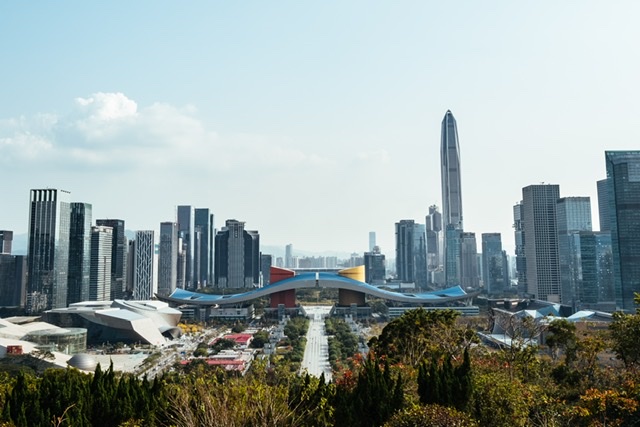
A sense of great excitement still pervades the city. You’re encouraged to have a go. Establishing a private company in Shenzhen takes only a few minutes and everybody has one. “Laile jiu shi Shenzhenren”, if you’re here you’re a Shenzhener, the City Government’s slogan says. The city is big and brash. The spiritual excitement is reflected in the built environment. Some of the world’s best commercial architecture creates great canyons of glass along broad boulevards. Shenzhen has the reputation of being China’s greenest city – beautiful parks grow quickly in the heat of Shenzhen and the seaside freeways with the brilliant purple of bougainvillea flourishing between palms and banyans must rank amongst the best urban landscapes in the world
Shenzhen is a relentlessly bourgeois city. No, they’re not the impoverished “migrant workers” chained to factory benches as spoken of by the popular press. The last factory in the old zone closed ten years ago under the pressure of booming land prices. Now the work force works in services, finance, logistics, insurance. One is struck by the bourgeois normalcy of life in Shenzhen. The Shenzhener owns his own car, always new, which he drives in a sometimes eccentric fashion. He lives in a flat on which he is paying a mortgage in a privately owned estate with extensive internal gardens, set in leafy streets. In the evenings he congregates in the garden, often with an over-groomed pet dog and gossips with his neighbours. He commutes to work on one of the world’s best and most extensive metro systems.
Let’s look at the service industries where Mr Shenzhen works. A gradual realisation has crept upon the world in the past few years that the new Silicon Valley is Shenzhen. Huawei has gone from “how do you pronounce that?” to a subject of political controversy, and people now know of Tencent, Oppo and ZTE, all Shenzhen companies, but few people know that the Shenzhen presence of these companies is all in R & D. Huawei’s garden campus with its international workforce led the way closely followed by the Hi-Tech Zone’s ZTE. In 1988, Shum Yip’s Terra Industrial Estate was a collection of eight storey factories in the middle of paddy fields making electronic components. Now the eight storey buildings remain but with R & D completely replacing manufacturing. Konka once made a TV sets at its factories at Overseas Chinese Town; those factories are now art galleries. Shenzhen Electronic Group’s Huaqiang Bei was similarly five storey factories but is now all high range retail.
Shenzhen is a major financial centre. Currently it is ranked number nine between San Francisco and Zurich in the Global Financial Centres Index. Two of the listed Chinese banks, Shenzhen Development Bank and China Merchants Bank are headquartered in Shenzhen. Shenzhen Development Bank has a particular place in the history of reform in China being the first entity to be identifiable as a real stock company. China Merchants Bank is the biggest retail bank in China and tenth biggest bank in the world by market capitalisation. Both of these institutions, although having substantial state owned enterprise shareholdings, are classified as “min jian” or non-state enterprises. Ping An Insurance, which started in the eighties when the leader of one of the zone’s areas asked his driver to “find out about insurance” is China’s largest financial entity and the ex-driver is its billionaire CEO. Shenzhen Stock Exchange ranks seventh in the world by market capitalisation. In keeping with its role as the guardian of reform, it concentrates on private and hi-tech enterprises.
Shenzhen is also a major player in transport and logistics. The World Shipping Council lists Shenzhen as the world’s third biggest container port with a throughput of 28 million TEUs in 2018. It’s interesting to note that Shenzhen’s throughput continues to grow while Hong Kong’s has dropped from 22.2 million TEUs in 2014 to 19.6 million in 2018. And despite the bulk of Shenzhen’s international air passenger traffic going through Hong Kong Shenzhen’s dazzling Massimiliano Fuksas-designed airport ranks twenty sixth in the world with 53 million passenger movements in 2019.
Where does this leave Hong Kong? It’s tempting to say that Hong Kong has missed a historic opportunity to exert a disproportionate influence on affairs throughout China. In 1997 Hong Kong was a substantial part of China’s economy. Its cultural influence was all-pervading. Hong Kong music and films were consumed all over China and Cantonese phrases became standard in the language. But the negativity which has characterised Hong Kong since the near coincidence in 1997 of the handover and the Asian Financial crisis has pervaded Hong Kong thinking about its position in China. If it’s Mainland, Hong Kong doesn’t want it. The widespread opposition to extending China’s high speed railway network to Hong Kong was suggestive.
Underlying the many mainly specious arguments against the new line was that it’s theirs and we want nothing to do with it. The decision to situate Chinese immigration and customs at the new West Kowloon station caused much muttering in legal circles about loss of sovereignty. Nobody thought to mention that Hong Kong Immigration and Customs had been operating on Mainland soil at the Shenzhen Bay checkpoint for a decade. Sadly this has probably meant that the opportunity for Hong Kongers of all political persuasions to play a part in social and political development on the Mainland has all but disappeared. Meanwhile Hong Kong people, most of whom have only the barest acquaintance with the city only twenty miles away, look down on Shenzhen as a poor dirty cousin. Reality is rapidly running away from this perception.

Ted Rule is former Chair of Shenzhen private equity firm Da Zheng Yuan International. Previously he was Managing Director of Asia Infrastructure Fund, Hong Kong, and China Director of Standard Chartered Asia, Hong Kong. he is a graduate of the University of Melbourne and the Australian National University in Chinese.
Comments
5 responses to “Shenzhen is overtaking Hongkong”
The question is this: Does Hkers choose freedom and democracy (as in the West) or prefer a better standard
of living. HKers cannot have both now because the protestors have wasted their efforts when the protest became violent and destroying property. The Chinese Central government tolerated as much as possible despite evidence of foreign involvemnt, and in restoring law and order, as well as saving face, it introduces the NSL which is more serious than the Extradition Law which sparked the protest.
“Village bias” is a cultural tribal bias typical of Cantonese culture, where one villiage can look down on others within the Guangdong Province; and the Cantonese look down on the Hakkas (from the North) & Fujians. Hence it was not unexpected that HKers look down on Shenzhen (a Hakka enclave, fishing villiage). As China becomes more “cosmopolitan” in their cities, these biases must give way to a modern inclusiveness of the Chinese people, where the traditinal biases should cease. As HK has develped away from the mainland, it has a lot to catch up with the rest of China on “cultural * political unitity” and on the expectation and aspiration of 1.4 billion people.
It is not too late for Hkers to really “return to the China” and put their future as one China for all to benefit and prosper. Otherwise, HK will beome the poorer cousins in the next 20 years.
}
}
Hong Kong is losing to Mainland China. Its poverty rates are high, it suffers from corruption and savage capitalism. It is now the most expensive city on earth. People are frustrated, but paradoxically, they are blaming socialist Beijing for their problems, instead of the legacy of British colonialism. ‘Across the line’, Shenzhen, Shanghai, Beijing, Xiang and other cities are leaving Hong Kong behind in almost all fields.
The city is run by an extreme capitalist system, ‘planned’ by corrupt tycoons/developers. The obsolete British legal system here is clearly geared to protect the rich, not the majority. That was essentially why the “Extradition Bill” was proposed: to protect Hong Kong inhabitants from the unbridled, untouchable, as well as unelected de facto rulers.
Not to mention the little case of the bride in a suitcase.
There is a whole world out in that direction for Hong Kongers and the rest of us to be aware of:
https://en.wikipedia.org/wiki/Guangdong-Hong_Kong-Macau_Greater_Bay_Area
Hong Kong will for some time, if it can escape its navel gazing, offer the outside world and international offices in Hong Kong, keys to that wider area, to be engaged with not constantly slammed.
In the early 1980s as we were navigating new and positive directions in Australia-China relations, older and by their own estimation wiser heads in Foreign Affairs came to me to say tut-tut, all that will fail, you will be disgraced. To visit Shenzhen then required imagination and trust in the future. International strategic policy needs vision now and into the future and avoidance of scared huddling and enemy focusing.
It is appropriate to look to human dimensions of China, creative work. I first recommend this charming movie
https://en.wikipedia.org/wiki/Shower_(film)
navigating between Shenzhen and traditional life, twenty years ago.
This is not Shenzhen, but modern Shanghai, family life, death and romance, told quietly, thought mushy perhaps by those who expect Chines films to be riddled with violence.
https://www.hollywoodreporter.com/review/last-letter-ni-hao-zhihua-film-review-1163733
Ted Rule offers a story of detail and inflection in political struggle between conservative and reform forces in China. This surely can be understood in Australia where in similar political struggle, conservative forces dominate. Here the dinosaurs frustrate reform, expunging positive possibilities. What can we say… China seems to be doing between in the struggle against dinosaurs. Mr Rule’s nuanced account counters the popular (in Australia) images of China as monolithic dictatorship. Useful to watch the wonderful wild and beautiful political satire whose English language title is “I am not madame. Bovary” (try SBS movies). Yes, things like this exist in China, with its mockery of party and government systems
https://cinema-scope.com/features/small-things-and-big-things-feng-xiaogangs-i-am-not-madame-bovary/
Those who prefer books might do well to look at the works of Nobel Prize winner Mo Yan, not as notorious as some because he remains in China. Start with this book offering a history of China through the twenty first century here
https://en.wikipedia.org/wiki/Big_Breasts_and_Wide_Hips
… a history mainly through the eyes of an individual with moderate and curious sexual deviance which might offend some in the grand tut-tut brigade. Mo Yan not running from China and thus less a hero for some.
These suggestions stray from Shenzhen but are offered to encourage people to read more widely, not depend simple on the ooh-ah-isms of much news and pseudo-news about China in Australia.
Thank you Mr Rule for such important facts.
Here is a human focused discussion of interest of Hong Kongers in living in the Greater Bay Area, including Shenzhen.
https://www.scmp.com/news/hong-kong/hong-kong-economy/article/3105193/greater-bay-area-bigger-homes-wide-open-spaces
I find the South China Morning Post valuable to follow for multiple reasons. Over 100 years old it was purchased by Murdoch but managed to shrug him off. It continues in Hong Kong with an independent voice despite new Hong Kong laws. It covers global affairs better than any Australian news outlet.