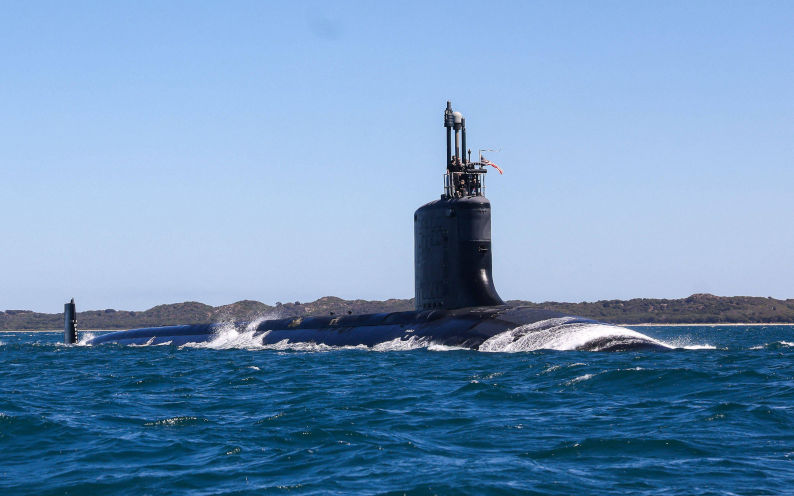
Australia still needs nuclear-powered submarines for long-range sea denial, but the current AUKUS pathway is too slow and risky, making a locally built conventional fleet essential to avoid a dangerous capability gap.
Australia’s prosperity and security are intrinsically linked to our maritime environment. As regional navies grow, maintaining the ability to operate freely and protect national interests requires capabilities that provide the government with flexible, independent options. Within an effective national defence posture, submarines have one primary role: they are potent and effective weapons of attack, creating profound uncertainty and structural asymmetry for an adversary.
To be truly effective, Australia’s submarines must have the long range and endurance required for forward sea denial – operating at the places where an adversary will most certainly be found, such as their home ports, training areas, and high-payoff trade routes. Restricting operations to our immediate geographic approaches hands the initiative to an opponent and constitutes a fundamental failure of forward sea denial.
Sensor density and the reality of transparent oceans
Predictions of entirely transparent oceans overstate the situation. While sensor density and ocean surveillance compilation are improving, the ocean remains a complex, non-linear medium that naturally masks acoustic and non-acoustic signatures. Sustaining persistent, wide-area surveillance over vast regions like the South China Sea presents an immense challenge that exceeds the organic capacity of predicted regional assets.
The execution of high-value forward operations within these contested environments will be structurally enhanced by deploying organic unmanned systems from the mother submarine. Utilising the manned platform as a forward command node that deploys autonomous off-board drones allows for deep stand-off detection, extended sensor coverage, and remote weapon placement. This deployment keeps the mother platform insulated from localised risks while maintaining absolute command authority over the tactical employment of these assets.
The immutable physics and survivability of nuclear power
It is this specific geographical reality that underpins the strategic case for nuclear propulsion. The immutable laws of physics dictate that conventional transits across immense oceanic distances are severely constrained by speed and the indiscretion of recharging. By eliminating the inescapable need to snort to run diesel generators, a nuclear-powered submarine can remain fully submerged, silent, and moving at high speed indefinitely.
Ultimately, the unique combination of high, sustained mobility and absolute stealth confers a level of platform survivability that no conventional submarine can replicate. In modern, high-threat environments, a conventional submarine’s survival is fundamentally compromised by the inescapable physics of its propulsion system; even with advanced batteries or Air Independent Propulsion (AIP), it must eventually slow down or approach the surface to snort, introducing acute windows of vulnerability.
Conversely, an SSN’s nuclear reactor allows it to maintain constant tactical speed while remaining deeply submerged, granting it the agility to continuously exploit oceanographic features – such as thermocline shadow zones – to break an adversary’s tracking solution. By decoupling high speed from the risk of detection, nuclear propulsion allows the platform to dictate the terms of engagement, evade searching forces after an attack, and survive to fight again. This qualitative leap in survivability is a critical justification for the immense fiscal investment and demanding national enterprise milestones required of a nuclear program.
The failing timeline of the optimal pathway
The current AUKUS “Optimal Pathway” is failing to meet the timeline required for our national security, primarily because the proposed SSN-AUKUS platform is simply too big, too expensive, and structurally too difficult to build for the industrial capacity available. The physical footprint, structural displacement, and technical complexity of a massive, next-generation nuclear-powered attack submarine exceed anything the Australian industrial base has ever contemplated.
This risk of late delivery is compound and systemic, driven by the state of our partners’ industrial bases. In the United Kingdom, vital shipyard infrastructure investments at Barrow have already slipped, and the reactor core production program has been rated “red” by infrastructure watchdogs for three consecutive years. Furthermore, the SSN-AUKUS design introduces technical risk, as the move to the new PWR3 reactor plant is being undertaken without the safety net of a shore-based prototype.
Australia’s planned insurance policy against these delays – the transfer of Virginia-class boats from the United States – is equally decoupled from industrial reality. Under US law, the President must certify to Congress that such transfers will not degrade United States undersea capabilities. However, the US submarine industrial base remains structurally constrained, with a persistent delivery rate of only 1.1 to 1.2 hulls per year.
The shift to the larger Block V and VI versions of the Virginia class, coupled with the growing workload demands of the Columbia-class ballistic missile submarine program, is likely to absorb productivity gains and may slow the rate of delivery. Given their own critical shortfall, the likelihood of a US President honestly certifying the divestment of operational hulls to Australia in 2031 is highly unlikely, leaving a dangerous capability vacuum as the Collins class reaches the end of its life.
The necessary pivot to Plan B
We must decouple our immediate defence needs from the long-term, high-risk aspiration of the current AUKUS pathway. Australia must vigorously support and leverage the foundational training pipelines, regulatory safety frameworks, and multi-billion-dollar industrial preparations currently being established under AUKUS to ensure the nation becomes genuinely “sovereign-ready”. However, we must recognise that we are currently aligned to build the wrong submarine.
A resilient national strategy requires a “Plan B” that prioritises the delivery of usable submarine capability sooner rather than later. Plan B must be readily implementable by looking for a submarine currently in production to replace the Collins fleet.
On initial assessment, the Naval Group/Dutch Orka program, based on the Suffren design and moulding in Australia’s extensive past design work on the Attack class, represents a strong candidate. It is designed as a modern, ocean-going, conventional submarine with lithium-ion batteries and a large generator solution, representing a significant capability advance on the Collins class.
Australia should initiate the construction of at least nine, and preferably 12, submarines to enable a resilient two-ocean basing capability. Because there is zero spare shipyard capacity in the United States, the United Kingdom, or France to construct hulls on our behalf, the future fleet must be built at the Osborne shipyard in South Australia. Drawing on the Collins-class experience, which successfully progressed from a bare, sandy construction site to the commissioning of HMAS Collins in nine years, a production start in 2030 could realistically deliver the first new conventional submarine by 2039 to avoid a capability gap.
Crucially, this conventional fleet must not be viewed as a permanent substitute for nuclear propulsion. The conventional fleet is the necessary industrial and human stepping stone to expand our submarine arm, establish a continuous build pipeline, and train the workforce required to achieve nuclear capability safely – not a cancellation of that long-term strategic requirement. Transitioning through a single, proven design pedigree built locally is the only way to exploit our AUKUS industrial preparations without inheriting the schedule hazards of the SSN-AUKUS design.

Peter Briggs
Peter Briggs retired from the RAN in 2001 after a 40-year career, specialising in submarines. This included two submarine commands, command of the RAN Submarine Squadron, director of Submarine Policy and Warfare and Head of Submarine Capability Team, established to rectify Collins introduction into service issues. He was the president of the Submarine Institute of Australia from 2006-09 and is a frequent contributor to public debate on Australian submarine matters.