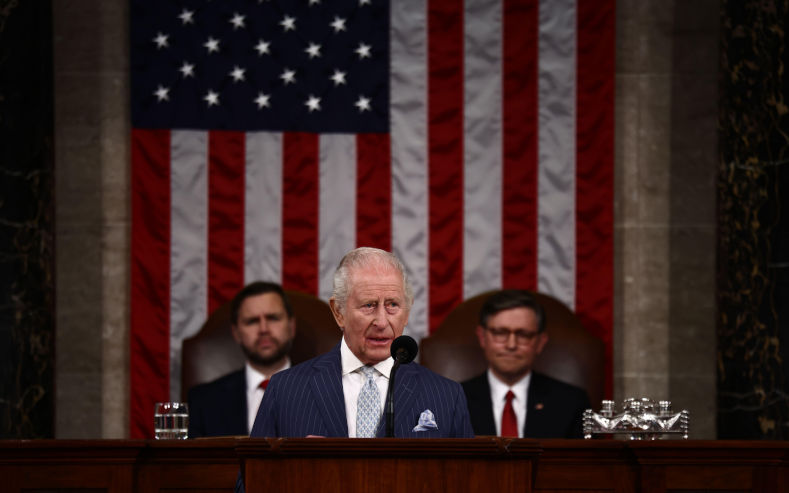
King Charles’ address to the US Congress highlighted the tension between democratic ideals and inherited power, revealing deeper strains in the western political and economic order.
King Charles’ address to the US Congress was a strange spectacle: a hereditary monarch standing in the chamber of the world’s most powerful republic to praise democracy, constitutionalism and the liberal order.
It was meant to symbolise continuity. It revealed contradiction.
Here was the residue of feudalism including crown, bloodline, inherited office, ceremony, deference being deployed to reassure a declining capitalist hegemony that its democratic mission still had moral force. The old empire came to Washington to steady the new empire.
The irony is not accidental. Liberal capitalism has always lived with these contradictions. It speaks the language of freedom while preserving vast inequalities of wealth, class and power. It celebrates merit while protecting inheritance. It praises democracy while allowing markets, corporations, dynasties, donors and security establishments to shape the real choices available to citizens.
The monarchy survives because capitalism has often found hereditary spectacle useful. It softens power. It wraps hierarchy in pageantry. It turns class rule into tradition. It makes inequality feel ancient, ceremonial and almost harmless.
So when Charles spoke of democracy, alliance and responsibility, he was not merely defending values. He was performing repair work for an exhausted order.
Britain is no longer an empire. The United States is no longer an unquestioned hegemon. The west no longer commands the future as confidently as it once claimed. Yet the symbols remain: crown, Congress, flag, anthem, alliance, civilisation.
This was the deeper meaning of the speech. A king addressed a republic because the republic itself is in trouble. Democracy required reassurance from hereditary authority. Capitalist modernity reached backward into feudal symbolism to steady its forward march.
For Australia, still tied to crown, alliance and AUKUS, the lesson is sharp. We are not merely dependent on America’s power. We remain entangled in the whole Anglo-imperial theatre of legitimacy.
The question is not whether Charles spoke well. He did.
The question is why a democracy in crisis needed a king to remind it what democracy means.

Stewart Sweeney
Stewart Sweeney is a writer and public policy advocate with a longstanding interest in the evolution and future of capitalism. He migrated from Scotland to Adelaide in 1975 to work with Premier Don Dunstan on industrial democracy. A former academic and trade unionist, he continues to contribute to public debate on economic justice, democratic reform, and sustainable development. His work reflects a deep commitment to the common good and the role of public purpose in shaping Australia’s future.