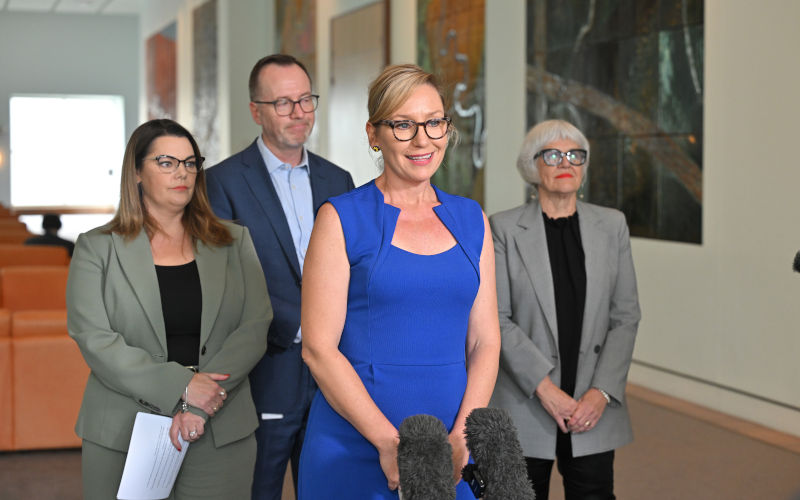
As Labor and Coalition support has collapsed, the Greens have remained stuck around 12 per cent – constrained by geography, culture and a changing generational base.
The story of Australian politics over the past quarter century is a story of decay. Not the decay of democracy itself, but of the two great political machines that once dominated it. At the turn of the century, the combined primary vote for Labor and the Coalition sat close to 90 per cent. It was the natural order of things. You were born into one tribe or the other, and you stayed there or some chose to shop between the two offerings.
That world is gone. Today the combined major party vote averages around 50 per cent across all published polls. Half the country has walked away from the political duopoly that governed Australia for a hundred years in some form or another. The beneficiaries of this collapse are well documented. One Nation has surged into territory once considered impossible. Independents have carved out fortresses in seats the Coalition assumed they owned, whilst a constellation of minor parties now harvests votes across the outer suburbs and the regions.
And yet, amid all this churn, one party has barely moved. The Greens.
For two decades, the Greens have been the third force in Australian politics. On paper, they should have been the great winners of major party decline. They were there first to challenge the established political order. They built the infrastructure, the brand, the parliamentary presence, and a loyal base. When voters started abandoning the major parties in serious numbers, the Greens were the obvious destination – well, they should have been.
Instead, they have flatlined.
The numbers
Consider the record. In 2001, the Greens polled 5 per cent of the national primary vote in the House of Representatives. Through the 2000s they climbed steadily, reaching 7.8 per cent in 2007 and peaking at 11.8 per cent in 2010, the Gillard minority parliament election. Then the ceiling appeared; they fell back to 8.7 per cent in 2013, recovered to just over 10 per cent in 2016 and 2019, and reached a shade over 12 per cent in 2022. They have hovered around that mark ever since, both at elections and in the published polling averages.
While the major party vote has shed close to 40 points, the Greens have added perhaps seven points across a quarter of a century, most of it before 2010. The great fragmentation of the Australian electorate has happened around them, and they have largely sat on the sidelines, as spectators. Why?
Culture and geography
The first part of the answer is cultural, and it’s geography, because in Australian politics those two things are now the same thing.
The Greens vote is not spread evenly across the country. It is concentrated, intensely, in a narrow band of territory: the inner suburbs of the capital cities, university precincts, and a handful of lifestyle regions, such as sea and tree change electorates. It is a vote of the tertiary educated, the professional, the renter in a gentrifying suburb, the academic, the public sector knowledge worker. It is, in short, the vote of a particular class occupying a particular geography and of course, a particular culture.
This is the party’s great strength and its permanent base. The cultural signals, messages, the Greens transmit – on climate, on social questions, on international affairs – resonate powerfully inside that geography and culture. Outside it, they don’t repel it but rather, fail to register at all. The voters who have deserted the major parties in the largest numbers over the past decade do not live in Fitzroy or Newtown. They live in the outer growth corridors and the regions. They are tradies, carers, small business operators, warehouse workers. They left school earlier, they carry larger mortgages relative to income, and they have watched their real living standards fall while the inner cities prospered, even during the inflationary crisis post-2022.
These voters are angry at the political establishment. But when they look at the Greens, they do not see an insurgency against that establishment. They see the establishment’s most credentialed wing. They see a party that speaks the language of inner-city Australia, and voted for by the people who seem to be doing fine. Of course, that is not entirely true because Australians in their 20s are the first generation to be worse off than the generation before them and many vote Greens.
However, perceptions and bias do a lot of heavy lifting here and the revolt against the major parties in outer suburban and regional Australia is in significant part a revolt against professional-class cultural authority, and for these voters, the Greens are the most concentrated expression of professional-class cultural authority in the parliament.
So when these voters walked out on Labor and the Coalition, they did not walk towards the Greens. They walked to One Nation, to a scattering of minor right parties, to independents, or to the informal pile. The great pool of available voters created by major party decline was never culturally available to the Greens.
Attrition
The second part of the story is more recent, and it is a story of attrition.
The Greens’ strongest cohort through the 2010s was the Millennial generation. When Millennials were younger, the Greens polled among them in the mid-20s. They were the natural party of the young renter, the recent graduate, the urban twenty-something locked out of the housing market.
That number has decayed. Among older Millennials, now deep into their thirties and early forties, the Greens typically poll in the high teens. Some of this is the familiar pattern of life stage. But the more important dynamic over the last electoral cycle has been tactical. Older Millennials have increasingly chosen to consolidate behind Labor. Faced with the rise of One Nation and the prospect of a fragmented right forming government, a meaningful share of Millennial Greens voters made a cold calculation: the priority is keeping the other side out, and Labor is the vehicle for doing it.
This drift has been quietly important for Labor. The party has been losing its own older Millennials at the other end, to minor parties and, to a lesser extent, to One Nation, particularly among men in the outer suburbs. The Greens-to-Labor movement among tactically minded Millennials has partly offset that loss. Labor, in effect, has been trading outer suburban Millennials for inner and middle suburban ones, with the Greens supplying the replacement stock.
For the Greens, the arithmetic is grim as their strongest generation is bleeding at both ends, to life stage and to tactical consolidation. On that trajectory alone, the party should be in visible decline.
The Gen Z floor
It is not, and the reason is Generation Z.
Gen Z is the one force holding the Greens’ national vote in place. Among this cohort, the Greens at times poll in the mid-30s. No party in Australian history has held that kind of share of a rising generation. And the generation is still arriving. By the close of this decade, there will be approximately 5 million Gen Z voters enrolled across the country. Even allowing for some attrition as life stages shift, the evidence to date suggests this generation is not moderating the way its predecessors did at the same age. Gen Z will remain the most left-leaning generation in Australia’s history and eventually, they will create a shift in Australian politics as profound as their parents, Gen Xers who are now gravitating to One Nation.
Every year, the electorate that made the old duopoly possible shrinks, and the electorate in which the Greens poll in the 30s grows. Over time, this should aid the Greens in the seats where progressive Gen Z concentrates, which is to say the inner urban seats they already contest and a widening ring of middle suburban seats with heavy renter and student populations. The generational tide is the strongest structural argument that the Greens’ long plateau eventually breaks upwards.
The qualifier
But even here, a qualifier is required, and it is an important one.
Gen Z is not only the most left-leaning generation in Australian history. It is also the most diverse. A very large share of this cohort are the children of migrants, or migrants themselves, and through migration alone that share will keep growing. The overseas born and second-generation component of Gen Z behaves differently from its Anglo and established counterpart. It leans left, but it leans Labor.
Diverse Gen Z voters are more focused on economic security, family advancement and community standing than on the post-material politics that anchors the Greens’ appeal. Their pathway into Australian politics runs through Labor’s suburban machinery, its community networks and its language of aspiration, not through the cultural politics of the inner city. As migration continues to reshape the composition of the youngest cohorts, this Labor-leaning segment of Gen Z will grow faster than the Greens-leaning segment.
This will dampen some of the Greens’ generational potential. The mid-30s number among Gen Z is real, but it is not evenly distributed, and the parts of the generation growing fastest are the parts least attached or attracted to the party.
Where that leaves them
So where are the Greens? Exactly where they have been for 15 years. Parked at 12 per cent, fenced in by culture and geography, losing Millennials out the back door while Gen Z arrives through the front.
The party is not declining, and that itself is an achievement in an era that has been unkind to every established political brand, which is exactly what the Greens are in 2026. But nor is it the vehicle of the great realignment. The collapse of the major parties has flowed around the Greens like water around a rock. The voters leaving the duopoly in the largest numbers were never theirs to win, and the generation that could lift them is being reshaped, by migration and by diversity, in ways that favour their oldest rival.
The Greens’ future is not about the national polling numbers. It’s in the inner urban geographies where Gen Z density will keep rising through the 2030s. The question is whether the party can hold that ground against a Labor Party that has learned to fight for the same voters, and that increasingly speaks to the fastest growing part of the generation the Greens are counting on.
Greatest Generation: born 1901 to 1927
Silent Generation: born 1928 to 1945
Baby Boomers: born 1946 to 1964
Generation X: born 1965 to 1980
Millennials (Gen Y): born 1981 to 1996
Generation Z: born 1997 to 2012
Generation Alpha: born 2013 to around 2025

Kos Samaras
Kos Samaras is a director at RedBridge Group, a research and strategy firm specialising in public opinion, social trends, and behavioural insights. He works across industry, government, and media to help organisations understand community attitudes and navigate complex social and political environments.