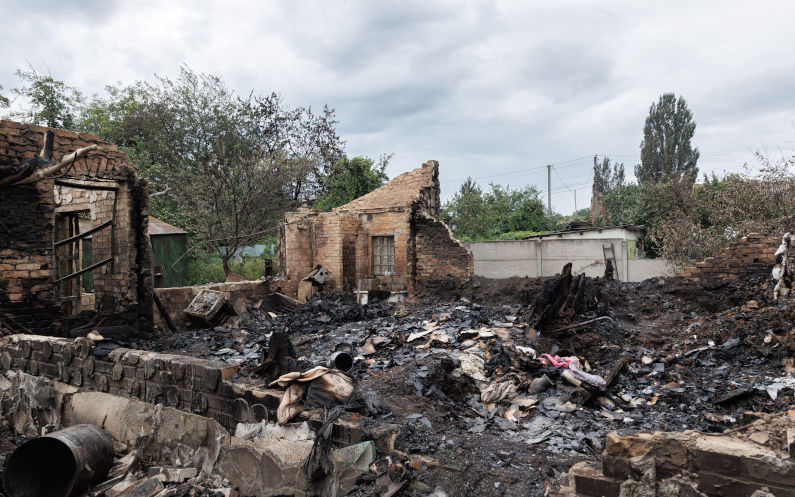
Russia’s invasion of Ukraine was illegal, but Australia’s response has also exposed a deeper inconsistency in how it applies international law, strategic interest and military support.
Senator David Shoebridge is right in opposing Australian military aid to Ukraine.
Australia should keep out of Ukraine/Russian military affairs. Perhaps the government thinks it’s more appropriate to assist white Christians in Ukraine than dusky Muslims in Palestine.
The Russian invasion of Ukraine was clearly a breach of international law. But it is not fair to say that it was entirely unprovoked. Russia has always been concerned about hostility on its western borders. When Hitler launched Operation Barbarossa in June 1941, the invasion force advanced directly through Ukraine. Its goals were to destroy Soviet forces in Ukraine, capture its rich agricultural lands and seize industrial centres like the Donbas.
With the end of the Cold War, NATO has been desperately looking for a new role. It even considers it has a future in Asia. No wonder Paul Keating said that the former secretary general of NATO Jens Stoltenberg was a “supreme fool”. Keating argued correctly that NATO has no business in Asia.
There have been numerous warnings about NATO expanding eastwards. But the dullards would not listen, including Bill Clinton, who saw an opportunity to exploit Russian weakness after the collapse of the Soviet Union.
Twenty-nine years ago, former prime minister Paul Keating issued a strong warning against expanding NATO: “The decision to expand NATO by inviting Poland, Hungary and the Czech Republic to participate and to hold out the prospect to others – in other words, to move Europe’s military demarcation point to the very borders of the former Soviet Union – is, I believe, an error which may rank in the end with the strategic miscalculations which prevented Germany from taking its full place in the international system at the beginning of this century.”
Malcolm Fraser told The Guardian in 2014 that “the move east… was provocative, unwise and a clear signal to Russia that NATO was not willing to make Russia a cooperative partner in European and world affairs…”.
In a 1994 memo, William Burns (US ambassador to Moscow from 2005) said: “hostility to early NATO expansion is almost universally felt across the domestic spectrum here”. He later warned that “Ukrainian entry into NATO is the brightest of all red lines for the Russian” elite.
Writing in The New York Times in 1997, George Kennan, the veteran US diplomat and architect of Cold War containment, said: “expanding NATO would be the most fateful error of American policy in the entire post-Cold War era”. He predicted it would “inflame the nationalistic anti-western and militaristic tendencies in Russian opinion”. He later called it a “tragic mistake and with no reason for this whatsoever”.
In his influential article ‘Why the Ukraine Crisis Is the West’s Fault’, John Mearsheimer, political scientist and professor at the University of Chicago, said that trying to turn Ukraine into a western stronghold on Russia’s border would ultimately lead to an intense geopolitical disaster.
Jeffrey Sachs, a prominent American public policy analyst, said: “… in 1990 when President Gorbachev ended the Warsaw Pact. The Western countries should have said yes, and we end NATO.”
He added: “It became instead a mechanism of US power expansion”. Sachs has frequently highlighted that US officials assured the Soviet Union that the alliance would not move one “inch eastward”, calling the subsequent expansion phases a betrayal of that foundational security understanding.
The Australian government gives lip service to the importance of our own region, but its actions tell a very different story. Foreign Minister Penny Wong attends NATO foreign ministers’ meetings, and Prime Minister Anthony Albanese has defended our NATO alignment on the grounds of the rules-based international order and that Australia has concerns wherever violation occurs. The reasoning is that a world in which Russia absorbs Ukrainian territory by force is a world in which China could absorb Taiwan by force.
This is all contrary to Australia’s strategic identity that Paul Keating pursued in relations with our own region. He believed that geography rather than ideology should be Australia’s strategic determinant. He pointed out that Australia’s selective invocation of the rules-based international order is quite inconsistent. It is a rules-based order that condemns Russian aggression against Ukraine but does not condemn US/Israeli conduct in Gaza.
Just contrast our actions over Ukraine and Gaza.
Australia has provided almost $A1.9 billion principally military support for Ukraine but only $A160 million for civil aid in Gaza and Lebanon.
Australia provided almost 20,000 temporary and humanitarian visas for Ukrainians. We provided about 4,000 tourist and humanitarian visas for Palestinians.
Australia has directly targeted sanctions against Putin, his immediate family, his inner circle and over 1,400 Russian individuals. Australia has not sanctioned Netanyahu or any of his direct leadership group.
Australia loudly welcomed the International Criminal Court’s (ICC) 2023 arrest warrant for Putin. Australia’s reaction to the ICC’s arrest warrant for Netanyahu was very low-key.
The Australian government is technically obliged to enforce the warrant against Netanyahu if he entered Australia, but our government has intentionally trodden lightly around possible enforcement. So, the Australian government invited the Israeli president instead.
The most important strategic priority for Australia is our relationship with China. Joining another country’s war on the other side of the world detracts from the importance of building a secure and peaceful relationship with China. We should not be drawn into the crazy attempts by NATO to confront Russia on a border that is so strategically important for it.
The Americans would be appalled if the Russians or Chinese established military bases on the border between Mexico and the United States. Why would they think that Russia would not be concerned about NATO bases on its border?
Unfortunately, there is no NATO and European leadership today like Willy Brandt, Konrad Adenauer, Charles de Gaulle or François Mitterrand. What a contrast with Merz and Macron!
Russia’s concerns must be taken seriously. For centuries, Europeans believed that the door into Russia could be easily pushed open. Russia has legitimate interests in European and world affairs. Europe will not have peace until Europeans accept that.
Mikhail Gorbachev was a staunch advocate for deeper integration and cooperation between Russia and Western Europe, a philosophy encapsulated by his famous concept of a “Common European Home”.
The successful foreign policies of Keating and former foreign minister Gareth Evans were possible because they were able to maintain an appropriate balance between the US and our region. Albanese and Wong have handicapped themselves by clinging to the North Atlantic, the US and Europe. They have tied one hand behind their backs.

John Menadue is the Founder of Pearls and Irritations and a board member. He was formerly the Editor-in-Chief. John was the Secretary of the Department of Prime Minister and Cabinet under Gough Whitlam and Malcolm Fraser, Ambassador to Japan, Secretary of the Department of Immigration and CEO of Qantas.