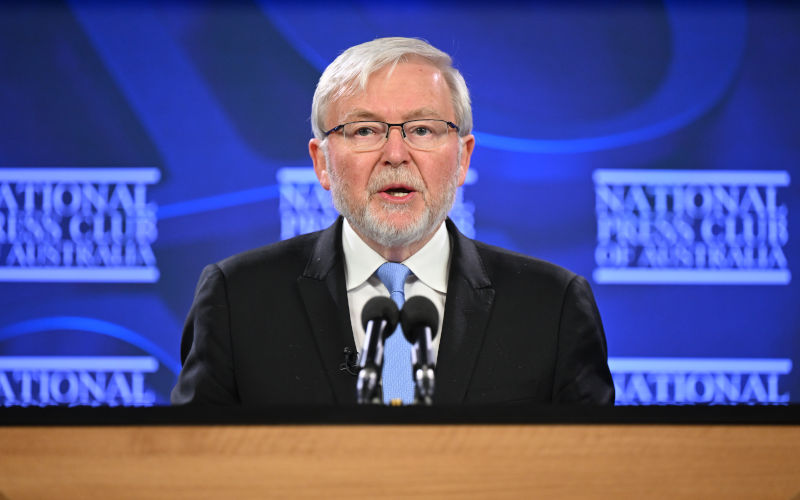
Kevin Rudd calls for greater Australian self-reliance while defending AUKUS and the US alliance, but key questions about sovereignty, deterrence and China remain unresolved.
Kevin Rudd’s address at the National Press Club on Thursday 10 September was fluent and knowledgeable, but contained some highly contestable assertions.
Dr Rudd was speaking in his capacity as CEO of the Asia Society. Dismissing doomsayers about Australia’s future, including the “howling banshees” of One Nation, he asserted nevertheless that everything adverse to Australia’s security was happening all at once. He singled out the rise of China, the AI revolution and climate change. The country, he said, faced unprecedented challenges, which required intelligence and courage to overcome.
Rudd asserted that despite smug boasts of some politicians to the contrary, Australia had never punched above its weight and was in fact risk averse. But incrementalism no longer worked. The nation urgently needed to become a substantial economic power in its own right – embrace a national industry policy, restart an automobile industry abandoned by Messrs Abbott and Hockey, become a world power in AI, go faster on renewable energy, expand critical mineral and rare earth extraction and processing, and develop Sydney as the hub of regional finance within a decade.
Regarding China, Rudd said that country’s stated economic ambition was to surpass the United States. In purchasing power parity terms it was a third bigger than the United States, was the world’s biggest manufacturer, spent more than the US on research and development, and relentlessly pursued expansion of its techno-industrial capacity.
In military terms, China had a much larger ground force than the United States, as many fifth-generation fighters, and as many surface vessels, many of them more modern than those in the US Navy. It had parity in submarines.
With a rhetorical flourish, Rudd asserted that Australia must continue to rely on three things, as it had since 1949: “deterrence, deterrence and deterrence”. We should, he said, rediscover national self-reliance and draw inspiration from Essington Lewis, who with several colleagues developed Australia’s munitions industry from 1939–41 and developed an Australian aircraft industry.
At the same time, we should maintain our alliance with the United States, an alliance which was a “force multiplier”. And despite the “pearl-clutching far left” (a slight against progressives he borrowed from the United States) Australia should continue to embrace ANZUS, AUKUS, and accept the nuclear-powered submarines AUKUS proposes. We should also tighten our defence relations with Japan, and further cultivate our relations with Indonesia, our closest neighbour and the world’s most populous Muslim country.
During question time Rudd danced around several questions relating to his defence proposal, particularly whether Australia should go to war against China with the United States if China tried to take Taiwan by force, something Rudd predicted may possibly, not probably, occur in 2028. He wryly observed that his own career had been reverse-engineered, beginning as prime minister, then ambassador to the United States, and now as CEO of an American-based think tank. His next move might be as first secretary in Australia’s embassy in Beijing. But then as now he refused to speculate on any Australian participation in a US–China conflict.
Rudd also refused to accept a proposition from the floor that AUKUS entrapped Australia into a conflict with China, only doubling down on the need for Australia to continue to support the United States. He asserted that Australia and the United States were two equal partners. Australia was still capable of making sovereign decisions. As for Australian involvement in a war with China, Rudd said he would not go there.
Rudd was equally circumspect about President Trump and the damage his unpredictable behaviour was having on US relations with allies, including Australia. He said one had to draw a distinction between noise and substance – between what Trump said and what in fact was going on. As ambassador in Washington, his “meat and potatoes” had been to engage cabinet secretaries and members of Congress as much as anyone else. Australia, Rudd said, was not a pushover, and the United States establishment realised this. Australia, said Rudd, must defend Australian interests, have a sovereign AI policy, and build our industrial capacity.
Three observations I would make about Dr Rudd’s address. The first is his refusal to acknowledge that AUKUS and the acquisition of American nuclear-powered submarines compromises Australia’s capacity to develop a sovereign Australian defence policy, as acknowledged by a growing number of informed Australian observers. If AUKUS is still extant and war happens between the United States and China, we will ineluctably be dragged in on the US side. And China is more likely to attack US and Australian assets on the Australian mainland than risk nuclear retaliation from Washington by attacking bases or cities on the US mainland.
Second is my scepticism about Dr Rudd’s belief in deterrence. Did US deterrence prevent North Korea from attacking South Korea in 1950? Did it prevent North Vietnam from invading and eventually taking South Vietnam in 1975? Did US intervention in Afghanistan deter the Taliban from sequestering the whole country in 2021? In any case, what threats to Australia, if any, were “deterred” by our defence relations with the United States, or even by our own military competence? Has alleged US support for Australia under ANZUS ever deterred another country from attacking us? No.
Third is Dr Rudd’s call for a revived auto industry in Australia. Right now, China is dominating the international industry, including European, Japanese and Korean manufacturers. (The auto industry in the United States is beyond redemption). In such an environment, how on earth does Dr Rudd believe Australia could revive its own auto industry, which from its beginnings in 1947 was highly protected?
Australians needed to hear from Rudd how we can coexist with China, not through “deterrence” – which is alliance-speak for aggression – but through advancing our common interests. He should have urged the government to consult our ASEAN neighbours about doing this and avoiding World War III.
Richard Broinowski AO is a former Australian diplomat, general manager of Radio Australia and adjunct professor at the Universities of Canberra and Sydney. He has published eight books, the latest being an expansion of his 2003 book Fact or Fission – the truth about Australia’ nuclear ambitions. The later edition includes extra chapters on Australia’s intention to acquire nuclear-powered submarines. (Scribe 2022). Richard Broinowski was a senior Australian diplomat who served in Iran in the 1970s and the Australian Ambassador to Cuba in the mid-1990s.