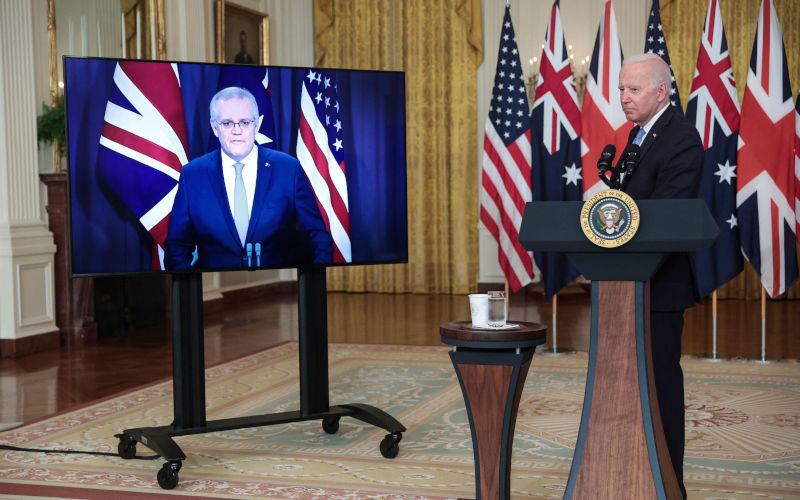
In his submission to the AUKUS Public Inquiry, Joe Camilleri argues revoking AUKUS must be part of wider reassessment of Australia’s place in the world.
The decision to become a party to the AUKUS security agreement stands as one of the saddest decisions ever made by an Australian government.
It was a decision made for the wrong reasons, in the wrong way, with unfortunate outcomes in the last five years and dire consequences looming in the years ahead.
Will the submarines be delivered on time? Will they have the desired state-of-the-art capabilities? Will they deliver the desired number of jobs? These are no doubt relevant questions, but they hardly go to the heart of the matter.
What is it that makes the AUKUS pact such an ill-considered and harmful policy initiative?
The entire decision-making process from its birth to the present has been thoroughly undemocratic. The discussions that led to the agreement in September 2021 were conducted in complete secrecy. And since then, government has said or done little to take the Australian public into its confidence. The costs, be they economic, environmental, diplomatic or cultural have not been seriously addressed, nor have the alleged benefits, nor how the project will proceed in practice, nor indeed how future decisions will be made and by whom. All this has been justified by repeating the time-worn and utterly duplicitous mantra of national security.
The first statement announcing the establishment of AUKUS told us that the intention was ‘to meet the challenges of the 21st century’, but with great care taken to leave the nature of these challenges unspecified. The partnership, it was claimed, would ‘deepen cooperation on a range of security and defence capabilities’, but little was said as to why enhanced defence cooperation was needed at this time, and even less as to what such cooperation would achieve in practice. Yet, within hours of being briefed the then leader of the opposition, Anthony Albanese affirmed Labor’s full support for AUKUS.
In the years that followed little has been said as to the function of the submarines, or the objectives to be served by trilateral defence cooperation. The concluding sentence of the Joint Leaders statement of March 2023 bears quoting in full:
We believe in a world that protects freedom and respects human rights, the rule of law, the independence of sovereign states and the rules-based international order. The steps we are announcing today will help us to advance these mutually beneficial objectives in the decades to come.
The question ‘how was this to be done?’ was left conveniently unaddressed.
The closest thing to an explanation of Australia’s underlying strategy was the reference by Defence Minister Richard Marles to the ‘complex strategic landscape’ that now prevailed in the ‘Indo-Pacific’ region and what he described as ‘the biggest conventional military build-up that we have seen since the end of the Second World War’. In subsequent statements, Marles made it clear that the offender was China. As a trading island nation, Australia had no option but to enhance its capacity ‘to project with impact’.
In the days that followed, countless words have been uttered inside and outside Parliament, but to this day the justification offered for the AUKUS partnership remains riddled with ambiguity, inconsistency and evasion. At no time has it been made clear:
- What are the specific strategic contingencies for which the submarines are intended?
- How does AUKUS fit within Australia’s broader security policies?
- What alternative security strategies were evaluated?
- What are the assumptions regarding China’s future behaviour that underpin the AUKUS decision?
And not the slightest attempt to consult with the public, let alone initiate a genuine national conversation on Australia’s security options, in what is a period of far-reaching change that is transforming both the regional and global landscape.
The democratic deficit becomes even more troubling, given the failure to consult the First Nations despite the fact that AUKUS implementation, including submarine operations, infrastructure, training, industrial production, weapons support and maritime transit, will affect a large part of Australian land and seas. The simple fact is that AUKUS carries far-reaching implications for:
- Native Title rights recognised under Australian law
- Land rights under legislation such as the Northern Territory’s Aboriginal Land Rights Act
- Indigenous interests in sea country and coastal waters
- Heritage protection relating to sacred sites and cultural landscapes
- Rights to consultation regarding the economic, environmental and cultural implications of land use and development projects.
As a consequence of the unfortunate experiences associated with earlier defence projects, Indigenous communities are especially concerned about the likely impact of AUKUS-related activities. These concerns cannot be adequately addressed piecemeal as individual facilities are about to be developed. An immediate and systematic assessment of Indigenous rights, needs and preferences with the full participation and oversight of Indigenous communities is the only viable approach. The consultation should extend to the very rationale of the AUKUS project, since it will impact so many spaces across Country, over which, let’s not forget, the First Nations have never ceded sovereignty. When dealing with the larger questions posed by the AUKUS adventure, a dose of Indigenous wisdom would not go astray.
The rationale for the AUKUS pact rests largely on the frequently insinuated assumption – never openly stated or adequately explained – that China poses a major threat to Australian security. This assessment rests on a questionable understanding of Chinese interests and intentions, and the methods by which China seeks to expand its influence regionally and globally.
Labor, it is true, has managed to stabilise somewhat the parlous state of relations with China, including the resumption of ministerial visits between the two countries, which eventually led to Albanese’s visit to Beijing in November 2023. Importantly, most Chinese trade sanctions imposed on Australian products in 2020–21 have been lifted.
However, after four years in office, the Albanese government still depicts China as a rising power whose aggressive posturing is matched by a much expanded capacity to flex military muscle.
China, it is true, has steadily increased its military spending, which rose from $286 billion in 2020 to an estimated $312 billion in 2025. Similarly, it has expanded its military presence both in the South China Sea and around Taiwan. None of this suggests that either its military spending or its ability to project military power regionally, let alone globally, are on a scale remotely comparable to that of the United States.
Successive US administrations have nevertheless used China’s increasing assertiveness in the South China Sea and the heightened tensions in relation with Taiwan to justify an expanded US naval presence on China’s doorstep, a position Australian governments have seen fit to support. AUKUS is therefore best understood as an expression of US strategic priorities, and Australia’s participation in AUKUS as yet another demonstration of Australia’s longstanding alignment with the United States.
Simply put, Australian governments remain wedded to the view that Australia’s security ultimately depends on protection by the United States. AUKUS begins to make sense once it is seen to be part of an overarching strategic orientation that includes ever higher levels of interoperability with the US military, multifaceted defence cooperation greatly facilitated by the 2014 Defence posture agreement, intimate links with US intelligence operations, and heavy reliance on the acquisition of expensive US military hardware.
AUKUS is a grotesque demonstration of the singular inability of Australian governments to question the value of these arrangements or the wisdom of America’s strategic outlook, especially when it comes to the Asia-Pacific region. All this at a time when US hegemonic power is in visible decline, and when such compliance will carry ever greater risks and financial costs.
The root of the problem lies in the addiction to imperial power that holds sway in the minds of many among Australia’s political, bureaucratic, military and intelligence elites. They see themselves as having unique access to an exclusive and powerful club that confers not just safety, but status and privilege – once the British club, now the American club. They have reluctantly accepted the demise of the former, but are not reconciled to the slow but steady decline of the latter. They feel most comfortable when connected to the anglophone world and, at best uneasy, when dealing with the East. This is the meaning and tragedy of AUKUS.
Senior Labor ministers, with an eye on the next election, see no value in provoking the ire of the security establishment that includes influential voices in the armed forces and the various security and intelligence agencies but also powerful elements in the civil bureaucracy, the media, think tanks and an array of other pressure groups, not least the defence industry.
Ultimately, the greatest cost of AUKUS and associated entanglements is not the financial outlay, but the continued entanglement with an imperial power in decline. Technological sophistication, high levels of military spending, and the flexing of military muscle on a global scale do not readily translate into military victory or political control. The deadly and largely ineffectual war on terror, the disastrous war in Iraq, the protracted conflict and humiliating retreat in Afghanistan, the unholy mess in Libya and Syria, and the unfolding tragedy in the Middle East, not least the folly of the Iran war, all point to the fragility and limits of US power.
The AUKUS misadventure is a highly damaging distraction that prevents Australia from addressing the crucially important task of assessing and responding to the pressing regional and global threats ahead.
Revoking the AUKUS agreement is an urgent necessity. Such a step, however, must be part of wider reassessment of Australia’s place in the world. Australia as a nation needs to pause and consider the very meaning of security in the light of the profound geopolitical, environmental, economic, technological and cultural transformation currently under way. The militarisation of security discourse and practice poses new and unprecedented dangers.
The overemphasis on military threats needs to give way to notion of human security where the accent is on reconciling divergent histories, interests and grievances within and between countries, rather than on fuelling arms races between expanding and ever costlier military arsenals.
What Australia needs more than ever is to strive for a security policy framework founded on three key principles: common security (Australia cannot be or feel secure unless its Asian and Pacific neighbours also feel secure); cooperative security (security can be achieved only when countries act in concert, bringing to the table diverse energies, resources and insights); comprehensive security (there is more to security than protection from external military threats – security also includes economic, cultural and ecological security).
Crucial to this enterprise is finding a pathway to a substantive and durable Australia–China security and cultural dialogue – to be developed in close consultation and cooperation with Asian and Pacific neighbours.
Conveying this perspective and recommendations that flow from it to the Australian government and more generally to the Australian parliament may serve some useful purpose. But such an exercise is unlikely to achieve a great deal in the short-to-medium term. The more pressing need is to address this assessment of the road ahead to the nation as a whole, and to the diverse organisations that make up Australia’s civil society.
In the light of the AUKUS fiasco, the urgent challenge before us is to cultivate an informed, respectful and ongoing national conversation about Australia’s place in the world, and the contribution it can and should make to its own security in tandem with the security of its neighbours, the security of the entire human family, and, of course, the security of the planet.

Joseph Camilleri is Emeritus Professor at La Trobe University in Melbourne, a Fellow of the Australian Academy of Social Sciences, Convener of Conversation at the Crossroads, and Co-Convener of SHAPE (Saving Humanity and Planet Earth)