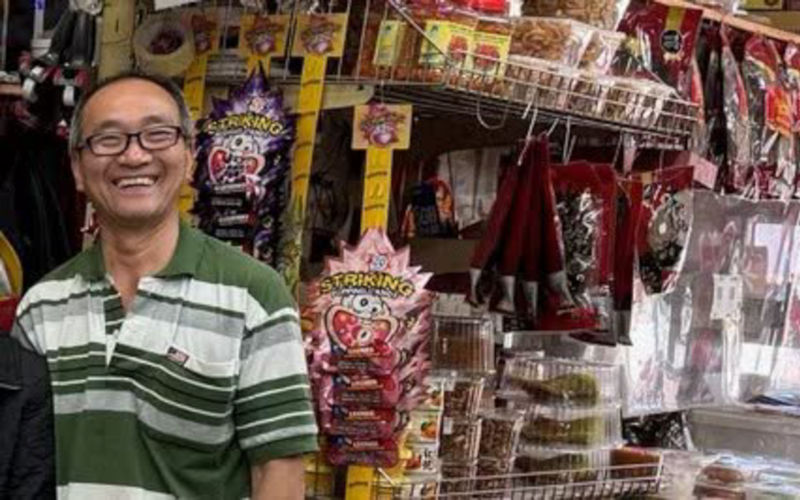
As anti-Asian rhetoric intensifies and One Nation rallies its supporters, the death of Melbourne grocer Van Viet Truong raises urgent questions about racism, political scapegoating and the society Australia is becoming.
This weekend’s rallies are a warning we cannot ignore
The death of Van Viet Truong in Melbourne is a profound tragedy. The 60-year-old grocer from Sunshine, died after intervening to help a neighbour being confronted by teenagers. Five youths aged 12 to 15 were initially charged, with charges against one subsequently withdrawn.
The public response has been predictable: rallies demanding tougher youth crime and bail laws. The media conversation focuses on juvenile justice, recidivism, and a supposedly failing system.
But we are looking in the wrong direction – and this weekend will prove it.
The atmosphere of hate
On 13 August, thousands of Australian students walked out of classrooms across the country to protest One Nation and its leader, Pauline Hanson. In Sydney, Melbourne, Brisbane, Perth, Adelaide and Canberra, they rallied against what the National Union of Students called her “racist politics”.
Hanson and her supporters will rally this weekend in turn – anti-Muslim, anti-immigration, anti-Asia in general. This is not speculation. Her National Press Club address called for a “monocultural” Australia. Her party’s primary vote has surged to 26 per cent, winning its first lower house seat in May.
The deeper question is not why five teenagers committed a violent act. Criminologists can answer that. The question is why our society has produced an environment where violence against Asian Australians is becoming thinkable.
For years, Australian political figures and media outlets have systematically cultivated fear and resentment towards Asia. Hanson’s “swamped by Asians” speech was just the beginning. The Coalition’s hawkish language towards China, Labor’s competition to appear “tough on China”, and the Murdoch media’s relentless “China threat” narrative have all contributed.
The Chinese ambassador to Australia recently pushed back against this “China threat” narrative, noting it has “never been proven” yet “deeply hurt the feelings of the people of both countries”. His words were met with accusations of “foreign interference”.
When you tell a population that a particular group is the enemy, some people will act on that incitement.
When Asian is ‘Asian enough’
Here is one of the most revealing aspects of this racism: perpetrators rarely distinguish between different Asian ethnicities. A Vietnamese-Australian woman is told to “go back to China”. A Japanese tourist is murdered because of resentment towards “the Japanese”. A Korean-Australian family is harassed for “bringing the coronavirus”.
This is not a mistake. It is a feature.
During the COVID-19 pandemic, migrant historians documented that perpetrators frequently misidentified anyone of East or South-East Asian appearance as mainland Chinese. Vietnamese, Korean, Japanese, Filipino, Thai – all were treated as interchangeable targets.
The specific nationality did not matter. The colour of their skin did. The shape of their eyes did.
What happens when we do nothing?
We have seen this play out before – in the United States after 9/11.
Sikh men, wearing turbans and beards as articles of their faith, were mistaken for Muslims and attacked. Between 2001 and 2011, there were at least 700 bias-related incidents against Sikhs in the US. In March 2011, two elderly Sikh men were shot while taking an afternoon stroll in California. They saw turbans and beards, and acted.
The victims had nothing to do with 9/11. Their faith was not Islam. They were not Arab. They were simply identified as the enemy.
“This is a complete case of mistaken identity,” said a Sikh civil rights leader. “When people look at me with a turban and beard, the first thing that comes to mind is, ‘That guy looks like Osama bin Laden’.”
Australia is not immune to this dynamic.
The human cost – and the danger
The attacks are already happening. A 23-year-old Chinese student in Sydney was beaten and dragged by her hair by two women who hurled racial slurs. In July, three Chinese students were attacked near Central Station by women shouting racial abuse. In Canberra, a 27-year-old Chinese woman was allegedly racially abused and assaulted before being threatened with a knife.
The perpetrators in these cases did not ask if the victims were Chinese or Vietnamese or Korean. They saw Asian faces and acted.
And now, with One Nation’s support surging and weekend rallies mobilising, the environment that makes violence thinkable is being actively cultivated.
What we are not talking about
While the media obsesses over bail laws and youth sentencing, we are not discussing:
The diplomatic alternatives that could secure our future without resorting to war. The economic interdependence that has kept our region stable for decades. The human cost of conditioning Australians to view 10 per cent of their own citizens – people of Chinese and South-East Asian background – as potential enemies.
The real question
Some will accuse me of exploiting a tragedy. I understand that. I am not arguing that Mr Truong was murdered because of Australia’s foreign policy. He was killed in a violent attack involving a group of youths. That is the immediate fact.
But I am asking why that crime happened in a society that has spent years dehumanising people who look like him. And why we are so quick to blame the kids while ignoring the environment that made such violence more thinkable.
Silence is not neutrality – it is complicity.
A call to action
We cannot allow 10 per cent of our population to be turned into scapegoats. We cannot allow the media to sell us a war nobody wants while ignoring division, hate and the erosion of our social fabric.
The question is not whether we are prosecuting youths harshly enough. The question is: what kind of society do we want to be?
Do we want a society that fears its neighbours and marches blindly towards a war that serves nobody’s interests? Or do we want a society that values its diversity, engages diplomatically with our region, and protects all its citizens?
If we choose the latter, it is time to stop blaming the kids and start looking at the people who are really responsible.
Van Viet Truong deserved better. We all do.

George Adams
George Adams is an educator and writer based in Australia with a background in Asia-Pacific logistics, aviation, and international education. His work focuses on geopolitics, regional strategy, and the cultural dimensions of foreign policy, particularly in Southeast Asia and the Indo-Pacific. He writes on how history, public sentiment, and strategic signalling shape state behaviour, and contributes analysis to independent policy and current affairs platforms. He also runs the Hanoi Trading Post, where he publishes long-form commentary on regional affairs, trade, medical tourism and strategy.