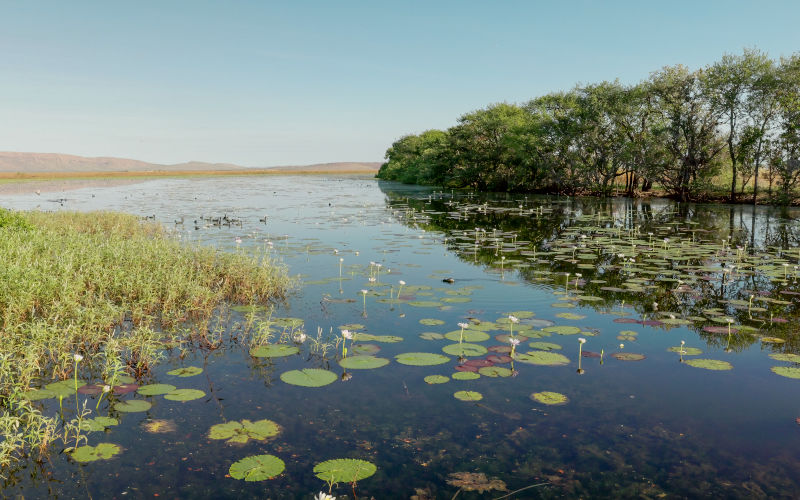
Humanity is living beyond its means as wetlands disappear and World Heritage sites face growing water risks – while one company plans to illuminate the night from space.
Humans have created global water bankruptcy
Of the planet’s 8.3 billion humans, 2.2 billion currently lack safe drinking water, 3.5 billion lack safe sanitation and 4 billion experience severe water scarcity for at least a month a year. Globally, the area of land under cultivation quadrupled during the 19th and 20th centuries and freshwater withdrawals trebled during the second half of the 20th century.
According to United Nations University, the world has gone beyond the period of humanitarian and ecosystem emergencies created by temporary water crises and has entered the era of global water bankruptcy, “a persistent post-crisis condition of a human-water system in which long-term water use has exceeded renewable inflows and safe depletion limits, causing irreversible degradation such that previous levels of water supply and ecosystem functions cannot realistically be restored”.
This is not like the stress of choosing between a weekend away and this year’s iPhone. Rather, it’s comparable to the inability to meet one’s debts and the insolvency incurred by purchasing a mansion in Toorak, a cornucopia of Harry Winston diamonds and a Ferrari Luce over the previous six months while on a shop assistant’s salary – “the world is already living beyond its hydrological means”.
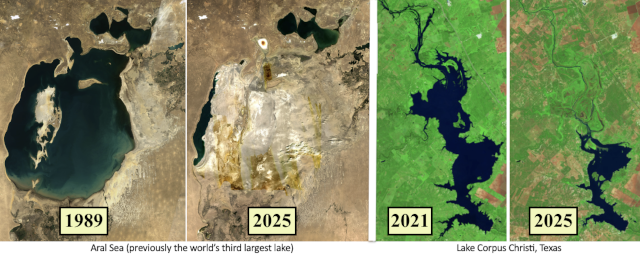
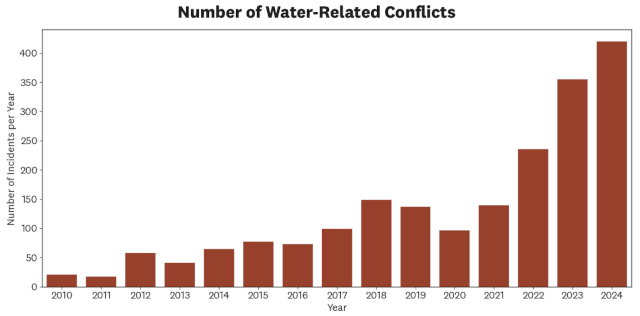
The consequences of this human-generated water bankruptcy are now visible all over the Earth in the dry riverbeds, shrunken lakes and wetlands, melting glaciers, depleted aquifers, salinated soils, bushfires, desertification, loss of topsoil, dust storms and increasing water-related conflicts.
Few places are free of risk but the most widespread and highest levels of overall water risk are seen in Africa, the Middle East, India and central Asia as far east as the Chinese coast. As visible in the map below, however, large areas of Australia are also at high risk.

The report argues that the current global water priorities of safe drinking water, sanitation and hygiene (WASH) and incremental efficiency gains are no longer fit for purpose. There must be a shift from crisis management to bankruptcy management. We must design justice- and equity-oriented institutions, development pathways and financial frameworks to govern human-water systems that admit the insolvency, prevent further water overspending, manage the irreversibility of some consequences, provide compensation for livelihoods that will be lost, and meet basic human needs while also safeguarding environmental flows.
Time to recognise the enormous value of wetlands
Wetlands, areas that are permanently or seasonally saturated with salt, brackish or fresh water, cover 6 per cent of Earth’s surface and include marshes, swamps, saltmarshes, peatlands, mangrove forests, estuaries and floodplains. They are complex transition zones between land and water, oxygen-rich and -poor areas, and phases of carbon storage and methane release that contain interlinked hydrological and biogeochemical processes. They are also often the juncture of natural ecosystems and human settlements, infrastructure and activities.
Wetlands store 30 per cent of the world’s soil carbon, support 40 per cent of known animal and plant species and provide enormous support to humans, valued at around $50 trillion annually. Regrettably, agriculture, urban expansion, invasive species and now climate change have destroyed about 90 per cent of the world’s wetlands over the last 300 years, including 35 per cent since 1970 (410 million hectares, about the size of WA and Queensland combined). Plus, around a quarter of the wetlands that remain are seriously degraded.
Dr Musonda Mumba, secretary-general of the Convention on Wetlands, describes some of the immediate consequences of wetland loss (e.g., declining fish stocks and greater exposure to ocean surges leading to the collapse of coastal communities, catastrophic inland flooding from increased run-off during storms, land subsidence, release of CO2 and methane). She also emphasises the harder-to-see, long-term destruction of complex wetland processes and ecosystems that cannot be easily or quickly repaired simply by restoring the natural hydrology. Indeed, some wetlands have already been irreplaceably lost. Dr Mumba recommends that “policymakers need to see wetlands as infrastructure”.
Dr Mumba highlights the tension between the restoration of wetland ecosystems for carbon storage and the achievement of climate goals on the one hand and, on the other, the needs of local communities who have provided stewardship of both intact and changed wetlands for generations and have depended on them for their livelihoods. She stresses the need for better data, mapping and monitoring of wetlands, strong enforcement of secure legal protections for remaining wetlands, and integrated spatial planning across the many government portfolios with an interest in wetlands. She pinpoints the need to protect and restore wetlands’ dynamic, multifunctional hydrological, geological and ecological systems rather than focusing on any single (e.g., water, agricultural, biodiversity or climate) goal.
Most importantly, Dr Mumba advocates for governance frameworks to incorporate the knowledge and perspectives of Indigenous peoples and local communities – “to move from treating traditional knowledge as consultation input to treating it as a governance resource [accompanied by] tenure security, genuine decision-making power, and finance that reaches communities directly”.
More broadly, it’s time for the public, farmers, developers, planners, politicians, all of society to stop regarding swamps, bogs and marshes as unproductive, insect-infested wastelands and start recognising their biogeochemical complexity and the essential services they provide to human societies.
Another fantastic what-could-possibly-go-wrong idea
US authorities have approved a plan by Reflect Orbital to launch a satellite with moveable mirrors that will redirect sunlight from areas that are in daylight to areas that are experiencing night. This will produce a brief, weak, 5 kilometre wide patch of illumination.
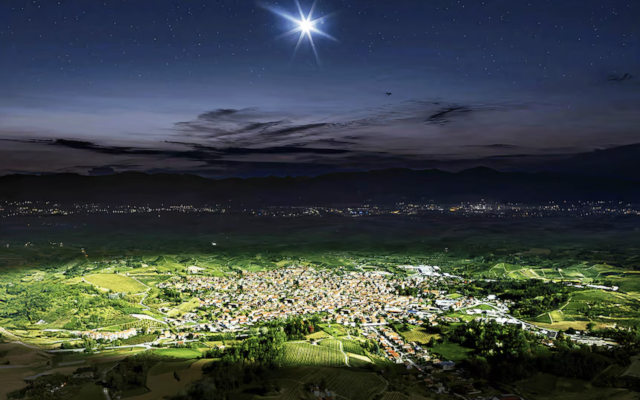
But if that seems hardly worth the trouble, no worries, this is just a trial. If all works well, there might be 50,000 satellites in orbit collectively capable of lighting an area as brightly as the midday sun for an hour. According to one of Reflect’s founders, “We basically sell the sunlight like it’s a resource. We’re here because for some reason, people just accept the Sun goes down at night”. I’m incredibly grateful to have had this ridiculous assumption demolished for me. I can’t believe I was so gullible for so long.
The potential uses of this assumption-shattering idea are countless: powering solar farms at night, lighting city streets without any climate-damaging emissions, more hours of photosynthesis to increase crop yields, assisting search and rescue missions, more accurate nocturnal bombing of Iran, natural light for night-time parties, maybe even a romantic “moonlit” dinner before you pop the question. Mind you, it could be a very expensive rejection – it’s been estimated that daytime levels of light for an hour would cost around $20 million.
I can already hear the killjoys complaining about the light pollution disrupting sleep patterns, ecosystems, evolutionary processes, migration behaviours, coral spawning, astronomical observations, aircraft pilots’ vision, etc. etc. Not to mention, Marxists droning on about capitalists expropriating workers’ sunlight. Calm down all of you. The company promises to be respectful, and as the founder said, “Let’s be innovative and control the light, get it where it needs to go”.
Looks like you’re going to have more time to attend to your other godly responsibilities, Apollo.
World Heritage sites at water risk
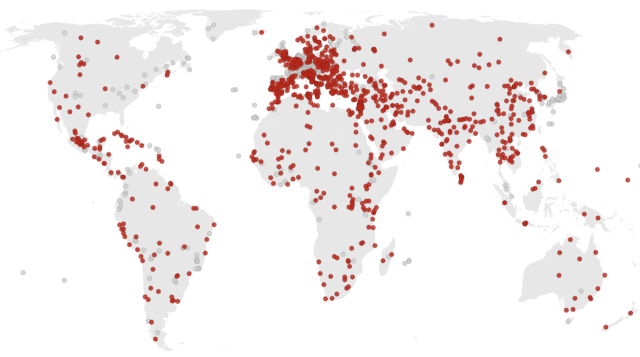
Water issues – scarcity, drought, pollution, flooding – are threatening three-quarters of UNESCO’s non-marine World Heritage sites, including 12 in Australia. Each red dot on the map below represents a site that is exposed to at least one severe risk. Go to the link and click on a dot to discover details of the site.

Peter Sainsbury is a retired public health worker with a long interest in social policy, particularly social justice, and now focusing on climate change and environmental sustainability. He is extremely pessimistic about the world avoiding catastrophic global warming.