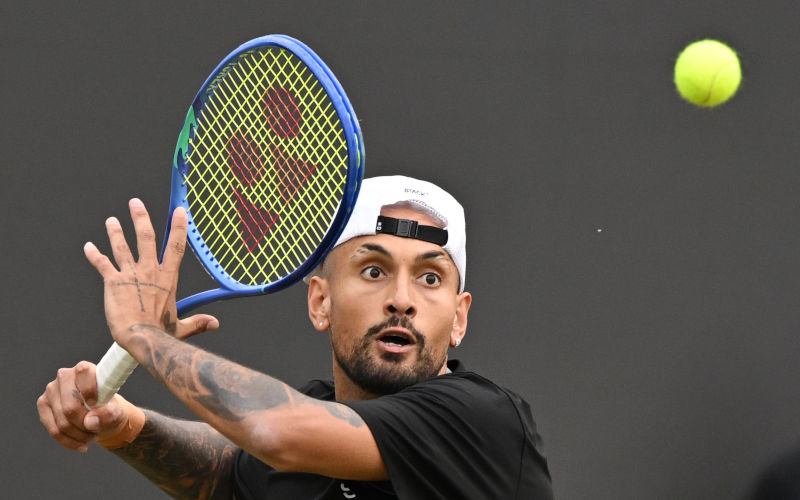
Nick Kyrgios, Rafael Nadal and Kylie Minogue took very different paths to success. Their lives raise a deeper question about ambition, sacrifice and what it really means to fulfil our potential.
Once again Nick Kyrgios is in the headlines for all the wrong reasons, testing positive for a cocaine metabolite. After the news was announced by the Orwellian-sounding International Tennis Integrity Agency, there was a short apologia from the man himself.
“I’ve always said I didn’t choose tennis – tennis chose me. But letting go of something that has been my whole life is one of the hardest things I’ve ever had to face.”
Many will take this to be nonsensical and avoidant. Wake up to yourself, Kyrgios. Tennis didn’t choose you. It was you who chose to squander your God-given talent. Stop making excuses.
Now I’m not suggesting that Kyrgios is a great philosopher, but his recent reflection points to something countercultural and profound. Kyrgios is describing the way a life can coalesce around us before we have rationally thought about it. We often do not choose our careers. We are thrown into them.
Growing up in Australian tennis academies where Nadal was idolised for his extraordinary work ethic, Kyrgios reacted against everything the Spanish tennis star represented. He wanted to demonstrate that you could “just have fun and be chilled” and still beat the top players. Remarkably, Kyrgios proved that this could be done, but he has never won a Grand Slam and has never quite reached his potential. Unlike Nadal.
The contrast between the two men could hardly be greater.
The recent Netflix documentary Rafa is billed as revealing the man behind the tennis player, someone who “opens up like never before”. Yet after watching four hours spanning Nadal’s career, I felt that I had watched a representation of the Will in the Schopenhauerian sense more than I had come to understand a flesh-and-blood human being. No matter how many times they showed Nadal cuddling up to his then two-year-old son, you got the impression that he never stopped thinking about tennis and what he needed to do to win the next match.
Nadal encapsulates the Western ethos of mind over matter to such an overwhelming degree that you wonder how he was able to do it. Yet his life also illustrates why things are more complicated than this. Without his uncle Toni’s relentless and heavy-handed approach, Nadal would never have become the player he became. Toni taught him that suffering and sacrifice were among the most important things in life, and his nephew internalised this.
Once Nadal started winning regularly, Toni drove him harder. The more Toni drove Nadal, the more his nephew drove himself. It was a vicious cycle that led to great success and self-belief, and to a rapid increase in on-court rituals and tics – lining up water bottles, pulling at his shorts, touching his ears, nose and forehead before every point. These somewhat endearing elements of Nadal’s game take on a different meaning when he admits that seeing himself doing them on television made him uneasy. Yet he couldn’t stop because they relieved his ever-increasing anxiety.
Tennis is a sport riddled with anxiety. It is one of the few sports in which everything is focused on the individual. In this way it mirrors the neoliberal ethic particularly well: you are individually responsible for your successes and your failures.
There is a telling scene in which Nadal is offered champagne after winning his first French Open. He raises the glass to his lips and then pulls it away. The people around him groan but there is no changing his mind. The following morning he wants to begin training for Wimbledon.
It is an almost perfect vignette of Nadal’s life. Like time before the Big Bang, there seems to be no Rafa outside tennis.
This can be contrasted with the famous story of Kyrgios drinking at the Dog and Fox pub near Wimbledon the night before playing Nadal, when he almost beat him. This has become part of Kyrgios’ mythology. With Nadal there appears to be nothing he will not do to realise his potential as a tennis player.
It’s hard not to see Kyrgios as Nadal’s shadow. Our culture knows which man it prefers. Nadal represents sacrifice, discipline and hard-won success; Kyrgios, immaturity and irreverence. Yet this raises a more difficult question. What does it actually mean to fulfil your potential? And what must be sacrificed along the way?
This is where Kylie Minogue provides an unexpected comparison.
Like Nadal, Kylie has recently been given the Netflix documentary treatment, promising a deep dive into her career. It is noticeable that both these recent documentaries use a single name as the title, Rafa and Kylie, so great is their fame that nothing else is needed.
Kylie’s career is also a testament to discipline and sustained attention. She went from being dismissed as a “singing budgie” to becoming an international pop star through sheer determination and unrelenting work.
But the Kylie documentary also confronts another side of this achievement: the life she did not live.
One of the enduring narratives surrounding Kylie is that her ambitions as a pop star thwarted her chances of becoming a mother. The documentary pointedly notes that we rarely ask the same question of successful men. A male performer can much more easily find someone willing to subordinate their own life to supporting their partner’s career.
Kylie’s diagnosis with breast cancer in her thirties also played a part. As she put it, “I was 36 when I got my diagnosis, so already it’s – you need to be thinking about children.”
Equally charismatic and capable in the singing department, Kylie’s younger sister Dannii has often been portrayed as someone who never fulfilled her potential because she was less driven than her sister. Yet Dannii lived parts of the life Kylie did not. She became a mother and found it easier to maintain long-term relationships.
In Kylie, Dannii is not presented as a rival or failed version of her older sister. She appears supportive and highly critical of the way the press treated Kylie and the damage this caused. When Kylie receives her cancer diagnosis, we see the two sisters and their parents come together. Despite all her success, Kylie emerges as someone intimately attached to her family. Because of this, her inability to have children is something that clearly affected her.
And yet, speaking about motherhood, she says simply: “But it wasn’t my path.”
There is something countercultural about this.
Like Kyrgios saying “tennis chose me”, Kylie uses the older language of fate in a culture obsessed with choice. Neither presents themselves simply as the sovereign author of their own life. And neither sees themselves as a tragic figure.
Their words provide a reality check to one of the great cultural myths of the moment: that we can have it all.
This can be contrasted with a famous saying attributed to Heidegger: to live an authentic life, we should spend more time around graveyards, so that we live in constant awareness that we’re mortal and that our attention is limited.
In every life there is always a narrowing of attention. To devote ourselves seriously to one possibility is necessarily to neglect others. The deeper our attention becomes, the more our horizons narrow.
For all sports stars there comes a point when the body imposes limits that the will cannot overcome. Nadal spent much of his career playing with serious and ongoing physical ailments while continually trying to overcome them. This makes the moment when he finally submits to his body’s limitations strangely moving; for the first time he appears as a human being.
In a culture where we are told that 50 is the new 30 and that there is nothing we cannot do, acceptance of limitations is easily mistaken for resignation.
But perhaps the opposite is true.
The lives of these sports stars and popular entertainers show that maturity is accepting that ultimately we can only follow one path. In this light, maybe Kyrgios is not as immature as he appears.
Adrian Rosenfeldt
Dr Adrian Rosenfeldt teaches at Melbourne University. He is a journalist, public speaker and the author of The God Debaters: New Atheist Identity-Making and the Religious Self in the New Millennium (2022). www.adrianrosenfeldt.com