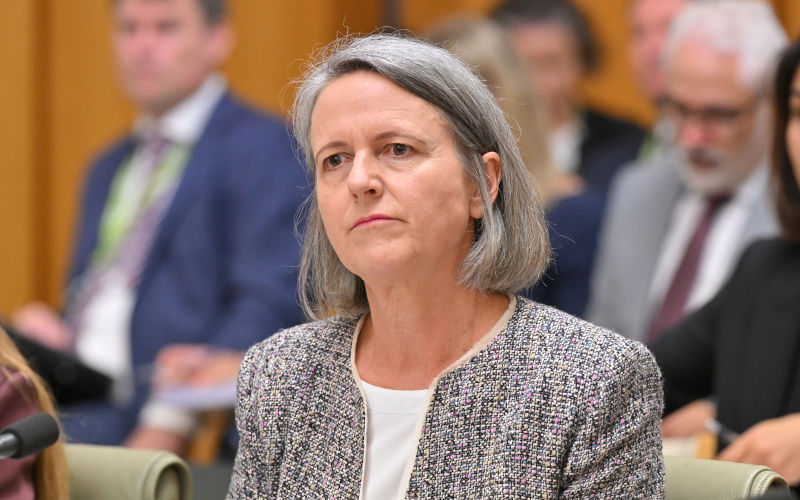
Jenny Wilkinson makes a strong case for evidence, pragmatism and intellectual rigour in the public service. But good advice also depends on ministers willing to hear it and officials protected from political pressure.
Sir Les Patterson, the one-time self-appointed chairman of the Australian Cheese Board and etiquette adviser to Australian governments, once explained that “I’m not an orator, ladies and gentlemen. I’m an Australian public servant.”
It’s a significant distinction that’s been validated by hundreds of public servants who, when let loose, have left captive audiences stupefied, confused and rueful.
It’s tempting to name names but that would be unfair, as it would be necessary in the space available herein to leave so many unacknowledged.
The secretary of the Department of the Treasury (DoT), Jenny Wilkinson, has bucked the trend of this sad history in an interesting and intelligent speech last month. It’s on the DoT’s website and it can be approached with confidence and without being distracted by its invocation of those morale-sapping words ‘leadership’ and ‘reform’.
Wilkinson contradicts the belief that good policy is “essentially a matter of good ideas. Find the right answer, make the argument, and the rest would follow.” Climate policy, she says, “disabused me of that notion fairly quickly.” For Wilkinson, “Durable reform is one of the hardest things a democratic system attempts [and that] … the public service has an irreplaceable role in making it possible.”
She stresses the need for public servants to do “hard thinking” so they can have “a genuine intellectual position on what would work better, and why”. She’s sensitive about the need for pragmatism and the futility of “producing technically elegant reform proposals that have no prospect of being adopted”. She says “Don’t let the perfect be the enemy of the good” – it’s cliché but it’s a good one.
Wilkinson notes that “good reform advice depends on good evidence” and that more sophisticated data has now given the public service analytical capabilities it hasn’t had. She instances how “integrated longitudinal data sets” better enabled the calculation of the “lifetime income impacts” of recent tax changes.
A couple of comments.
First, while Wilkinson says that in her experience “decision makers in all governments” she has worked for have been “keen to hear other views”, that’s not always so. Indeed, a treasurer in the near past is reputed to have asked the DoT to worry more about giving him options than policy advice. That is to say, good policy relies not only on the supply of good advice but on ministerial and government demand for it. Indeed, if demand is low, public service policy capacity will shrivel.
Second, Wilkinson doesn’t mention the risks inherent in laws that allow departmental secretaries to be summarily dismissed for any or no reason. These rules are unhealthy, for secretaries can be tempted to moderate advice in order not to give offence that could get them sacked. This is not theoretical; some secretaries have been sacked simply for being associated with unliked policies.
Third, it’s great that data sets can now better explain the long-term effects of policies, although much politics remains stubbornly attached to the short term because that often matches the span of interest of voters. Of course, the long-term consequences of policies should be emphasised, but getting the message across can be awkward, including to ministers.
When it comes to explaining the evidence base, Wilkinson says the public service should not “go silent”, yet the question of public servants engaging in public debate, she says, “is genuinely unresolved for our profession.” Maybe, but maybe the question is more misunderstood.
Prior to 1973, the matter of public comment by public servants was neither unresolved nor misunderstood. It was absolutely prohibited by Public Service Regulation 34(b), of which some officials fell foul, including, in the early 1960s, the head of the Commonwealth Serum Laboratories (CSL), Dr Percival Bazeley. He had been involved in the mass production of penicillin and had worked in the United States with Jonas Salk on polio vaccines. All that counted for nothing, however, when, as head of the CSL, he dared to make critical comments about legislation affecting the laboratories. He was charged, found guilty and demoted to a relatively junior position in the CSL, from which he resigned and returned to work with Salk in California.
Regulation 34(b) was repealed in 1973 and replaced with guidelines saying that public servants should have, to the maximum extent possible, the same political rights as other citizens. The guidelines also recognised a place for officials in helping explain the background and basis of policy without advocating for or criticising it.
This is tricky territory, the way through which, Wilkinson says, is for public servants “to be clear about what the evidence shows … [and] do that in a way which is rigorous, which has integrity, and which is apolitical.” That is a necessary condition but it will not always be sufficient, for when below-the-belt arguers like Pauline, Barnaby, Anthony and Angus get to work on what public servants have said, much can go wrong. Wilkinson is right to say that public servants should be clear about the evidence; however, the fundamental test about whether to speak up and what to say should rely on a judgment about the risks of officials being dragged into partisan politics if they do so.
What is often left unstated is why officials, mostly senior ones, should be circumspect about their public comments. The nub is that if senior officials get to be identified as aligned with political positions, governments will be tempted to make political sympathy the primary basis for their appointment and tenure, a temptation that has been evident in Australian public administration from time to time. For example, in the early 1980s there was a school of thought within the ALP wanting to reserve a proportion of senior positions in the Commonwealth public service for political appointments.
Such an arrangement would have matched the deliberately politicised approach to senior appointments in the United States federal civil service, the consequences of which are now manifest in the grotesquerie of Trump and his toadies who, if they want to keep their jobs, can only tell him things consistent with whatever is in his crazed ‘mind’.
Anyway, Wilkinson’s thoughtful and engaging speech is worth reading and talking about. It’s to be hoped some of her senior colleagues can emulate her rather than following the dreary habits of so many senior public servants.

Paddy Gourley is a superannuated Commonwealth public servant.