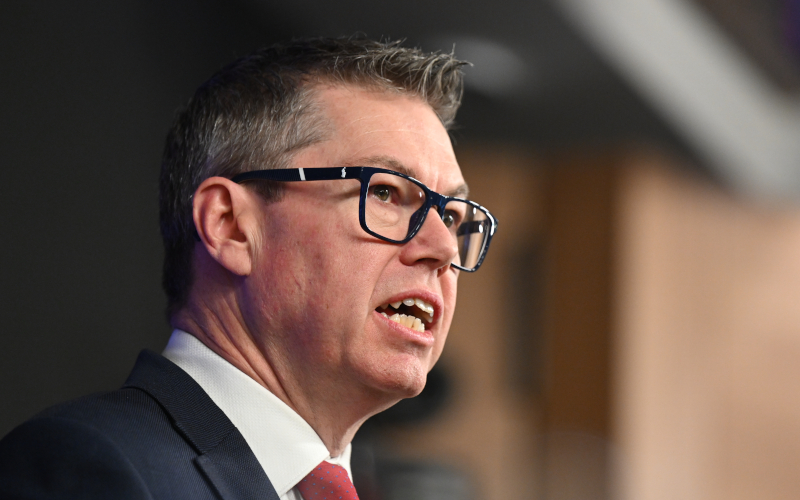
Pat Conroy’s speech at the National Press Club was not a convincing presentation of the ALP’s record on defence.
The Minister for Defence Industry, Pat Conroy, can rightly claim an unenviable spot in the lower ranks of the debauched world of contemporary political chatter. On 2 July he solidified that status in a speech at the National Press Club titled “Progressive Patriotism”. It is a masterpiece of befuddling cliché, historical distortion and the gratuitous use of complimentary superlatives, including about himself. The speech is a little better than his smearing of Sir Robert Menzies in off-the-cuff comments at the Press Club, although not by much.
Conroy kicks off by saying that “progressive patriotism…is confidence in, and celebration of, what our national project has built”, adding that it “means backing Australian workers and Australian industry to make and sustain our critical defence capabilities…growing our self-reliance and strengthening our sovereignty…[and] investing in the areas of domestic industry we need…”.
How AUKUS is strengthening sovereignty is not clear.
The quandary of meaning is not eased when Conroy links “progressive patriotism” to his government’s “Future Made in Australia” laws, which have spawned a program weighed down with another meaningless label and under which billions are being doled out on projects whose internal rates of return, if they’ve been calculated, cannot be disclosed to taxpayer shareholders for shoddy reasons of “commercial-in-confidence”.
Those who try to make sense of Conroy’s exposition of “progressive patriotism” should be warned that it’s akin to sticking one’s head in a bucket of mud. His political tactics, however, are more obvious. Branding increased defence spending as “progressive patriotism” saves having to justify it in strategic risk terms and makes any who dare raise questions look regressively unpatriotic.
Conroy, in trying to boost the ALP’s defence reputation, is as unreliable on history as he is on definitions. He says, “[Andrew] Fisher led Australia in World War One”. That’s true but only for the first year of that war during the disastrous Gallipoli campaign. Billy Hughes was the Prime Minister for the last three years of the First World War, something Conroy cannot mention as Hughes split from the ALP and is now not well regarded in it for that reason.
Undaunted, Conroy moves quickly on to claim that “Hawke and Keating built the Collins Class submarines”. Did they? Work on the replacement of the Oberon submarines began during the Fraser Government and development funds were provided in its last budget. It’s true that the troubled construction of the Collins replacement began during the Hawke and Keating governments but it did not come into full service until four years into the life of the Howard government. The last of the Collins boats was commissioned in March 2003, seven years after Keating ceased to be the Prime Minister.
For the present, Conroy says “the Albanese government is delivering the largest increase in peacetime defence investment ever – delivering the most significant reforms to the Department in 50 years…”.
Defence spending claims make no sense in nominal terms; they should be taken as a proportion of GDP. At the moment, defence spending is fractionally over 2 per cent of GDP and may edge up a little from that over the next three or four years. In rough terms, defence spending in the 1950s was about 3.5 per cent of GDP, slipping to around 2.8 per cent in the 1960s. Thus, it’s hard to see Conroy’s claims as being all that different from the fake assertions of the Defence Minister (oops, sorry) Deputy Prime Minister (the Hon Richard Marles) that China’s military build up has been the biggest since the end of the Second World War.
Conroy’s puffery that the government’s defence “reforms” are the greatest in 50 years can be taken with a grain of salt. Sure, six months ago the government said it would set up a Defence Delivery Agency to organise military procurements. Only now has a Defence Delivery Group been formed and the plan is to take another year before it “transitions” into the Delivery Agency whose form is yet to be defined – executive agency, statutory authority, government-owned company? No one seems to know.
Conroy says “we have to move quickly” but setting up this new agency is moving at the speed of a well slowed-down acquisition project. It looks very much like previous experiments that have not worked ideally. Meanwhile, the assertion this is the “biggest reform” in the Defence Department for 50 years is put into the shadows by the reduction in the size of the Department from around 45,000 to 15,000 in the “peace dividend” era of the late 1980s and early 1990s.
In the four years Conroy has been a defence minister, it’s far from evident he has been able to do much to improve the defence organisation. If he were to remain at his post, he might do well to be less boastful and smug, tone down his rhetoric and brush up on his history.
For all the reasons canvassed by Gareth Evans, Mike Gilligan and Peter Briggs in P&I and more, the AUKUS project would appear to be dangling by a thread. If these grave risks we face are to be minimised, Conroy and the Deputy Prime Minister – the defence organisation’s chief executives – need to do a whole lot better. They’re fooling themselves by boosting the present at the expense of the past. Fantasies and distortions will get them nowhere. They should be much less impressed with what they’ve done. They should speak clearly and honestly if they want to be believed.

Paddy Gourley is a superannuated Commonwealth public servant.