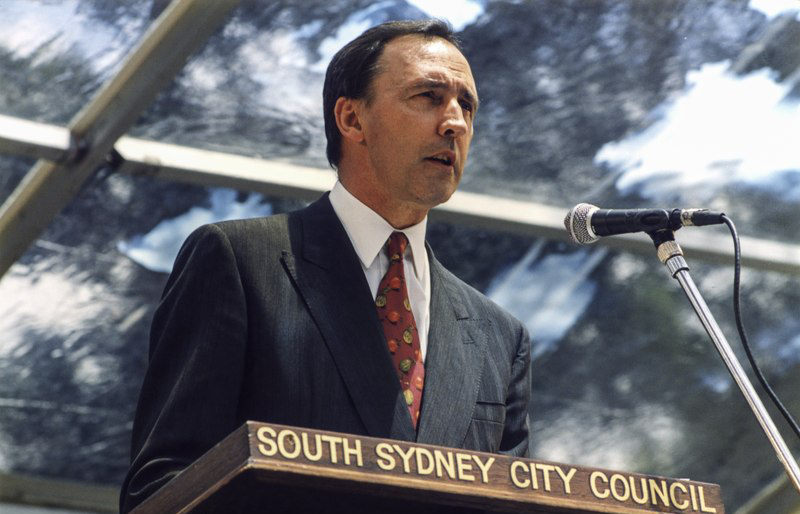
In this speech, James Curran reflects on Paul Keating’s foreign policy legacy and argues that Australia has lost the strategic confidence and autonomy needed to shape its own future in a changing Asia.
The arc of Australian political culture has been stretched a long way from March 1996 when Paul Keating left the Lodge.
Then, his ‘big picture’ was farewelled – some thought for good – from the stage at Bankstown Sports Club as he conceded defeat to John Howard.
And from then on, the proposition that an Australian prime minister should outline a vision for the country’s future, or even a coherent narrative of its identity and place in the world, has been typically met with scorn and derision. Proof, say the critics, that this kind of rhetoric and thinking was inimical to the bread and butter of daily domestic politics. Australians, we are constantly told, just don’t go for the ‘vision thing’.
At that election, and the three that followed it, the people instead elected a prime minister offering a vision of the country as “relaxed and comfortable” about its past, present and future.
And so we are where we are. With a community that appears to crave greater direction and decisiveness from its leaders at a time when populism and uncertainty thrive off one another. With that has come a certain yearning for the kind of integrated domestic and international vision for which Keating was known.
The publication of my study of Keating’s foreign policy, Grand Ambition, has if nothing else ignited renewed debate on whether, in fact, that kind of conceptual coherence in shaping an argument or story about the country and its future has again found its moment.
Arguably, there is a deeper irony at work here: for all the conservative lionising of John Howard’s celebrated comment that “the times will suit” him, the times now appear to suit Keating and his forward-looking agenda about where the country is headed and the kind of hard thinking it needs to do to secure its footing in a rapidly changing world.
Now that is not to say an Australian republic and lasting reconciliation with the nation’s Indigenous peoples can be realised via a séance of the Keating true believers.
Nor is it to discount the obvious point that those that followed him have had to deal with a different set of international circumstances.
But the barren terrain of Australian political leadership over the last two decades, the inability of the current prime minister, and most of his predecessors, to speak with conviction about Australia’s suite of strategic and economic challenges, is fuelling new interest in just what Keating was saying and doing in the early 1990s, a period when Australia faced a fluid and unsettling international and regional environment at Cold War’s end. But a moment, too, that offered the chance for a more creative diplomacy with Australian agency at its core.
It is of course true, as I argue in the book, that Australia might not have been altogether ready in the early 1990s for some dimensions of the Keating vision. An electorate still digesting great meals of economic reform in the previous decade might not have been ready to swallow the idea of becoming a reconciled republic engaged in Asia in the next one.
It was, after all, only 20 years since the country had abandoned ‘White Australia’; less than a decade since ‘reconciliation’ morphed from a Labor campaign slogan in 1983 about ending the industrial disputation of the Fraser years to being the lodestar for redressing Indigenous dispossession; only five years since the head of the Foreign Affairs department said that Australia did not have a region of the world it could naturally call ‘home’.
But as Keating so often said, leaders had to grasp the moment. So it is worth considering, even if briefly, what aspects of Paul Keating’s vision remain relevant.
His creation of the APEC leaders summit has survived, even if APEC now bobs around in the alphabet soup of Asian multilateralism. Next month in China, APEC leaders will meet for the 34th successive time, giving not only Australia a seat at that table, but providing a forum in which the US and Chinese leaders can meet on the margins – a regular outlet for dialogue amid the constant drumbeat of crisis in US-China relations. Keating tells me “with the APEC Leaders summit I broke the bank: by giving Australian prime ministers a seat at the top table, I made it easier for my successors to advocate for Australia’s place at the G20 and other regional and international fora”.
Further, Keating’s defence agreement with Indonesia’s Suharto, signed in 1995, was not only excising from the Australian strategic imagination the spectre of Indonesia as a source of caprice or expansionist intent, it was looking ahead to the possibility that the regional balance of power might be disturbed by a rising China. He was trying to ensure that Australia was surrounded by allies in the event a new great power flexed its strategic muscle. Though that agreement was abandoned by Jakarta in 1999 following East Timor’s vote for independence, it has now been renewed, with Prime Minister Anthony Albanese citing the Keating agreement as its inspiration.
And the arguments that Keating was making to President George W Bush in January 1992, about the need for the US to not turn in on itself – to in effect “keep it on the streets in Asia” and remain outward looking – now looks prescient as Trump disdains those very multilateral trading structures and, the Iran debacle aside, turns the US inwards. Albanese has also reprised the Keating formula of Australia ‘seeking its security in, not from Asia’.
What remains particularly striking about the Keating vision is, of course, its conceptual unity: having presided with Bob Hawke over the globalisation of the Australian economy, Keating wanted his prime ministership to be the cultural bookend of those seismic reforms: the moment, as he put it in early 1992, when the country could be “independent in ways that we’ve never been”. Australia had made consistent efforts to connect to and belong in Asia in the 1970s and 1980s, but Keating invested that agenda with a greater sense of urgency and intensity than those that came before: he understood that many of the Asian nations themselves had decolonised and had grasped their independence. An Australian republic and reconciliation with Indigenous Australians, he claimed, would answer beyond doubt that Australia too had left its imperial baggage behind. That it could truly belong to the region.
But his vision was also about Australian nationalism: about putting Australia first, long before that kind of phrase could become freighted with Trumpian grievance.
And here is where the legacy might be more relevant than ever, especially as Pauline Hanson once more attempts to fan new flames from the smouldering embers of the monoculture and as politicians thump tables about ‘Australian’ values. Here again Keating stands apart from those before him. Whitlam, Fraser and Hawke all trod warily around the question of whether Australia could, in fact, have a self-sufficient nationalism of its own. Each said more what Australian nationalism was not, rather than attempt to set out a story of what made Australia distinctive, and each dedicated more energy to fleshing out the multicultural idea.
Keating, too, championed multiculturalism but preferred to emphasise the idea that it needed to be a “blended singularity”. He recognised that in a globalising world a national community still needed a sense of communal or social bonding. That it needed to hold together. He gave that distinctiveness a content and history in his speeches, taking on those who still defined Australia primarily through the lens of the British heritage: as my book shows, in speeches on the republic, the Anzac legend, Australia’s place in Asia, on its troubled relationships with the Indigenous peoples, there was a need for Australians to look at and understand their history, as he once said, “with a capital A”.
Keating has, in my view, been misjudged by his conservative opponents and other critics, largely on account of his invective and style.
Compare, though, if you will, the kind of story Keating told with the supposed Morrison ‘doctrine’ on China. The point is, lest I need to spell it out, there is no comparison. Keating looked outward, Morrison stoked fear.
As the former Downer speechwriter Dr Peter Collins wrote in a perceptive review of my book, the question is “not whether Australia should recover ‘Keatingism’, it is what Australia should recover from Keating”. As Collins went on to write, “democracies need people to ask whether assumptions have hardened into doctrine”. That, he says, is what makes Grand Ambition “unusually alive for a work of political history”.
As I have argued here, Keating’s policies have both sense and indeed relevance for the contemporary moment. Especially given that his arguments about America needing to be an offshore balancer – that is, basically acknowledging China as its equal in Asia – were more or less endorsed by Trump in Washington only two weeks ago.
There is no doubt, of course, that Howard subsequently, and highly consciously, sought to turn around much of Keating’s foreign policy. There were events such as East Timor in 1999 and 9/11 that forced his hand, but he did come to bury the Keating legacy on many of these issues, most particularly the place of the British connection, the alliance and the extent to which Australia could be meaningfully part of Asia. It was to be ‘Asia first but not Asia only’, ‘practical’ not ‘cultural’ regionalism, ‘practical’ not ‘symbolic’ reconciliation. A foreign policy document published by the Coalition in the 1996 campaign even borrowed from Kipling to refer to Asia as ‘the East’. The change in language was important. Yes, his and subsequent governments still engaged with Asia – I note here Howard and Downer’s achievement of gaining membership of the East Asia Summit, Tony Abbott’s free trade agreements (FTAs) with Korea, Japan and China, Turnbull’s rescuing of the Trans-Pacific Partnership (TPP).
But Howard succeeded on returning the alliance to become the be all and end all of Australian foreign policy: because the ALP was in subsequent years to follow him, with even greater enthusiasm and, in some cases, ever greater displays and acts of deference. Who can forget Kevin Rudd’s salute to George W Bush at the NATO summit in Bucharest in 2008? Who would have picked Albanese to give away even more of the Australian continent so that Washington can store its weapons here and build more logistics hubs? So that B-52 bombers – the aircraft carriers of the air – can take off on operational missions from the Northern Territory. Albanese has become the real father of AUKUS. Now what an odyssey that is from his early political career.
What I am saying is that Howard – and all of his supporters in the think tanks, in the press, in the Australian-American Leadership Dialogue – got what they wanted in bringing the alliance back to the centre of Australian strategic policy: and now we find ourselves in a dangerous position, entangled in US grand strategy and losing our autonomy. Such is the life of the permanent auxiliary. I don’t think these changes, which started with Howard but were continued by two left-wing Labor prime ministers in Gillard and Albanese, are fully understood by the electorate. And they have not been explained properly.
This loss of autonomy in our foreign policy is the great scandal of our times. There needs to be a thorough and brutal accounting of how this happened.
I would suggest that a preliminary part of this was the loss of sceptical foreign policy thinking, and that is a loss that can be precisely dated: to the Howard government’s decision to commit to the Iraq war in 2003.
I mean, here we were, under Howard, doing ‘alliance maintenance’: all that intimacy with people we said shared the same cultural values. Then Trump comes along and swiftly, brutally, disposes of that kind of sentiment. So much for 100 years of mateship, “and a hundred more”.
The continuing self-delusion that still accompanies the Iraq commitment is remarkable. What explains the high moral tone adopted in its continued justification?
That commitment is surely when Australia got back into lock step with the Americans, even though it was obvious the enterprise was going to be a strategic error. And we know from American studies of the decision to go to war that this was not just the loony Bush or the evil Cheney: the Democrats were in it up to their necks too. This was a deliberate decision of the US elite.
Was Australia then simply saying “me too”, as if ANZUS obliges us to do what the Americans want?
I noted too the cabinet records release earlier this year showed that then chief of the defence force Angus Houston warned against sending special forces back to Afghanistan in 2005, but Howard insisted they should return.
The answer is not really about Howard’s sympathy with the US after 9/11, that is a given. But it is a question of the part he played in accepting the flawed intelligence and arguments for going to war and being involved in the cover-up.
From then on the Australian political class were stitched up. Simon Crean’s speech of opposition to the Iraq war is probably Labor’s last stand on a more self-reliant foreign policy.
For by 2010 a Labor government led by a figure, Julia Gillard, who emerged initially from the Victorian socialist left, moved with alacrity to shore up its alliance credentials. Julia Gillard agreed to the US marine rotation in Darwin.
By 2014 Bishop and Abbott presided over the force posture changes: one former senior official has told me that during those decisions the National Security Committee (NSC) was not told about the implications down the track of allowing the Americans greater and greater access to Australian territory and military facilities.
Or were these decisions seen as normal steps in the policy of ‘alliance maintenance’?
The point is that we have not had to do this kind of thinking since the Vietnam war. And that too explains why the challenge is difficult. And the contributions we made in Afghanistan and Iraq did not cost us much.
So the debate over Grand Ambition is I think, even if indirectly, highlighting the frailties of contemporary Australian foreign policy.
In an age when successive governments have given more and more to Washington in terms of logistical and military access to the Australian continent, when Morrison and Albanese have stubbornly refused to win the social licence for the AUKUS submarine project, and when the Murdoch press endlessly indulges yellow journalism about the ‘China threat’, Keating is raising issues centrally concerned with the country’s autonomy and sovereignty.
And about how it learns to live in an Asia where the US may well end up being not the guarantor, but balancing power. China may not have to win every facet of its strategic competition with the US in order to dominate Asia: so what does this mean for Australia? We don’t have to beat China, but we have to live with China.
With both sides of politics – so completely trapped within and strategically beholden to the US alliance – Keating is once more making the case that the country must have greater confidence to shape its own future.
There may well come the time to pick a side in the defining strategic contest of our era between the US and China.
But to do so too early suggests insecurity and a lack of faith in the power of one’s convictions and identity. The Keating legacy is about having greater confidence in Australia’s sense of self and an abiding faith in a national destiny conceived here, not in the halls of a foreign power.
James Curran (Professor of Modern History, Sydney University)

James Curran is Professor of Modern History and senior fellow at Sydney University’s US Studies Centre. He is writing a book on Australia’s China debate for New South Press.
James Curran is the AFR’s International Editor and Professor of Modern History at the Sydney University.