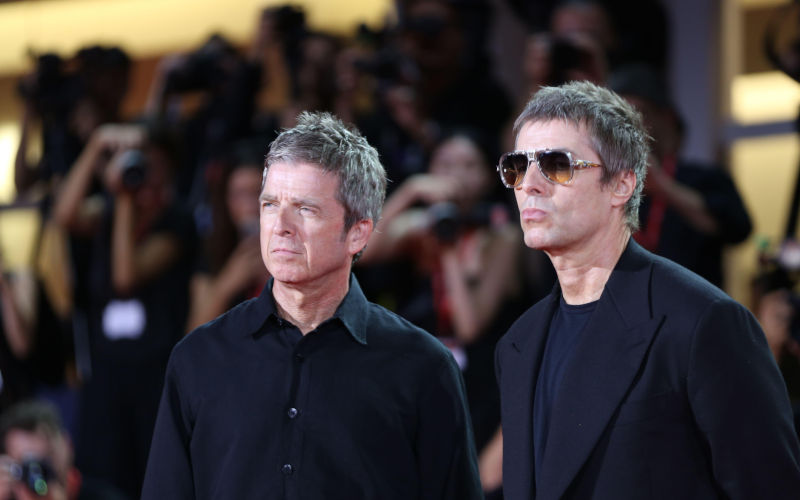
Oasis are easy to mock for blunt songs and ridiculous lyrics, but the tension between Liam and Noel Gallagher helps explain why their music still carries such emotional weight.
Just days after the release of the new Oasis documentary, Don’t Look Back in Anger, Liam and Noel Gallagher have announced that they will tour together again in 2027. Four of those shows will take them back to Knebworth, where 250,000 people saw them perform over two nights in 1996.
The documentary has generated plenty of attention, not least for its images of grown men crying, strangers embracing and the Gallagher brothers reconciling after 15 years of not speaking.
But when it comes to Oasis, many of us would like to keep our distance. The band has long been ridiculed for their meat-and-potatoes simplicity, Liam’s unrelenting earnest whine and some truly ridiculous lyrics. Champagne Supernova contains the immortal line: “Slowly walking down the hall, faster than a cannonball.” Noel himself has admitted that he has no idea what some of his most famous songs mean. Yet people continue to tell him how much those songs mean to them. So what is going on here and why should we care?
I have had a long and chequered relationship with Oasis. I was living in Hackney in inner London for two years from 1994 to 1995 when the band exploded into British culture. Next door lived a group of brothers who played Oasis constantly. Every morning I would wake to hear the title track from their inescapably popular album (What’s the Story) Morning Glory? coming through the wall. I remember particularly hating the line, “Tomorrow doesn’t know what it doesn’t know too soon”. It was so idiotic.
I could see what Noel was trying to do. The Beatles had made a virtue out of lines that seemed to evade ordinary meaning, Ringoisms such as A Hard Day’s Night and Tomorrow Never Knows. But at least they seemed to point towards something recognisable. Noel’s lyrics appeared to be pointing towards nothing at all.
As 1995 wore on, my irritation grew when I realised that it was almost impossible to go to a pub without hearing Don’t Look Back in Anger or Wonderwall. I felt like I was a cast member of Invasion of the Body Snatchers. Everyone seemed to be on board the Oasis bandwagon except for me.
Wonderwall in particular rubbed me up the wrong way. “Maybe, you’re going to be the one who saves me. But after all, you’re my Wonderwall.” Meaningless doggerel sung with unearned conviction. Liam sounded like a stupid labrador off the leash who didn’t know any better.
To be fair, some of my irritation was due to the fact that they were doing everything that I wanted to do. I had gone to London to become a rock star and unsurprisingly things did not go according to plan.
Then one night on the top floor of a council house in Hackney, I experienced a moment of metanoia. It occurred after I had spent a long day recording what I hoped would be my band’s breakthrough song in the bass player’s tiny bedroom. As I lay on the bed with his blonde girlfriend and a few of his mother’s many cats, my crafty bandmate started playing B-sides of the many singles Oasis had released that year. As each song came and went – Half the World Away, Headshrinker, Rockin’ Chair, Round Our Way – I found myself agreeing with him that they were a lot better than Wonderwall. In fact, there seemed to be an endless number of great songs that were not being played on the radio.
At first I thought that this change in perspective was just the culmination of being worn down over time. Just like Winston at the end of 1984, who discovers that life is easier once he learns to love Big Brother. But then I came to realise that when you looked beneath the hood of what appeared to be the most basic band in recent history, something unusual was going on.
What I had initially missed with Oasis was the strange relationship between the two brothers and the way this worked itself into the music. Oasis are often dismissed because their individual parts seem so simple. Noel’s songs can look slight on the page. Liam’s stage persona can look like a caricature. But this misses the unusual dynamic between them.
Noel often writes songs that are romantic, vulnerable and introspective, full of longing for something just out of reach. When he takes on the occasional lead vocal, this comes through very clearly. His performance of the song Half the World Away is intimate and endearing. In contrast, when Liam sings his older brother’s songs he does so in a voice that is gruff, confrontational and full of enough extroverted confidence to fill a stadium.
In this way, the tentative vulnerability inherent in the songs is sung by a singer who sounds utterly bulletproof and certain. This creates friction and instability, tension and release.
I came to realise that this complex and contradictory dynamic that drives the best Oasis songs will only work with lyrics, music and melodies that are the opposite – simple, stable and reliable. If Oasis lyrics had the elusive poetry of Bob Dylan and the musical sophistication of Steely Dan, it would not work. There would be too much going on. The songs would become difficult, unpalatable and marginal.
The song Acquiesce shows how this dynamic works in practice. It was originally released as the B-side of the UK number one single Some Might Say. In the verses Liam aggressively spits out lines full of uncertainty and introspective confusion, “I don’t know what it is that makes me feel alive”, before Noel plaintively delivers the chorus:
“We need each other
We believe in one another
And I know we’re going to uncover
What’s sleepin’ in our soul.”
The contradiction is built into the performance itself. Liam gives uncertainty the force of certainty, while Noel makes certainty sound fragile and strained – it is right at the top of his range.
Acquiesce also shows how rarely Oasis songs settle into a single meaning. Liam thought the song was about the two brothers singing to each other, but Noel described that idea as “total fucking bullshit”. Yet after 15 years of not speaking, it is almost impossible to hear Noel sing “we need each other” without thinking about the brothers’ relationship.
This is where the distinction between signifier and signified becomes useful. In semiotics, the signifier is the word, image or sound we encounter, while the signified is the meaning we attach to it. The Korean-German philosopher Byung-Chul Han argues that modern culture increasingly wants the signifier absorbed into the signified, so that words and images deliver a clear and fixed meaning. When this happens, he says, language loses some of its “magic and splendour”.
Something similar happens when the Oasis reunion is reduced to a single narrative, with every article using terms such as reconciliation, nostalgia, community and redemption. But reducing it to any one of these things risks losing the contradictory dynamic that made Oasis interesting in the first place. It mistakes the signifier for the signified.
My own relationship with Oasis has been just as difficult to pin down. When I returned to Australia my friends and fellow band members were not impressed with my newfound love of Oasis. They thought it was beneath me. I distinctly remember blasting 1997’s Be Here Now out of a boombox during rehearsal breaks and copping plenty of flak.
Now that I am an academic, I am no longer so open about liking Oasis. Brash masculinity, mass crowd fever and populist thinking are not things that go down particularly well in university corridors. Instead, I followed last year’s reunion tour by watching clips on my own in the early morning before I started work. Those mornings inevitably took me back 30 years ago, to waking in Hackney with Oasis coming through the wall:
“Weeeeeell. What’s the story morning glory. Weeeeell. Need a little time to wake up, wake up.”
Back then, the song sounded stupid. But now it transported me back to the exhilarating sense of freedom and possibility that I felt when I was 23 years old, immersed in a culture on the opposite side of the world. The fuzzy buzz of the distorted guitars, the mantra-like choruses and Liam’s voice now work as a direct conduit to that period.
From watching the new documentary, it becomes clear that the Oasis reunion repeated this same process for so many others. Yet it is strange to see the multitude of emotional younger fans who were not alive when Oasis were popular. They seem to be yearning for a time before they were born. In this way the band signify a fluid and open feeling more than a specific lived experience. Talking about making the documentary, the writer Steven Knight said this:
“It isn’t just that this generation have found a connection with the music … there are fathers and sons … mothers and daughters, mothers and sons … who have their own interpretation of what the music is … they look to each other and there’s that bridge. And they just start crying. We were all astonished at the absolute outpouring of emotion.”
The same emotional response extends to the relationship between Liam and Noel. Many fans want the brothers back together even though it may not result in new music. In fact, the Gallagher brothers are very aware of this. In July, when a fan pleaded for a new Oasis album and said it could “change lives”, Liam replied that he was not prepared for the criticism if it failed to “sell 100 million copies in the first hour” and perform various miracles, before concluding: “Let’s just do some gigs and be happy.”
For many this is more than enough. They do not necessarily want a new masterpiece. They want the brothers standing next to each other again singing the old songs. Just the sight of Liam and Noel back together means so many different things to so many different people. The reunion has come to signify as much as the songs.
What is striking about the reunion is how little the brothers themselves have talked about repairing their relationship. During the tour they gave few interviews. Co-director Will Lovelace described things this way: “The relationship builds as they’re doing the actual work. That’s why people get it and people feel the emotion because you’re feeling the emotion that they’re not expressing.”
In the documentary we see their first rehearsal where Liam arrives, sings for two hours and then leaves without any real exchange between the brothers. Lovelace says things were forgiven “without saying a word”.
This sits uneasily with the therapeutic culture that dominates much of public life today. We have become accustomed to thinking that damaged relationships are repaired through talking, articulating hurt, identifying responsibility and working through what went wrong. Metallica’s painful documentary, Some Kind of Monster, from 2004, certainly went down this pathway, with its band therapist, endless band meetings and therapy sessions.
Yet male intimacy is often indirect and unresolved. Men show up, they share tasks, they stand beside one another. Meaning is expressed through action rather than articulation. Turning up can signify loyalty. Simply standing beside someone can signify forgiveness.
When Liam and Noel walked on stage in Cardiff, Liam grabbed Noel’s hand and hoisted it into the air. It had not been planned. The gesture was simple, but the meanings attached to it were not. For Noel, the emotional response from the crowd was apparently so strong that he struggled to face them and remained numb for much of the opening section of the concert.
Like the songs themselves, the reunion had become something more complicated and elusive than Noel had imagined.
Live Forever may be the clearest musical expression of this elusive quality. The unusual opening image in the song came from Noel Gallagher’s childhood irritation with his father’s garden allotment. But what begins with something mundane quickly opens into something much larger:
Maybe I don’t really wanna know
How your garden grows
‘Cause I just wanna fly …
Wanna live, I don’t wanna die
Maybe you’re the same as me
We see things they’ll never see
You and I are gonna live forever
This optimism is not accidental. Noel wrote Live Forever in reaction to the nihilism surrounding grunge and Nirvana’s lead singer, Kurt Cobain. He recalled hearing Nirvana’s I Hate Myself and I Want to Die and thinking, “I’m not having that.”
Just as Oasis were beginning to break in early 1994, Cobain killed himself. A few months later Oasis released Live Forever. Liam’s voice gave his brother’s simple sentiment a harder edge, turning Noel’s yearning into something closer to defiance.
That optimism and defiance have allowed Live Forever to travel far beyond the circumstances in which Noel wrote it. In 2017, Liam performed the song a cappella at the end of a concert to commemorate the Manchester Arena bombing. In the new documentary, we see the same song performed at the reunion concerts as an elegy for the Stone Roses bass player Mani.
Oasis are still popular and important because they show how music can act as a signifier without being tied down to a singular signified. Live Forever is a song written as an assertion of life that has become a song people reach for in the presence of death. The song can signify youthful ambition, defiance and collective grief without being reduced to any one of them. Its openness is not emptiness.
Our culture increasingly demands that things declare themselves. Artists are asked what their work means. Public figures are expected to state their politics. Relationships are something to be explained psychologically. Religion is often judged according to propositions rather than symbols, rituals or mystery.
We are forever searching for the signified. Music reminds us that this may be a mistake.
Oasis songs cannot be reduced to one meaning, any more than the relationship between Liam and Noel can be reduced to a story of reconciliation. Both are unstable, elusive and alive, like the dynamic that occurs when Liam performs Noel’s songs.
Thirty years ago I heard Oasis coming through a wall in Hackney and thought they sounded simple and ridiculous. I could not have known what those songs would eventually come to mean to me.
Adrian Rosenfeldt
Dr Adrian Rosenfeldt teaches at Melbourne University. He is a journalist, public speaker and the author of The God Debaters: New Atheist Identity-Making and the Religious Self in the New Millennium (2022).