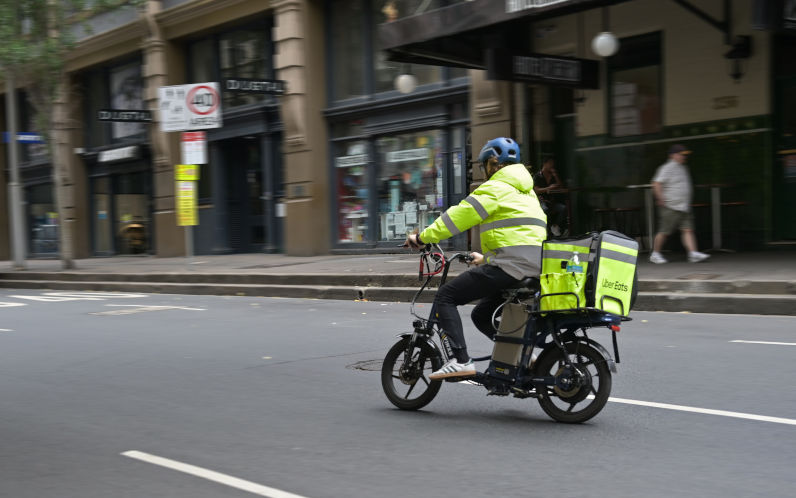
What looks like reckless behaviour on the streets reflects a deeper system of incentives in the gig economy that rewards speed, constant availability and risk-taking.
How many of us have had a near miss with an e-bike delivery rider?
You step out to cross a bike lane, glance both ways, and think you’re clear. Then something rushes past. It’s the speed that catches you off guard. Faster than expected. Faster than seems reasonable. Most of us make a quick judgement. The rider is reckless. They should slow down.
But that judgement may be too simple.
These gig economy workers are not fully in control. And this is not through any simple fault of their own. They are responding to a culture, a system of incentives and pressures, that is so pervasive it is rarely named. It appears as common sense, as choice.
A recent study of delivery riders in Melbourne shows how this operates in practice. Riders decide whether to accept jobs based on weather, demand and incentives. They are not ordered to work, yet their decisions are made under pressure. They often find themselves working in unsafe situations, rushing to meet targets that are unreasonable, and in conditions they would otherwise avoid. As one rider put it, “It’s important to stop when you are tired … but it might be difficult, especially for people wanting to earn money.”
This logic has a history. Under capitalism, time becomes something that is intimately connected to work. “Time is money,” as Benjamin Franklin famously put it. Time is no longer simply lived; it is measured, valued and exchanged.
Frederick Taylor helped tighten capitalism’s grip on time. He did this by entering factories with a stopwatch, measuring how long each task should take and breaking work into its smallest components. His aim was to create a system geared toward maximum productivity: what came to be known as Taylorism. Once this had been established, it was the worker’s role to fit into a structure that had already been decided. They had no choice.
Neoliberalism marks a further shift in which workers are told they are independent, flexible, and responsible for their own success or failure. What was once understood as an external system is now experienced as personal choice. There is no overbearing taskmaster. Only the individual psychology of the worker. I am not being productive enough. There must be something wrong with me.
The gig economy uses technology to bring these strands together. The factory has disappeared. The supervisor is no longer visible. In their place is the app.
The apps that gig economy workers use track movement, measure performance, and subtly nudge behaviour. Bonuses appear during peak periods. Demand surges in bad weather. Incentives are offered precisely when conditions are least favourable. Every minute becomes something to account for. Time itself is internalised.
Riders describe these incentives as a form of “positive manipulation,” where rewards encourage them to work in the very situations they would otherwise avoid. The app offers “quests”, targets that promise extra pay if enough deliveries are completed within a set time. What appears as a game makes the work more demanding and leaves the rider increasingly isolated. As one courier put it, “There’s nobody you can talk to. Everything is automated.”
The speed and convenience of food delivery is something many of us now take for granted. But what appears effortless on one side depends on workers operating under highly alienating conditions on the other.
Gig economy platforms present work as freedom, but this freedom is tightly constrained. The system rewards speed and constant availability, while penalising anything else. Ratings, acceptance rates and delivery times determine who continues to receive work.
The rider is not alone. Casual workers, freelancers, and those working from home increasingly find themselves in similar conditions. The boundaries between work and non-work blur. The sense of being “on call” never fully disappears. It is an anxiety-producing Mephistophelean concoction where time, productivity, individual responsibility and exploitation work hand in hand. This is no longer confined to the gig economy. It shapes how many of us experience time and understand ourselves. The rider simply makes this visible.
So when you see an e-bike rider rush past, it is worth pausing before placing the blame.
They are moving within a system that demands speed, rewards increased productivity and leaves little room to slow down. They are racing, not because they choose to, but because the game they are playing has rules they cannot afford to ignore.

Adrian Rosenfeldt
Dr Adrian Rosenfeldt teaches at Melbourne University. He is a journalist, public speaker and the author of The God Debaters: New Atheist Identity-Making and the Religious Self in the New Millennium (2022).