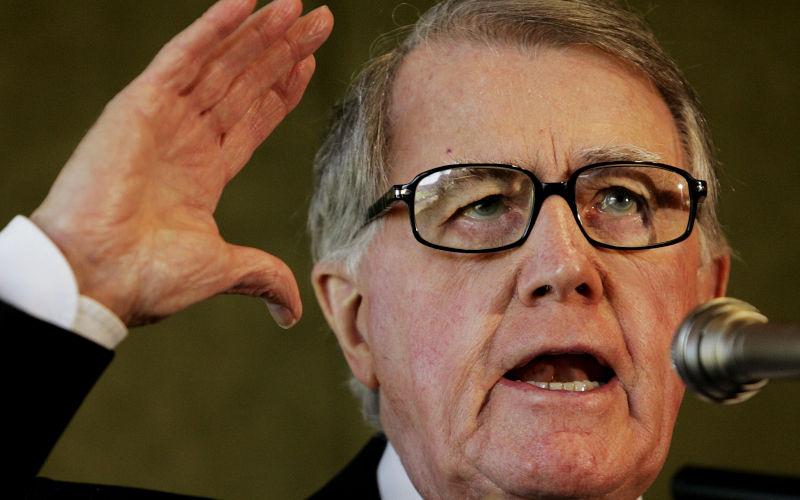
Fifty years after Neville Wran’s rise to power, his leadership offers enduring lessons in political strategy, discipline and understanding the electorate.
As we approach the 50th anniversary of the Wran government’s historic election in NSW, we are provided with an opportunity to reflect on the lessons Labor learned during a volatile period in Australian politics. And how they have influenced future governments.
Neville Wran led Labor to power in NSW barely six months after The Dismissal – which had seen the Whitlam government ingloriously despatched by the voters after a tumultuous three years in office.
The ALP had briefly emerged from 23 years in the political wilderness federally. Paralleled by a decade in opposition in NSW.
The party’s resurrection, so soon, was largely unexpected. Wran not only restored its fortunes, he laid the foundations on which subsequent successful federal and state governments across the country have been built.
Wran demonstrated the key strengths of political leadership. The ability to read the public mood – politics being ‘the art of the possible’. A likeable persona. A willingness to accept that which was achievable and that which was not. Along with the insight to know what was really needed, and how to get things done.
So, what changed the course of Labor history in NSW 50 years ago? An inspired deal between the leaders of its then warring factions.
John Ducker was the boss of what is now Unions NSW and a hard man from Labor’s right wing. Jack Ferguson, an equally tough former unionist, was the leader of the left wing in the NSW parliament. Wran was a leading barrister and a member of what was then a part-time upper house, the Legislative Council.
Who approached whom? I suspect it was Wran who first floated the idea with Ducker and Ferguson, perhaps characteristically dismissing the “knuckleheads” currently in the Legislative Assembly, where governments are formed. Others may be able to provide a definitive answer.
When Wran became opposition leader, people immediately took notice. He was the sort of bloke who just looked like he should be running the place. ‘Nifty Nev’, he was called.
His most celebrated victory was in the 1978 general election – dubbed by the media as a ‘Wranslide’. Labor secured a 23-seat swing, with 58 per cent of the primary vote and 61 per cent two-party preferred. The campaign slogan was ‘Wran’s Our Man’.
But it was winning a by-election for the seat of Earlwood earlier that year which had turned a corner for Wran and demonstrated his growing electoral appeal.
The former Liberal premier had hung around, unlike today’s vanquished leaders who grab their parliamentary super and head off looking for a corporate gig.
The Liberal Party had held Earlwood for more than 30 years. It was therefore thought unwinnable by the party’s power brokers.
Wran wasn’t optimistic either. His response was typically robust. “I don’t expect to win. I just don’t want to be clobbered”, he told one of his ministers. “Let’s get someone out there who knows what they’re doing” (expletives deleted).
The unsuccessful Liberal Party candidate was a then little-known rugby coach called Alan Jones. An infamous moment in the campaign, reported along with a photo in the local paper, saw Jones on the stage at a fundraiser in a Greek costume dress.
Years later, Wran would say to me “I’m not sure we did ourselves a favour there, son. Might have been better to have let him win”. But at the time it was widely seen as a massive victory.
When the Wran government was sworn in, his ministers were allocated a private secretary, an assistant private secretary, a press secretary and a ‘typing pool’. It was years before we saw an influx of politically appointed staffers. Back then, governments were almost exclusively reliant on their public servants for policy advice.
Given the dysfunction that plagued the Whitlam era, Wran instituted administrative arrangements designed to ensure stability and rigour in decision making.
In particular, he was determined not to be undermined by his bureaucrats. Whitlam didn’t just face a public service disinterested in his reform platform. Having climbed the ‘greasy pole’ under a long-term conservative administration, most of his inherited department heads were overtly hostile.
One of Wran’s first appointments was a public servant named Gerry Gleeson, who he made head of the Department of Premier and Cabinet. Their arrangement was straightforward. Wran made it clear he didn’t care who Gleeson hired or fired. Just so long as he made sure there were no major stuff-ups. Nothing to embarrass the government. Gleeson was pretty successful, for a time!
But Wran frequently let everyone know that, ultimately, he was in charge.
When the XPT was due to take to the tracks the transport department decided its first run would be to Wagga. “Nuts to that”, was Wran’s response. “We can’t win that seat”.
So, the first XPT travelled to Armidale in the Northern Tablelands electorate, which was one of the unexpected wins in the Wranslide. The premier rode the train, ensuring the event secured valuable media coverage for the local member, who was returned at the next general election.
Regular (at times monthly) visits to targeted marginal seats in regional areas by the premier is credited as a primary reason for the Wranslide.
Arguably, Wran’s most significant administrative move was to create a cabinet subcommittee known as Policies and Priorities (or simply P&P).
This group consisted of the top six ministers. Nothing controversial made it onto the cabinet agenda unless it had been through P&P. If something on the agenda turned out to be contentious, it was flicked to P&P.
In addition to vetting important decisions, P&P was effectively Wran’s praetorian guard. Just as cabinet solidarity requires ministers to publicly support decisions they had opposed, P&P members were expected to back its recommendations when they went to cabinet. They mostly did!
P&P also followed the practice described by fictional UK prime minister Francis Urquhart in the television series ‘House of Cards’. From time to time, Wran could rely on its members to “put a bit of stick about” if there was disquiet on the backbench.
Wran’s third important administrative action was the creation of the Ministerial Advisory Unit – which was immediately dubbed the Mau Mau, after the notorious Kenyan guerrillas.
The Mau Mau was headed by David Hill, who went on to run the NSW railways under Wran. While it was physically and notionally housed in the Department of Premier and Cabinet rather than Wran’s private office, the Mau Mau was effectively a highly qualified professional group which undertook special assignments for Wran.
Its most significant achievement was uncovering so-called ‘hollow logs’ – millions of dollars squirrelled away in the public accounts – which were subsequently used to improve the state’s budget and to fund new initiatives.
Founding Mau Mau member Milton Cockburn has recently published a definitive book, entitled The Assassination of Neville Wran. Not one for a leisurely Sunday afternoon read, it’s the result of years of research and is packed with detail – as this extract from the introduction demonstrates.
“The book contains much previously unpublished material. Access to unreported file notes of the head of the Premier’s Department alters the common narrative that the Wran Government dragged its feet in investigating Federal Police wiretaps revealing possible corruption of a prisoner early-release scheme. A previously secret report by a federal Parliamentary Commission of Inquiry, released in 2017 but unreported until now, exonerates Wran on an allegation arising from ‘the Age tapes’ that he promoted a public servant at the urging of controversial solicitor Morgan Ryan”.
While Wran does not come off unblemished, Cockburn contends there is no evidence he was corrupt, as some journalists looking for a headline have asserted. His conclusion – and that of many others who knew Wran well – can be summed up as follows (my paraphrasing).
Wran was a politician for the time. He governed with a combination of determination, resignation and acceptance. Perhaps being a barrister had hardened him to the reality the world is a murky place and what any leader can do about its brutal reality is limited.
Wran stepped aside at one point while allegations against him were under investigation by a Royal Commission – which ultimately cleared him. This was when he made his most famous and oft-quoted comment, “Balmain Boys Don’t’ Cry”.
Cockburn notes that as a bloke who claimed he hadn’t set out to do much, the list of the Wran government’s achievements is a long one.
It began the transformation of Sydney, including the redevelopment of Darling Harbour and the construction of the Entertainment and Exhibition Centre.
It reformed archaic laws – repealing the Summary Offences Act, introducing more victim-sensitive sexual assault legislation and decriminalising homosexuality. The Antidiscrimination Act and Aboriginal Land Rights legislation were enacted during Wran’s premiership. It was also responsible for the establishment of the NSW Director of Public Prosecution, although the legislation was actually introduced by the then Attorney General Terry Sheahan, shortly after Wran’s resignation.
Wran also introduced electoral reforms, including a democratically elected Legislative Council, four-year parliamentary terms, public funding for political parties and an MP’s pecuniary interests register.
There are too many other Wran initiatives to list them all. One that’s seldom mentioned is his personal intervention to allow surfing to become an official school sport in NSW – overruling a concerted campaign by education authorities who wanted to retain a ban applying at the time.
When he retired after a record term of more than 10 years (subsequently topped by Bob Carr, also at 10 years plus), Wran was asked at a news conference what was his greatest achievement as premier. His immediate response was “saving the rainforests”.
The decision to block the logging of a native rainforest at Terania Creek in northern NSW was controversial at the time and one of the most fractious matters within the Wran caucus. It was some years before then party general secretary and later a federal senator, Graham Richardson, became a high-profile ‘greenie’ – thus healing wounds within the party and helping give Labor greater electoral appeal, in line with broad public sentiment.
The Terania Creek decision set a precedent which has seen subsequent state and federal ALP governments embrace pro-environment policies, and thereby creating a stark differentiator between our two major political parties, to this day.
All up, Wran despatched seven Liberal party leaders (Lewis, Willis, Coleman, Mason, McDonald, Dowd and Greiner) – recording four straight election wins.
LAURIE PATTON worked for Neville Wran’s first Attorney General and Leader of the House, Frank Walker. He was the government’s first externally appointed ministerial policy advisor. On Wran’s instruction, he was dispatched to manage the Earlwood by-election. Laurie has since advised other state and federal ministers and has held corporate and NFP executive roles, primarily in the media.

Laurie Patton is a prominent public interest advocacy and marketing/communications practitioner. He is a former political advisor, journalist and media executive.