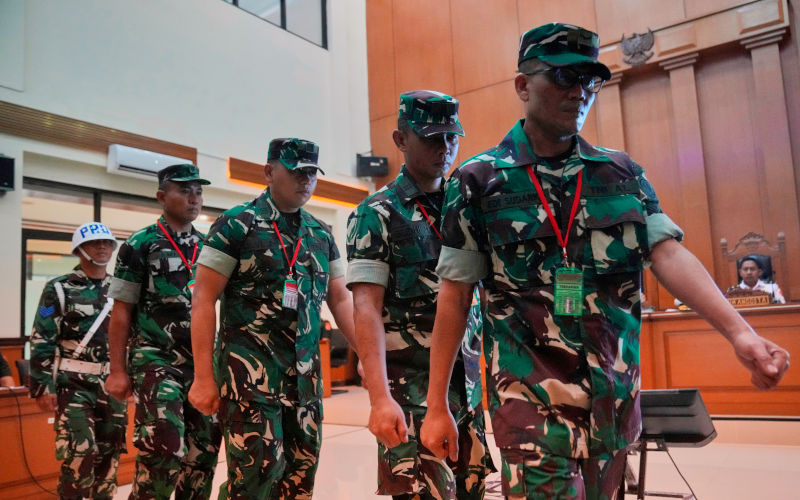
An acid attack by four Indonesian National Armed Forces (TNI) soldiers on a human rights activist highlights growing tensions as President Prabowo reinstates military influence in Indonesia’s civilian administration.
Is Indonesia using state-sanctioned violence to crush critics of its administration of the world’s third-largest democracy? Since a revolution at the end of the last century, it claims to have thrown off a 32-year autocracy led by former general Soeharto. But the replacement government, now run by Soeharto’s former son-in-law, Prabowo Subianto, is a “flawed democracy” according to the London-based Economic Intelligence Unit.
Arousing most concern are laws to put the military (Tentara Nasional Indonesia, TNI) in control of systems and departments previously run by civilians. NGOs have been leading critics of this trend, with one prominent human rights advocate, Andrie Yunus, assaulted in an acid attack on 12 March 2026 as he left his Central Jakarta office around 11 pm. Yunus is the Deputy Coordinator of the Commission for the Disappeared and Victims of Violence (KontraS) and has been an outspoken critic of the return to a military-run state. He had been receiving phone threats but had still been planning to release research into violence perpetrated by the security forces.
Amnesty International Indonesia collected 295 incidents of intimidation against human rights defenders and labelled 2025 as the Year of Living Dangerously for activists. (The title of the 1978 Christopher Koch book and Peter Weir’s 1982 film retains its relevance and potency.) Acid is often the weapon of choice. It doesn’t go bang and arouse security or upset body scanners; blokes carrying plastic drink bottles rarely arouse suspicion.
Yunus was critical of the TNI’s growing influence, largely through inserting officers into the leadership of government departments that had been handling civilian affairs for almost three decades, since the collapse of Soeharto’s New Order government. Prabowo is a former three-star general sacked in 1998 for allegedly disobeying orders while he was Commander of the Army Strategic Reserve Command. Now as President, he has even put TNI officers in charge of the government’s free-school meal program and its rice control and distribution agency.
Yunus’s ambushers were four active-duty intelligence officers, who are on trial in a military court, where it is alleged they were motivated by personal revenge to splash his face and clothes with acid. Another version blames Yunus for causing distress in 2025 when he disrupted a hotel meeting of politicians and bureaucrats discussing the revision of the TNI Law. The defendants consider Yunus’s actions had insulted the military.
Researchers for Yunus’s defence have scrutinised security camera tapes of the incident and claim another 10 soldiers were involved as watchouts, making the attack a coordinated affair. A flask of the prepared acid mix was tossed in Yunus’s face, under his helmet and down his overclothes. He was thrown off his machine, screaming in agony, according to witnesses. Twenty per cent of his body is burnt and he will likely lose his right eye. He is still in hospital.
Prabowo has reportedly said: “This is terrorism, isn’t it? A barbaric act. We must pursue.” But KontraS is unimpressed by the pledge and angry about the prosecution being held in a military court, even if the proceedings are open to the media.
Yunus has written to the President:
In various cases involving civilians harmed by military personnel, including forced disappearances, killings, torture, and domestic violence, military courts have never delivered justice, accountability, or full institutional responsibility up to the chain of command. This only perpetuates a record of impunity.
This appeal was binned.
Jakarta Military Court chief Colonel Fredy Ferdian Isnartanto has tried to justify keeping the case in his jurisdiction. He told a press conference:
If this were handled in a civilian court, it would not be appropriate, and the legal process would not proceed. It could even be rejected by the district court.
The track record on prosecutions is not good. Ten years ago, a former policeman turned corruption investigator, Novel Baswedan, was walking home from his local mosque in North Jakarta when two men threw acid at his face. He lost an eye. After more than two years of investigation and a presidential order to find the assailants, the result was a disappointment. Two active police officers were convicted and jailed for a year. Novel’s supporters said they were scapegoats.
The stand-out in the business of removing government critics has to be the 2004 assassination of lawyer Munir Said Thalib, the founder of KontraS in 1998. He was poisoned on a Garuda flight while heading to Utrecht University to study for a master’s degree in international law and human rights. A post-mortem found arsenic in an orange drink. He died before landing. The then-President Susilo Bambang Yudhoyono (another former general) promised Munir’s widow, Suciwati, that the case would be thoroughly investigated. It wasn’t.
According to the nation’s leading daily, Kompas,
the shadow of the military’s return to dominance in civilian governance is now increasingly apparent. A total of 2,500 active TNI personnel have quietly taken up civilian positions, a figure that exceeds the limits set by law.
If the revision of the TNI Law currently being discussed by the DPR (Parliament) is passed, the last barrier to military involvement in civilian bureaucracy will collapse.
Not only that, but soldiers will also be given the opportunity to engage in business activities, blurring the clear line that has long separated the military from economic and political interests.
The California-based Asia Sentinel magazine has warned of “the darkening face of Indonesia’s democracy” with “reports of intimidation and terror directed at activists, legislative initiatives widely seen as constraining press freedom, and, perhaps most strikingly, the reactivation of military command structures at the regional level”.
How does this affect Australia? Along with the US, in early 2000s, Australia banned Prabowo from visiting on the grounds of his alleged human rights record in Papua and Timor. But in politics, pragmatism usually smothers principles. Prabowo got his visa once he founded his right-wing populist Gerindra (Great Indonesia) party in 2008 and became its candidate for the presidency.
Earlier this year, PM Anthony Albanese visited Jakarta to sign a security deal between the TNI and the ADF, saying, “No country is more important to Australia — or to the prosperity, security and stability of the Indo-Pacific than Indonesia”. No mention of human rights, the rules of warfare and the sharing of values. Our soldiers mingling with theirs should beware of misunderstandings that could lead to criticisms and cool drink bottles with suspect contents.

Duncan Graham has been a journalist for more than 40 years in print, radio and TV. He is the author of People Next Door (UWA Press). He is now writing for the English language media in Indonesia from within Indonesia.
Duncan Graham has an MPhil degree, a Walkley Award, two Human Rights Commission awards and other prizes for his radio, TV and print journalism in Australia. He lives in East Java.