When you’ve run out of options to solve the climate problem sensibly, do something ludicrous like damming the Bering Strait. All Norway’s new cars are EVs. Greenhouse gas emissions are up 50 per cent since nations decided to control them.
Damn the Bering Strait!
In the interests of brevity, I’m going to assume that readers know what a climate tipping point is, that the Atlantic Meridional Overturning Circulation (AMOC) is the name of the surface and deep water currents that keep the Atlantic Ocean circulating between the tropics and the poles, that although the current flows happen in the Atlantic, the AMOC is a major influence on climates worldwide, and that the weakening of the AMOC as a result of climate change is (some say) in danger of reaching a tipping point when its complete shutdown will become inevitable with disastrous consequences for the climate, weather patterns, nations and communities around the globe – phew! Readers wanting more information about the AMOC should have a look at David Spratt’s article in P&I. For a primer on tipping points, see The Global Tipping Points report 2025. So, now we’re all on the same page, on with the story…
Climate change is proceeding at such an alarming rate and with already alarming consequences that some people, despairing that humans are not going to reduce their greenhouse gas emissions sufficiently rapidly to avoid truly catastrophic global warming, are proposing and researching what would otherwise be considered truly outlandish technological ‘solutions’, for example solar radiation management (using cloud brightening, floating a giant parasol in space and surrounding the Earth with a blanket of reflective particles in the atmosphere), direct capture of CO2 from the atmosphere, and refreezing the Arctic.
Here’s a proposal I haven’t come across previously: building an 80km dam across the Bering Strait between Alaska and Russia. Closing the Strait, it is suggested, will allow less of the fresh water released from the melting Arctic ice to flow into the northern Atlantic Ocean.
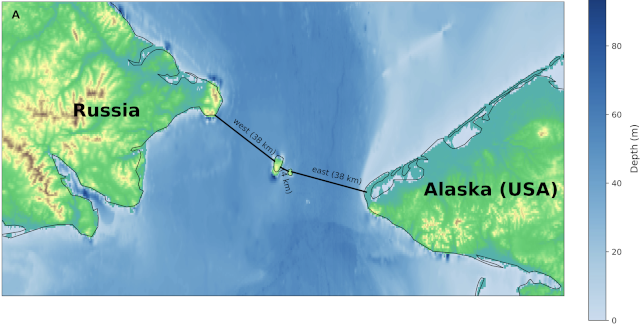
Part of the present problem is that increasing amounts of Arctic ice melt are reducing the salinity of the adjacent Atlantic surface, making the water less dense and preventing the cold surface water from sinking and drawing warmer surface water north from the tropics. This process provides some of the driving force for the AMOC.
Moving around to the Pacific Ocean, paleoclimate models show that when the Bering Strait has been closed naturally the AMOC has been stronger because the flow of fresh water from the North Pacific to the Atlantic is reduced, as is the flow from the Arctic to the Atlantic.
Modelling of the proposal to dam the Bering Strait suggests that this could delay the AMOC reaching its tipping point…but we mustn’t wait too long. Damming only works if the AMOC is still strong enough when it happens.
As a (mostly lapsed) sociologist, I’m well-acquainted with non-sociologists using their claimed ‘common sense’ to rubbish solid research that produces results or proposals they consider to be ridiculous. I’m not going to fall into that trap by criticising the proposal or the researchers who freely declare that the idea is currently mainly conceptual and that the technical feasibility, economic effects and environmental impacts need to be much more fully explored.
No, my point is not that the proponents are stupid but that humanity must be stupid, or at least those who are currently controlling the world’s political decisions, to allow a situation to develop where it is possible to even consider damming the Bering Strait.
Sun-dimming, the new climate colonialism
Beyond the Bering Strait, there are many geoengineering proposals for managing an environment that is in grave danger of being pushed out of the stability that has existed for last 10,000 years by humanity’s failure to reduce greenhouse gas emissions quickly enough. They all raise serious issues regarding not just their technical feasibility but also ethics, transparency, democracy, power, security, governance, patents and profits, use in conflicts and political economy.
Solar radiation management (sun-dimming), a group of geoengineering technologies being seriously considered at present, highlights these concerns. There is a genuine risk that if one or more of the nascent technologies matures and is deployed, the sky and the air we breathe (traditionally considered a free public good) will become contested sites for national, military and commercial control and profiteering (disaster capitalism). While this is happening, communities will be kept in the dark, have little or no say in decision-making and suffer, almost certainly unequally, any untoward consequences of interfering with Earth’s radiative balance at the planetary scale. As ever, the important questions will be: who decides? who wins? and who loses? And, most crucially, who decides who decides?
(I can’t avoid a wry smile at Amazon promoting Naomi Klein’s The Shock Doctrine: The Rise of Disaster Capitalism and Antony Lowenstein’s Disaster Capitalism: Making a Killing Out of Catastrophe.)
“When you change the government, you change the country”
People can respond quickly and as desired to the policy levers governments put in place. But simply imploring people to do something isn’t enough. Take these examples from the US and Norway.
In the US since 2020 there was a slow increase in the proportion of passenger car, truck and SUV sales that have been EVs (including plug-in hybrids)…until last year. In 2025, EV sales fell by 4 per cent. The explanation is, of course, changes to the US government’s policies on incentives, tariffs and environmental standards.
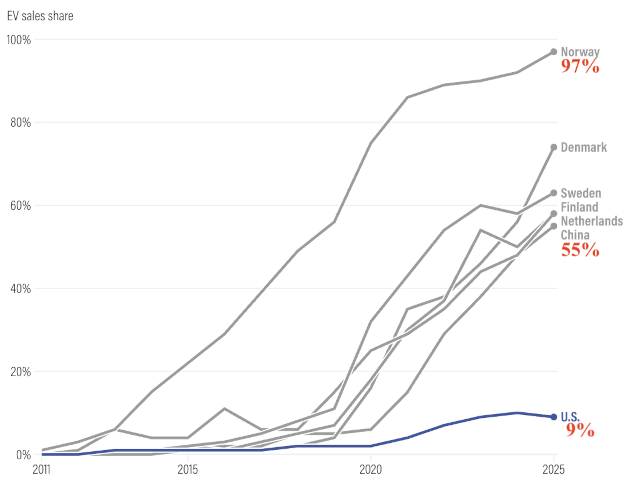
New cars sales can be deceptive, however. In Norway, where EV sales have exceeded 50 per cent for eight years, still only 30 per cent of the car fleet is an EV. In Australia, where EVs hit a record 14.5 per cent of new car sales in March this year, less than 2 per cent of the car fleet is an EV. But Norway’s 30 per cent is going to increase rapidly.
Regular readers will be aware that I am totally dismissive of using good news stories about the transition to renewable energy to justify optimism that the world is getting on top of global warming. For new readers, controlling global warming will occur only when we reduce and eliminate greenhouse gas emissions.
That said, I can’t resist the graph below for illustrating the dramatic change that can occur when authorities and societies set their minds to it. The sale of diesel- and petrol-driven passenger cars has plummeted in Norway from 100 per cent around 2010 to almost zero in 2025. Not only that, although sales of hybrids provided a bridge through the transition between about 2010 and 2024, their sales have now almost completely disappeared. EVs have captured very close to 100 per cent of the new car market. Well done the Norwegians.
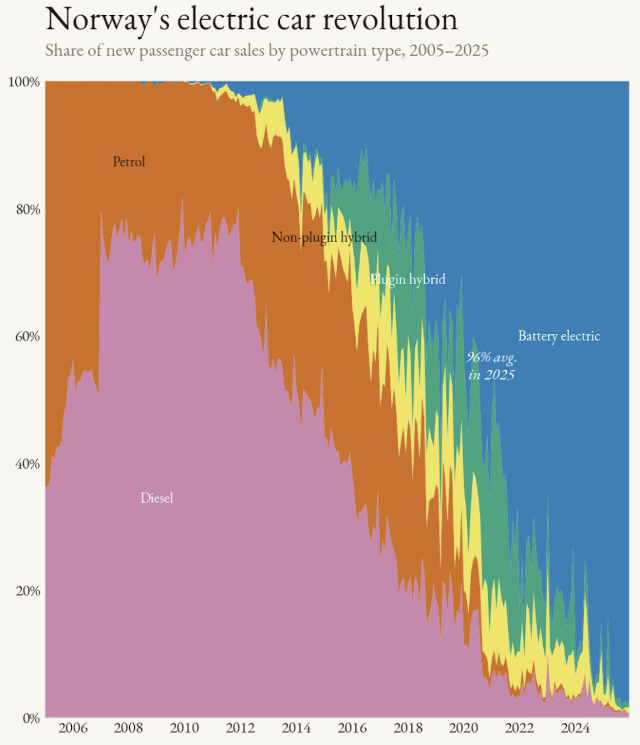
It’s notable that the Norwegian experience is a true transition: in new vehicle sales, EVs have replaced fossil fuel engines. A transition of fossil fuels to renewables has not yet started globally. So far, renewables have simply augmented continuing increases in fossil fuel use.
Greenhouse gases: the where from, where to and which
I have written about earlier editions of the World Resource Institute’s report on greenhouse gas (GHG) emissions but for anyone wanting an understanding of current emissions, it’s a great resource, so I’m bringing it and the underlying Climate Watch platform to your attention again.
There’s far too much in the report and the platform for me to cover comprehensively, so I’m focussing on just two aspects and encourage you to explore the links for yourself if you want more detail.
First, the complex figure below shows for 2023 the flow of the four most important GHGs from the sectors where they originate to where they are used. The details in the figure are too small to be read in P&I but I’m including it to give you a sense of what the figure looks like. If you want the details, hit the WRI link.
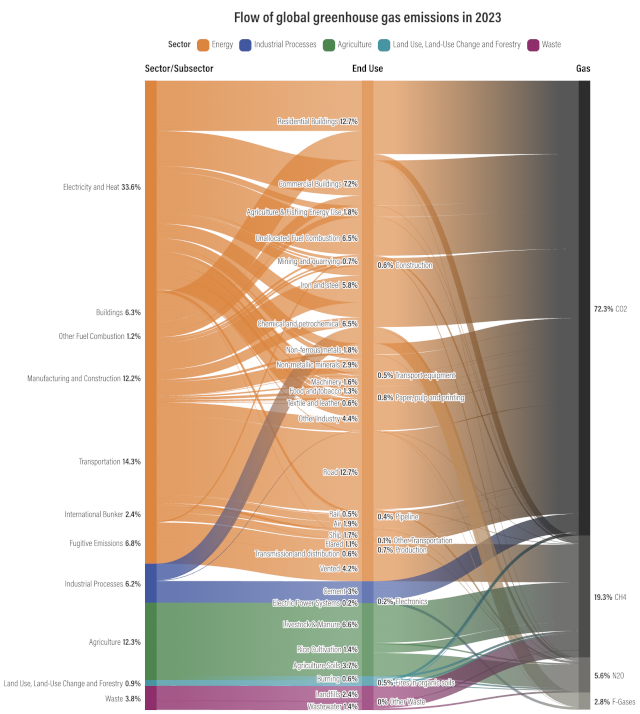
The good news is that I’ve done the hard work for you and summarised the major features in the table below.
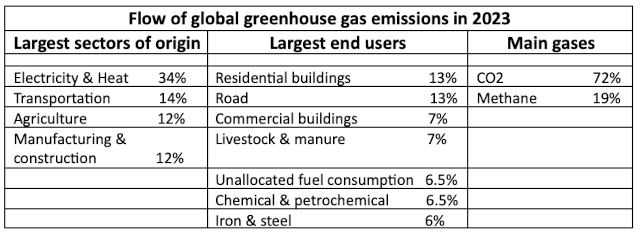
As you can see, just four sectors are responsible for producing almost three-quarters of GHG emissions but, not surprisingly, dig down into the end users and there are few dominant ones. Buildings at 20 per cent and roads at 13 per cent are the only sectors that stand out. As ever, CO2 dominates the gases but methane is particularly important at present because of its large short-term influence on global warming.
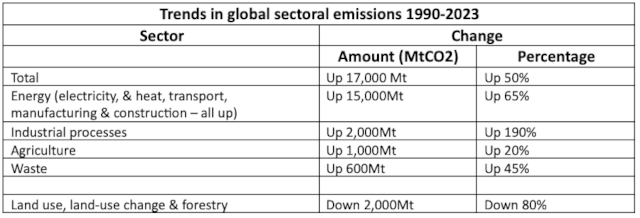
Second, the trends in sectoral emissions between 1990 (roughly the start of the UNFCCC’s efforts to limit GHG emissions) and 2023 clearly demonstrate why we’re stuffed. What has been achieved in those 33 years?: a 50 per cent increase in emissions and still growing.
Puffin peace
Put the tai chai, valerian, chamomile tea, yoga, magnesium and mindfulness aside for a moment, and relax with puffins for five minutes.

I’m off on my travels again, so no Sunday columns from me for the next few weeks. Back online on 21 June.

Peter Sainsbury is a retired public health worker with a long interest in social policy, particularly social justice, and now focusing on climate change and environmental sustainability. He is extremely pessimistic about the world avoiding catastrophic global warming.