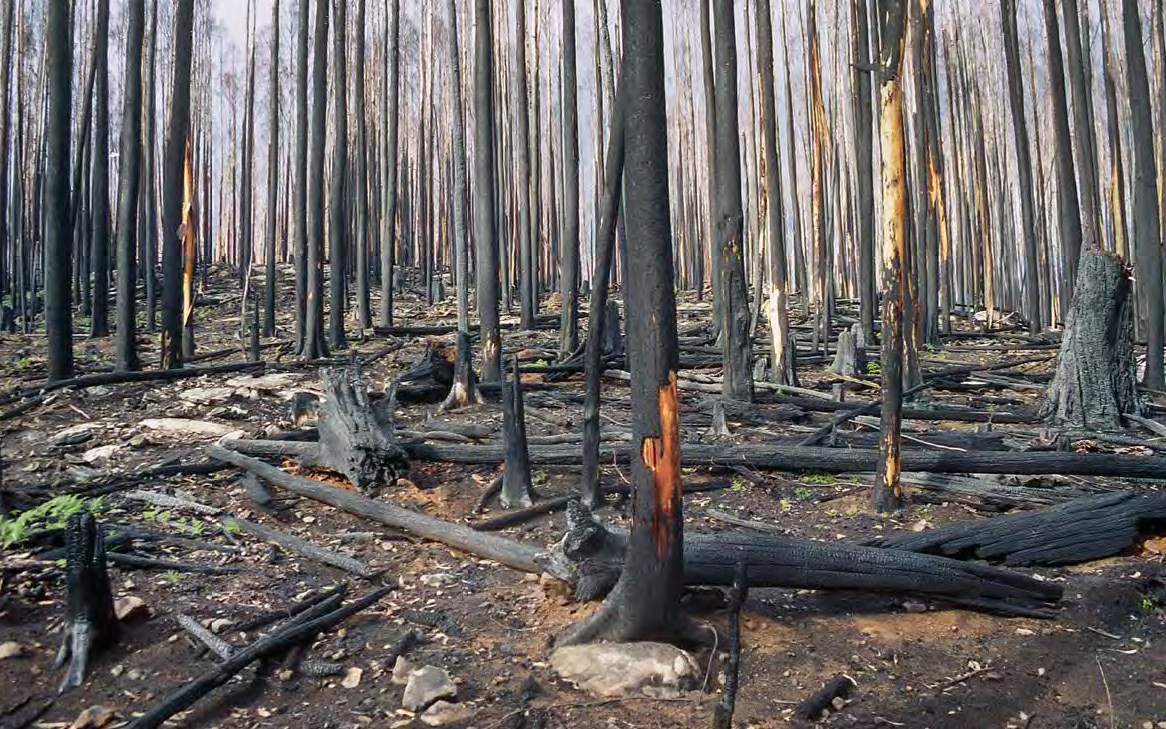
Many proposals to create so-called ‘healthy forests’ through thinning and repeated burning risk further damaging Australian ecosystems already degraded by logging, clearing and over-management.
There has been increasing discussion about what constitutes a so-called ‘healthy forest’. There is even a foundation that aims, in part, to make forests healthy, typically by using industrial forestry methods like mechanical thinning and/or regular burning. But what actually is a healthy forest? What are the characteristics of a healthy forest? And what kinds of management can produce a healthy forest? These are important questions to answer because it affects decisions about how best to manage Australia’s forests as well as the nation’s woodlands.
What constitutes a healthy forest will vary with the type of forest in question such as tall open forest versus an open grassy box-gum woodland. It will also vary with the natural stage of forest development for a given forest type; such as whether we are examining a patch of long undisturbed old growth forest or a young forest regenerating after a wildfire.
These are not just subtle nuances; they are fundamentally important to thinking about good management.
Large old trees are a critical component of many types of healthy forest and woodland. These trees play a wide range of key roles, including supporting an array of tree-related microhabitats (termed TReMS) such as hollows and bark fissures. They also store disproportionately large amounts of carbon relative to the other trees in a stand. Sadly, large old trees are increasingly rare or are virtually missing from many Australian forests, especially those with a long-term history of industrial logging.
The understorey and midstorey layers can be another critical part of a forest or woodland and a key part of determining if it is healthy. These are the vegetation layers underneath the overstorey trees. Understorey and midstorey layers provide habitat for many species, and are where animals forage and nest.
Many studies from around the world, including in Australia, have shown that significantly more species inhabit patches of vegetation where there are multiple layers. This is because structurally complex forests and woodlands support more niches to support more species. Understorey and midstorey trees like wattles also play key nutrient fixing roles that can promote the growth of overstorey eucalypts – a vital function given the nutrient-poor soils that characterise many parts of Australia.
A dense understorey and/or midstorey is a natural part of the development of some types of forest and woodland. Indeed, a dense understorey and/or midstorey layer is critical for limiting the highly negative effects of the hyper-aggressive native Noisy Miner on many small-bodied native birds of conservation concern.
There is even a body of ecological theory and supporting evidence to describe these effects, called the landscape texture hypothesis. In fact, our long-term studies have shown that areas of densely structured regrowth woodland support a suite of birds not found in old growth woodland. This means that to support the full suite of birds in a landscape, it is important that landscapes support areas of dense regrowth woodland as well as old growth woodland. Unfortunately, the understorey and/or midstorey is missing from many woodlands in Australia, particularly those with a long-term history of extensive and repeated clearing and livestock grazing.
Unhealthy forests and woodlands can be created by human land management. Examples include clearing, logging, mechanical thinning, and too-frequent burning. These activities lead to the widespread loss of large old trees, over-simplification of the structure of forests and woodlands, degradation or loss of habitat for many species, and the alteration of key ecological processes such as an increase in fire severity.
Some people have recommended using the same methods that led to forest degradation in the first place to restore forests and woodlands so that they become healthy. One of these proposed methods is mechanical thinning. Mechanical thinning will grow fatter trees faster, but not taller trees (because the removal of neighbouring trees reduces competition for light). Fatter trees also do not necessarily develop hollows faster because cavity development is a function of tree physiology and the ability to heal wound tissue.
At the same time, thinning can remove the dense regrowth habitats that are important for many species and increase interference competition by over-abundant native ‘pest’ species such as the Noisy Miner. It can also increase fire risks and generate significant amounts of greenhouse gas emissions that contribute to climate change.
Of course, for the vast majority of forests and woodlands globally, mechanical thinning is entirely unnecessary. This is because these vegetation types thin themselves naturally. That is, self-thinning is a natural process whereby as forests and woodlands mature, they become characterised by fewer, larger old trees. And for many locations, natural self-thinning is part of a transition to a less flammable mature forest state.
It is important to remember that forests and woodlands have existed in Australia for more than 180 million years without the kinds of industrial intervention now proposed to radically alter them. The problems caused by humans, and especially those created in the past 240 years, will not be solved by continuing to employ the same kinds of inappropriate management regimes that have been used by Europeans.
These perspectives matter because in many cases, calls to create so-called ‘healthy forests’ will often lack scientific evidence to support them and may ultimately do far more environmental damage than if forests and woodlands had been left to mature naturally.
David Lindenmayer
Professor David Lindenmayer is a distinguished Australian scientist and academic, specialising in landscape ecology, conservation, and biodiversity. His research focuses on integrating nature conservation with agricultural production, improving biodiversity conservation in forestry and plantations, and enhancing fire management practices. With over 1000 peer-reviewed papers and 50 books, David is one of the most published ecologists globally. He leads large-scale, long-term research programs in south-eastern Australia. A Fellow of the Australian Academy of Science, he has received numerous prestigious awards, including the ESA Whittaker Award, multiple Eureka Prizes, and the Australian Natural History Medal.