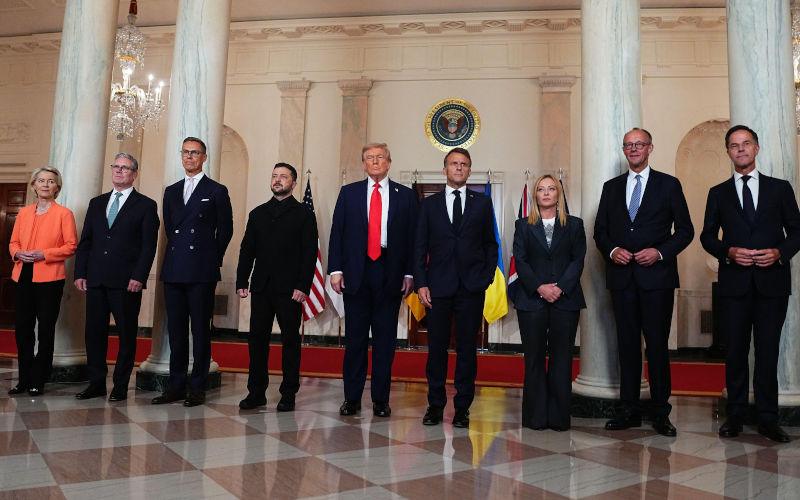
In the seventh of an eight-part series, John Keane asks if other democracies can decouple themselves from the American empire.
America’s obligations to territorial democracies like Canada, South Africa, Chile, India, Australia, New Zealand, or Germany, France and other member states of the EU are fast crumbling. Their leaders and citizens are being forced to cope as best they can. That they call themselves democracies or appeal to democratic ideals isn’t of much significance or concern to the flailing empire.
To use a favourite backroom phrase of American diplomats, their governments can go fuck themselves. They are going to be forced to face up to the new reality: don’t naïvely suppose that America is automatically on your side, pay your debts and higher tariffs, honour your military commitments, buy our weapons, do what we tell you to do, or we’ll make life difficult for you. Recognise that we intend to back away from costly conflicts (‘forever wars’) where our military grip is slipping. Understand that, since our primary priority is America First, we want to consolidate our power ruthlessly in certain zones, especially our new focus on the Western Hemisphere, to withdraw from others, all the while supporting the vision of a Greater Israel, which, for instance, involves building a new mega-embassy and surveillance and command centre in Lebanon.
The abusive language hurled by Trump at the leaders of the EU member states is a harbinger of things to come. ‘You’ll have to start learning how to fight for yourself, the USA won’t be there to help you anymore, just like you weren’t there for us,’ Trump said in a post on Truth Social. ‘Iran has been, essentially, decimated. The hard part is done. Go get your own oil.’
More of this kind of confrontational talk is surely coming. Unless democracy’s friend serendipity steps in, the consequence will be that the democratic world will experience something like a 21st-century perverse replay of the century before. Then, after a half-century of social unrest, economic stagnation, dictatorship, global war and totalitarianism, by 1941 only eleven parliamentary democracies had managed to preserve their independence. That year President Roosevelt called for ‘bravely shielding the great flame of democracy from the blackout of barbarism’. Those democracies did so by knuckling down and keeping their distance, as far as they could geographically and emotionally, from the general anti-democratic trends of the age.
For democrats, civil society defenders and democratically elected governments in cities, states and cross-border organisations, present-day trends and troubling futures are arguably going to be just as challenging as they were during those dark times. Within the outlier democracies, some right-wing parties and governments have already been emboldened by Trumpism, but it’s to be hoped (with examples like Hungary in mind) that not everything will go the way of the failing empire.
Whatever happens, there’s a new question facing democrats of our age: if hope is the anticipation of a future that’s judged to be both possible and desirable, then what are the chances that the democracies, which were once America’s friends, will survive and thrive? Will their leaders and citizens wake up to what is going on? Might they come to understand that every crisis is an opportunity? Or that this is the moment when they create and muster outside sources of support, which serve to preserve and enliven their spirit and substance?
Can the democracies once under the thumb of the United States decolonise themselves? Can they come to accept that decolonisation is not exclusively a problem confronting the ‘Global South’? Have they the foresight, courage and wisdom to understand that entrapment in an empire, whatever material advantages it brings, is not just a matter of corporate takeovers and military bases but involves domination of bodies, hearts, minds and ways of thinking and speaking? Can these democracies comprehend the truth that for all its glorious achievements the American empire brought ‘violence, excess, waste, mercantilism, bluff, conformism, stupidity, vulgarity, disorder’ and that, as Aimé Césaire wrote in 1955, ‘one never recovers unscarred’ from imperial domination?
Are these democracies able to shed their own inner illusions, throw off old habits, ditch words and phrases (liberal democracy, for instance) that function as soothing and numbing alibis of their disempowerment? Can they come to the realisation that dependence on America had damaging and disabling effects, and that they must strive to find new words for capturing more precisely their altered thoughts, feelings and expectations and say goodbye to indifference and fatalism as forms of complicity, that they must straighten their spines and stand up in new and more boldly imaginative ways in support of the spirit and substance of their own democracies?
This article was drawn from notes prepared for public lectures in Nanjing and Oxford, May-June 2026
Read earlier articles in the Decolonising democracy series.

John Keane is Professor of Politics at the University of Sydney. Renowned globally for his creative thinking about politics, history, media and democracy, he is the author of the best-selling Tom Paine: A Political Life (1995), The Life and Death of Democracy (2009), Power and Humility (2018), The New Despotism (2020) and The Shortest History of Democracy (2022), which has been published in more than a dozen languages. He was nominated for the 2021 Balzan Prize (Italy) and the Holberg Prize (Norway) for outstanding global contributions to the human sciences.His latest books are China’s Galaxy Empire (2025) and Demagogues and Despots: Democracies on the Brink (2026).