In the sixth of an eight-part series, John Keane discusses the ramifications of the US withdrawal from international organisations on other democracies.
What about the fate of smaller and less powerful democracies such as Canada, Germany, South Africa, Australia, Spain, Ghana, New Zealand and Australia? How well will they fare under the emerging conditions caused by the decline of the American empire? When answering these questions, it must be remembered: territorial democracies cannot function, let alone flourish, in sovereign state settings alone. Going-it-alone autarky is impossible.
To say this is to cast doubts on the ‘no state, no democracy’ (Juan Linz) principle. Long a clichéd political science tenet, it is conceptually, historically and practically false in its underestimation or outright denial of the critical importance of cross-border mechanisms as preconditions of democracy. The old argument was that a state is an indispensable precondition of successful democratisation, understood as free elections, a multi-party system, and civil freedoms such as citizens’ right to independent media and freedom of assembly. A set of institutions within that state has a monopoly of violence within a defined territory so it can protect and rule over a population, which shares a sense of nationhood, and can deliver public goods other than political order. The conventional argument has obvious pertinence in settings where the turbulence generated by war, revolution, or uncivil war can destroy or render stillborn democratic strivings. Unsurprisingly, sovereign independence of a territorial state was the mantra of virtually every recorded instance of the struggle for political independence from modern empires, whether in Spanish America (beginning with Colombia, Venezuela and Paraguay in the 1810s), in China and Southeast Asia (in Indonesia, Vietnam and the Philippines following the end of the Second World War) or in Africa from the mid-1950s (Sudan, Tunisia, Morocco, Ghana and Guinea).
When we speak today of democracy, it is normally presumed that democracy must be housed in a bordered polity. But the double trouble with this ‘no state, no democracy’ argument is not only that states are fickle because – as cities, provinces and states within the polity know well – their modus operandi regularly crushes democratic efforts to rein in governmental and socio-economic power and to apply the brakes on their war-making powers. Less obviously, the spirit of democracy can only flourish within state settings when any given state is both unhampered by external bullying, boycotts and economic, diplomatic and other sanctions, and, more positively, supported by webs of outside institutions and forces that protect and nurture the spirit and substance of democracy. The democratisation of post-imperial Japan and post-apartheid South Africa and the re-democratisation of post-Nazi Germany and Northern Ireland after the Troubles are obvious past cases in point.
For the old democracies of the Atlantic region, and outliers such as South Africa, Ghana, Japan, Australia and New Zealand, a new and highly unfamiliar version of this ‘no outside support, no democracy’ formula now applies with a vengeance. So does the Kissinger rule: to be the enemy of the United States is dangerous, to be its friend might well be fatal.
Embedded within, and dependent upon, various cross-border arrangements, many of them formerly led by the United States, these remaining democracies are already feeling the open abandonment by the United States of the democratic principles of power sharing, public accountability, rule of law and justice for the weak. Excluding India, they comprise only a small percentage of the world’s population, which is one reason they are showing signs of creeping nervousness. Daily they are being forced to realise that America is voting against, and generally giving the moral and budgetary finger to, cross-border institutions and agencies (such as USAID, UNESCO and NATO), which they also supported but which the political leaders of the crumbling empire now dislike or no longer control.
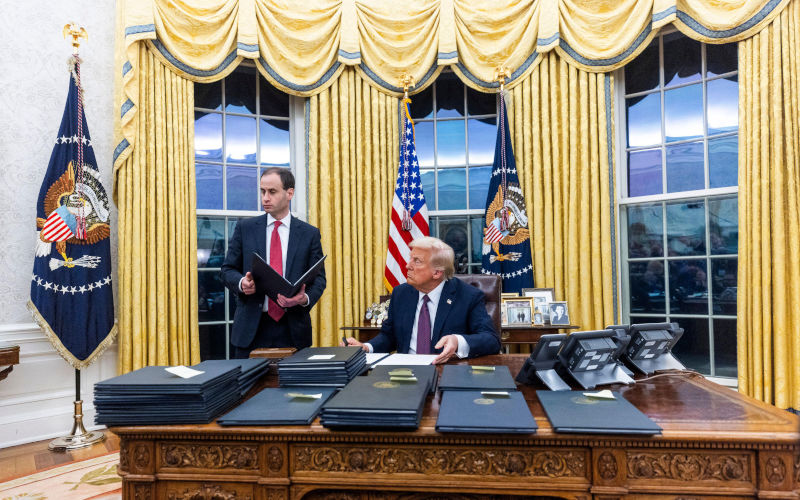
The executive order to withdraw from the WHO – signed on the first day of the second term of Trump’s presidency – was an ominous harbinger of things to come. Until recently, the United States contributed around 15 per cent of WHO annual funding. It played an important role in the multi-state organisation’s monitoring, information sharing and response to acute medical crises and longer-term global health care trends. Never mind that the American withdrawal will cause job losses and reduce the capacity of an organisation already in need of reform and struggling financially or that America’s walking away from the WHO will threaten the health of American citizens, damage overseas technical assistance programs and supply chains and, perhaps, in the end help wreck the global health diplomacy and assistance efforts of the outlier democracies.
The fierce American logic of withdrawal and regrouping is what now matters. It’s brutal: with apologies to Thrasymachus, injustice is the will of those who were once strong. The rest of the world can go to hell. The cross-border ability to understand what’s happening elsewhere, and to participate in decisions about matters of global importance, is old hat. The new watchwords are sauve qui peut: each government and people affected by challenges and crises must from now on fend for themselves as best they can.
This is the sharp point of the announced withdrawal (in January 2026) of the United States from 66 international organisations, including the Global Forum on Migration and Development, the Intergovernmental Panel on Climate Change, the Partnership for Atlantic Cooperation, and the UN Democracy Fund.
This article was drawn from notes prepared for public lectures in Nanjing and Oxford, May-June 2026
Read earlier articles in the Decolonising democracy series

John Keane is Professor of Politics at the University of Sydney. Renowned globally for his creative thinking about politics, history, media and democracy, he is the author of the best-selling Tom Paine: A Political Life (1995), The Life and Death of Democracy (2009), Power and Humility (2018), The New Despotism (2020) and The Shortest History of Democracy (2022), which has been published in more than a dozen languages. He was nominated for the 2021 Balzan Prize (Italy) and the Holberg Prize (Norway) for outstanding global contributions to the human sciences.His latest books are China’s Galaxy Empire (2025) and Demagogues and Despots: Democracies on the Brink (2026).