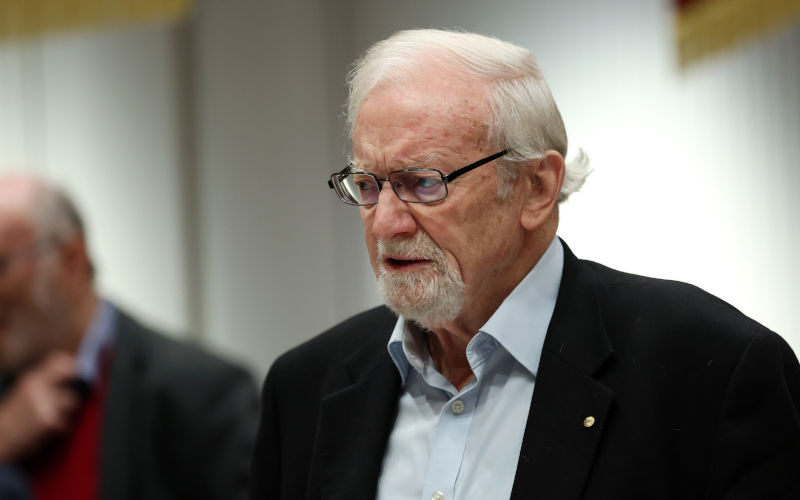
In a submission to the public inquiry into AUKUS, former foreign minister Gareth Evans argues the submarine project is not in Australia’s national interest, warning that doubts over delivery, excessive cost and loss of sovereign agency demand an urgent Plan B.
The AUKUS Pillar I Submarine project was misconceived from the outset, and the passage of time since its announcement in 2021 has served only to make more compelling the conclusion that it is not in Australia’s national interest to continue our commitment to it. For three main reasons: there are huge doubts about its deliverability, its cost to Australia manifestly outweighs its benefits, and its implementation would profoundly limit Australia’s independent sovereign agency.
Other concerns have been raised about the project, most importantly its potential contribution to nuclear weapons proliferation, the environmental impact of nuclear waste disposal, and the likely difficulties that will be experienced recruiting and sustaining a much-expanded submariner force.
While real, these problems are all likely to prove reasonably manageable – through, respectively, the negotiation of IAEA safeguards protocols, creative underground engineering solutions for the relatively small amounts of waste involved, and sufficiently attractive financial incentives for personnel. Others will have a different view, but for me the really critical objections remain deliverability, cost-benefit and sovereign agency.
Deliverability
There has been from the beginning zero certainty of the timely delivery of the eight promised AUKUS boats, and every piece of evidence now available on the public record reinforces scepticism as to whether any of them will be delivered on time, or indeed at all.
The first tranche, of three existing Virginia-class boats, is to be supplied by the US from 2032, but that has always been premised on the assumption that the Pentagon had its own inventory requirements, and meeting the Australian requirement would require an increase in the annual build rate from 1.2 to 2.3. Despite our contribution already of some $US2 billion to enhance the US shipyard capacity, with more to come, that hasn’t happened. On the calculation of retired Rear Admiral Peter Briggs, one of Australia’s most credentialed submariners, by 2032 the US Navy will have only 41 platforms, as against its ‘safe minimum’ of 48, and its target of 66.
The first consequence of that US industrial reality is the recently announced agreement that all three of the promised Virginias, not just the first two, will be second-hand, with that meaning (given the finite 33-year life of the sealed HEU nuclear-propulsion units) a likely available remaining life for the Australian navy for each of them of no more than 15-20 years.
Even more troublingly, the US determination to maintain and expand its own nuclear fleet size, as regularly, forcefully and influentially articulated by the Pentagon’s Under-Secretary of Defense for Policy Elbridge Colby, compels the conclusion that the delivery to Australia of any of the first tranche simply cannot be assumed – except on the assumption by the US that they will remain for all practical purposes just an extension of its own fleet, which starkly raises the sovereign agency issue addressed later in this submission.
An even bigger question mark hangs over the deliverability of the second tranche of the AUKUS submarine project: the five new-design SSN-AUKUS attack submarines to be jointly built by the UK and Australia (the hulls to be built in Adelaide, and married to reactors built in Barrow-in-Furness) with the first Australian boat entering into service in the early 2040s. Meeting even that very protracted delivery timetable would require the UK to deliver a completely debugged, wholly new SSN-AUKUS design by the late 2030s, with the Osborne shipyard in Adelaide being completely capable of playing its part thereafter.
Believing that any of this will happen requires even more heroic levels of optimism than needed for the US Virginias. Every report coming out of the UK indicates that its defence-industrial base is presently under extraordinary stress, with submarine building schedules tightening and costs increasing, and with every prospect of further deterioration, notwithstanding Australia’s commitment to spending $4.5 billion over 10 years to help boost production rates. Barrow-in-Furness is struggling to attract and retain the skilled workforce – nuclear qualified engineers, designers and tradespeople – needed to meet existing orders, let alone the massive new demands associated with SSN-AUKUS.
And when it comes to the capacity of the Australian end to deliver, in terms of the hugely skilled workforce and technological sophistication required, it is difficult to contest in this context (however much I might in others) the judgement of and my long-serving successor as foreign minister, and very much South Australian native, Alexander Downer, who said in 2023 that building nuclear-powered submarines in Adelaide was a ‘fairytale’, and as recently as last weekend (The Australian, 6 June) a ‘mirage’ which is ‘just not going to happen’.
Even in the wholly unlikely event that everything falls smoothly into place in the whole vastly complex enterprise – transfers of US Virginias, British design and UK-Australia joint build of the new SSN-AUKUS boats, human resource availability, manageable costs and all the rest – Australia will be waiting decades, until well into the 2050s, for the last boat to arrive. And that poses real capability-gap issues for us, given that our existing six-boat Collins-class fleet, which first came into service from the late 1990s, is already on geriatric life-support: even with the recently announced Life-of-Type Extension program, it cannot be operationally sustained beyond the early 2040s.
Cost-benefit
It is unquestionable that nuclear-propelled submarines are much more capable than conventionally powered boats when it comes to speed and endurance, and that both the Virginias and new SSN-AUKUS class boats would be able to deploy significantly further afield, for much longer, with more capacity to move quickly away from risk situations than any conventional alternative, and with their size enabling them to deploy significantly more attack firepower.
Perhaps their greatest claimed advantage is their much superior undetectability, not having to periodically surface or snorkel, although it is a very large assumption that this advantage will remain immune from technological challenge in the decades ahead.
It is acknowledged by the Australian government that this greater capability will come at enormous financial cost, currently estimated at up to $368 billion over 30 years, although at this distance any final figure must be almost wholly speculative. The question is whether that cost can be justified by the benefits it will bring for our national security, given that it is on any view far in excess of what it would take to buy a larger fleet of conventionally powered boats, and have them in service much earlier, with money left over for other kinetic and non-kinetic weaponry of arguably greater utility in fighting future wars.
The crucial issue is what national security needs are these boats satisfying – what are they for? Less often addressed than it should be is the reality that even with a full fleet of eight new boats in service, normal operating constraints mean that only two, or at most three of them, will be deployable across our vast maritime environment – in the Indian Ocean, Pacific and to our north – at any one time. Even acknowledging the superior capability of nuclear-propelled submarines, making large assumptions about their continued detectability advantages, and accepting for the sake of argument the utility of ‘deterrence at a distance’, how useful will all this actually be for Australia’s defence? Just how much intelligence gathering, or archipelagic chokepoint protection, or sea-lane protection, or deterrence, will that number of boats make possible?
As to the question of what these boats are for, the only credible answer is for them to play the role which the US manifestly wants them to play, and for which they are best equipped: primarily as supplementary assets, effectively embedded into US military command, for the task of finding, tracking, attacking and destroying Chinese submarines seen as a nuclear threat to the US mainland, as they move into and around West Pacific waters. Australian Ministers have never explicitly conceded as much, but the conclusion is inescapable that from the outset the whole enterprise has been viewed through an alliance reinforcement lens, with this role for the boats being the understood quid pro quo.
The Morrison and Albanese Governments could hardly have been left in any doubt as to what the US thought it was getting, beyond a poultice of money, in return for sharing its extraordinarily sensitive and sophisticated nuclear technology with us. President Biden’s Deputy Secretary of State Kurt Campbell let the cat out of the bag with his indiscreet observation at the time of the announcement that ‘we have them locked in now for the next 40 years’. It was perception of the US’s own strategic advantage, not ours, that drove Washington’s agreement to the deal.
The interesting point here is that US does not actually see its strategic advantage primarily in terms of our accommodating American wishes in our use of the boats themselves. While the contribution I have described would be seen as valuable, the small number of Australian boats involved means that it would be marginal, and not much missed should Australia withdraw from the whole AUKUS enterprise. Certainly, our three Virginias would not be missed at all, simply reverting to formal US ownership, not just their de facto control.
What is clearly very much valued by the US is Australia’s willingness – both as an explicit part of the AUKUS deal and as additional measures designed to continue to endear ourselves to the Washington military establishment – to make important new basing facilities available to its military: above all the Stirling submarine base south of Perth (especially useful in support of potential US operations to interdict Chinese energy supplies entering the Malacca Strait chokepoint), but also the B52 bomber base at Tindal in the Northern Territory, and the Marine Corps Rotational Force base in Darwin.
The reality is that the whole AUKUS deal represents a doubling down on our commitment to the US alliance, on the basis that these new targets we have painted on our back, not to mention the long-standing one of the Pine Gap satellite communications and signals intelligence facility, are simply the insurance premiums we need to pay for the security protection, including extended nuclear deterrence, we continue to have under ANZUS. And all this on the assumption that in the foreseeable future we face a real threat of military attack, or at the very least serious subjugation of our legitimate national interests, from a formidable regional foe, the People’s Republic of China.
If those judgments are credible, the benefits of AUKUS do exceed its costs. If they are less than compelling the costs of AUKUS are manifestly too high, and I believe that to be the case.
As to the US alliance, the purchase price we are now paying, for all its exorbitance, will never be enough to guarantee the absolute protective insurance that supporters of AUKUS think they are buying. The limitations of US alliance relationships generally have been shown in stark relief with Donald Trump’s second-term presidency. He sees allies as free-loading encumbrances rather than assets; has no respect for international law and institutions; has no instinct to push back against the excesses of authoritarian governments; and thinks rather – to the extent he thinks consistently at all – in terms of every major power (including Russia, China and the US itself) having within its own sphere of influence unrestricted license to act as it pleases (politically and militarily, if not economically).
Even if, as hopefully will be the case, the pendulum swings back with Trump’s departure, the reality is that, whatever the psychological comfort it might have offered us in days gone by, ANZUS has never legally bound the US to defend us, even in the event of existential attack. Under whoever is president in future, Washington will, no doubt, shake a deterrent fist, and threaten and deliver retaliation, if its own assets on Australian soil are threatened or attacked, but that is as far as our expectations should extend.
The notion that extended nuclear deterrence justifies our prostration – that the US really would be prepared to sacrifice San Francisco for Sydney, let alone Miami for Melbourne —is, and always has been, a ludicrous delusion.
This submission does not advocate Australia walking away from the US alliance: we still benefit significantly from the intelligence cooperation and access to sophisticated technology that has always been part of it, and certainly stand to benefit further from the research cooperation envisaged under AUKUS Pillar II. But we should stop being so dewy-eyed about what always has been, and will be, a very one-sided relationship, and be very conscious of the risks involved in excessively entangling ourselves in what too often in the past has been, and may again be in the future, wrong-headed military decision-making in Washington.
As to the threat posed by China, there is certainly much about then PRC’s recent behaviour to justify security concern in our region, including its international law-defying territorial ambition in, and militarisation of, the South China Sea; its repeatedly stated determination to unify Taiwan with the mainland by force if necessary; its dramatically increasing military capability, including nuclear arsenal; its manifest desire to resume its historical role of regional hegemon, to whom obeisance is due, in Southeast Asia; its continued assertiveness on other territorial fronts with Japan and India; and its efforts to increase its presence and influence in smaller but strategically significant regional players, including the Solomon Islands, Papua New Guinea and Timor Leste.
All that acknowledged, panic is not remotely warranted. Much of the behaviour in question is no more than can and should be expected of a hugely trade-dependent, not just regional but now global, economic superpower, resentful of any continuing claim by America to unchallenged primacy in regional and global affairs, and wanting to claim its own strategic space, and to generally reassert some of its historical greatness after more than a century of wounded national pride. There is no reason to assume that, Taiwan apart, China would ever contemplate outright military aggression – Hitler, Tojo or Putin-style – against any of its regional neighbours, let alone the United States.
It is not appeasement to demand that those who beat the drums of war justify their fear mongering with more than rhetoric. And it is not appeasement to believe that Australia’s national interests – as for others in our region (with whom, to its credit, the Albanese Government has been assiduously strengthening ties) trying to navigate a course between the US and China – lie in maintaining close and mutually beneficial relations with both the neighbourhood giants, not becoming either’s patsy, and working diplomatically to encourage détente between them. While the reduction in tension may prove temporary – like almost everything else associated with the Trump presidency – it is encouraging that the recent Xi-Trump summit showed a willingness to achieve ‘strategic stability’ between the two superpowers rather than pursue a potentially catastrophic confrontation.
While it is of course the case that any country’s defence preparedness, and its deterrent armoury, should be premised on potential adversaries’ capability – not on their presumed intent – it makes no sense to talk up the potential threat posed to us by China, let alone take steps which make some kind of military action against Australia more rather than less likely. Not only has there never been any suggestion of China having designs on our territory – nor any conceivable advantage for China in severing its trade ties with us – but physical invasion has always been wildly implausible logistically, and will remain so. Beijing is closer to London than it is to Sydney.
It is certainly not inconceivable that a major war will erupt between the US and China over Taiwan, even though President Trump has recently shown much less enthusiasm for rushing to its defence, or even maintaining ambiguity about that intention, than his predecessors. The big risk here is that Australia will join in on the US side, under irresistible pressure from Washington and out of a misplaced sense of optimism that will thereby be buying further lifetime insurance protection from our great and powerful ally. Outright invasion by China might not be an option, but grey-zone operations, blockade attempts and hit-and-run attacks on particular facilities – the increasing number of major US military installations on Australian soil being obvious targets – certainly would be.
If sanity does not prevail, and war does erupt, this is not a fight it would make any sense for Australia to join. While obviously we should and would deplore any attack on a flourishing democracy, the reality is that Taiwan has always been a special case, not enjoying the same kind of universally recognised sovereignty as Kuwait or Ukraine. Our involvement in a war in its defence would make almost zero military difference, but come at vast cost to us, above all economically with the overnight severance of all links with our major trading partner that it would obviously entail.
So, the ultimate crazy irony is that, with AUKUS and its associated commitments, Australia is spending an eye-watering amount to build a capability to defend us from a military threat which in fact is most likely to arise simply because we have that capability – and are using it to fight alongside the US in a conflict in which it is not in our interest to engage, without any guarantee of support in return should we ever need it.
Sovereign agency
Australian governments will always insist that they maintain full control as to how the AUKUS assets are used, and that will always remain the case on paper. But the reality is otherwise, and will rapidly become apparent if and when serious tensions arise. It simply defies credibility to think that Washington will ever go ahead with its sale of Virginias to us, or allow the further access to highly sensitive nuclear technology involved in the SSN-AUKUS follow-on project, in the absence of an understanding that we will deploy those boats to join the US in any fight in which it chooses to engage anywhere in our region, particularly over Taiwan.
Are we all meant to ignore Kurt Campbell’s observation, already quoted, that ‘we have them locked in now for the next 40 years? Or Elbridge Colby’s, just before he was appointed to the senior policy role in the Pentagon, that delivery of any Virginias to Australia would be highly imprudent without ‘an iron-clad guarantee that they can be deployed at the will of the United States’? Or of Ely Ratner, the Biden administration’s lead on the Indo-Pacific, in Canberra in February this year, more subtly but unmistakably, that there was a ‘need for very serious and deep alliance conversations about our expectations around roles and missions’.
I have had personal ministerial experience of being a junior allied partner of the US in a hot conflict situation – the first Gulf War in 1991—and my recollections are not pretty.
Those who deny, or ignore, the loss of Australian sovereign independence that is necessarily involved in our commitment to the AUKUS project are simply defying reality. And those who accept the reality of our loss of sovereign agency but actually applaud it as a as a price worth paying for our protection – as Michael Pezzullo, for one, has done in cheering what he describes as a “‘pooling of sovereignty’ in the face of a belligerent China” – seem to have lost not only any sense of national pride, but of Australia’s national interest.
What next?
The strength of the case against Australia continuing its commitment to AUKUS Pillar I is such that the most rational course for the government to now take would be to move immediately to formally abandon the agreement, escaping the tentacles of the sunk cost fallacy, and to embrace a militarily and financially credible alternative Plan B. (Actually Plan ‘D’, recalling that AUKUS was preceded by two earlier Collins-replacement enterprises: a serious but unconsummated attraction to Japanese boats, and a formal contract to buy French ones.)
It has to be acknowledged, however, that the Albanese Labor Government, having passed up, on coming into office in 2022, the opportunity to comprehensively and stringently review an AUKUS agreement still then in its infancy, and a second opportunity in 2025 when the Pentagon announced its own review, remains strongly politically wedded to it (as is the Liberal-National Coalition, and – for what it’s worth – One Nation).
The current political commitment is so strong that it is difficult to imagine a unilateral change of course, however compelling the rational arguments for doing so. The unhappy reality is that termination of the agreement will probably have to await a determination of unwillingness or inability by the US and/or the UK to meet their respective obligations under it, each of them having clear opt-out rights under the agreement. And, with Australia remaining meanwhile such a compliant cash cow, that is not likely to happen until at least 2032, and maybe years later.
But at the very least the Albanese Government – recognising, as it must, the reality and gravity of the risk that the AUKUS submarine fleet will simply not be delivered on time, in the necessary numbers, or at all – should now devote major resources to developing a fallback plan premised on the possibility of that failure.
It is not the purpose of this submission to prescribe the elements of an optimal Plan B, whether adopted immediately or developed on a contingency basis. Others will be better equipped to do that. But prima facie, it would appear to entail:
- the early purchase, much more cheaply off-the shelf, from a capable supplier (France, Japan, Germany, Sweden or possibly South Korea) of an alternative submarine fleet, not necessarily nuclear-propelled (though French Suffrens remain an option here), of a sufficient size and capability to maintain credible post-Collins sea-lane protection in our most vulnerable surrounds;
- more resources devoted to other kinetic weapons within Australia’s capacity to deploy effectively – like drones, uncrewed submarines, anti-ship missiles, sea-mines, air-to-air missiles and strike missiles; and
- more resources devoted to the non-kinetic cyber-warfare weapons that are likely to play an ever-greater role everywhere in future conflict.
In the latter two areas the highly sophisticated technological cooperation envisaged in AUKUS Pillar II would be extremely relevant, and it is no part of this submission to argue for its termination or downplay its potential significance.
Of course, the longer the implementation of a Plan B is deferred, the harder it will be to ensure that any replacement submarines will be in place by the time the Collins-class boats reach their final use-by date. It may be that a better defence option in these circumstances would be simply to recognise that the latest revolution in military technology is real, and that our huge continent and maritime surrounds will be less well protected by a handful of crewed submarines, than by relying wholly on a combination of self-managed air, missile, underwater, and cyber detection and destruction capabilities, with a major reliance on autonomous delivery systems.
My regretful conclusion is that Australia’s no-holds-barred bipartisan embrace of AUKUS Pillar I is more likely than not to prove one of the worst defence and foreign policy decisions our country has made, not only putting at profound risk our sovereign independence, but generating more risk than reward for the very national security it promises to protect. I cannot imagine this decision being made by any of the Hawke-Keating Governments of which I was part for 13 years. Times have changed.
Submission by Professor the Hon Gareth Evans AC KC to AUKUS Public Inquiry (Independent Civil Society Review), Melbourne Hearing, 11 June 2026
____________
*Biographical Note Professor the Hon Gareth Evans AC KC FASSA FAIIA was a Cabinet Minister throughout the Hawke and Keating Australian Labor Party Governments from 1983-96, including as Foreign Minister from 1988-96, where he played central roles in the Cambodian peace process, the creation of APEC and the ASEAN Regional Forum, and in bringing to conclusion the Chemical Weapon Convention. After leaving politics he was President of the Brussels-based International Crisis Group from 2000-09, and Chancellor of the Australian National University from 2010-19, where he is now Distinguished Honorary Professor. He co-chaired the International Commission on Intervention and State Sovereignty (2001), which initiated the ‘responsibility to protect’ concept, and the Australia-Japan International Commission on Nuclear Non-Proliferation and Disarmament (2009). He has written or edited fourteen books, including Good International Citizenship: The Case for Decency (2022), Incorrigible Optimist: A Political Memoir (2017), Nuclear Weapons: The State of Play (joint author,2015), The Responsibility to Protect: Ending Mass Atrocity Crimes Once and for All (2008) and Cooperating for Peace (1993). He has received a number of national and international awards, most recently the ROK 2023 Jeju Peace Award for his significant contributions over three decades in promoting peace, reconciliation and human rights as foreign minister, NGO head, international commission member, writer and advocate.

Gareth Evans was a Cabinet Minister throughout the Hawke-Keating governments, including as as Attorney-General from 1983-84 and Foreign Minister from 1988-96; led the Brussels-based International Crisis Group from 2000-09; and was Chancellor of the Australian National University from 2010-19, where he is now Distinguished Honorary Professor. He co-chaired major international commissions on mass atrocity crimes and nuclear weapons, and has written or edited fourteen books, most recently Good International Citizenship: The Case for Decency and Incorrigible Optimist: A Political Memoir.