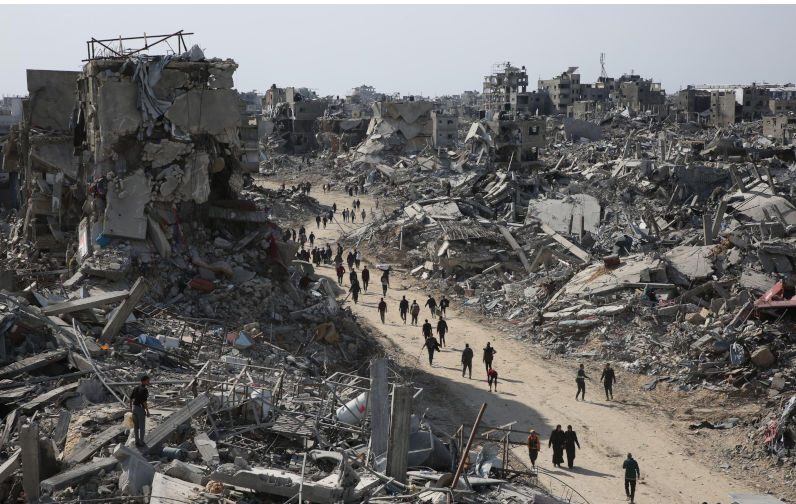
Plans to remake Gaza as an economic project ignore the deeper reality of land, memory and belonging, reducing historical peoples to statistics while denying the political rights and human dignity that cannot be displaced.
Within decision-making circles in Washington, there prevails an unspoken yet deeply rooted belief that real history begins only when settler-colonial interests and corporations intervene. For policymakers there, whether cloaked in liberal Democratic rhetoric or Republican pragmatism, the world is nothing more than a flat landscape of investment opportunities or security threats. This mindset, historically shaped upon the ruins of the idea of “land without an owner,” still perceives national borders as ending where the reach of weapons begins. It views geography not as a reservoir of human memory, but merely as a real estate asset that can be reshaped and repurposed according to the demands of the present moment.
This pattern of consciousness, which disregards the accumulated truths of history, explains repeated “American” failures to understand the will of peoples deeply rooted in their land. This historical ignorance becomes most visible when the US administration approaches the suffering of peoples, as in the Gaza Strip, with the mentality of a real estate developer. When leaders in the United States speak about transforming Gaza into “Dubai” or the “Riviera of the East,” they are not offering political solutions. They are practicing a form of visual arrogance that views the land as an empty plot ready for material investment. They ignore that the land they seek to “improve” is in fact filled with souls and stories.
The attempt to develop Gaza into an economic centre while ignoring the political rights of its people reflects a profound ignorance of the historical continuity of nations. The human being who confronts the machinery of war with a bare chest does not do so for a shopping centre or a glass tower. He dies for an olive tree planted by his grandfather hundreds of years ago, before the United States itself even emerged as a political entity on the map.
This is the existential cultural clash in which American initiatives repeatedly fail; the pragmatic westerner sees land as a means to prosperity, while deeply rooted peoples it as the purpose of existence and the ultimate embodiment of identity.
This blindness toward the “spirit of place” is not confined to foreign policy, but extends to the mentality managing domestic affairs within the United States today. There is a clear thread connecting projects of forced displacement in the Middle East with the deportation systems operated by the US Immigration and Customs Enforcement (ICE) agency.
In both cases, the statistical mindset reduces human beings to numbers on departure lists, or to surplus populations that must be removed to purify the space. The individual targeted for uprooting from his land in Palestine under the pretext of political realism is the same individual pursued in US cities because he does not possess the proper document granting him the right to exist there.
It is a state founded upon paper, believing that paper alone grants or withdraws legitimacy, while forgetting that belonging to the land predates constitutions and surpasses visas in depth. The US policymaker believes that all peoples think like the American citizen who moves from one state to another in search of better employment, and that the Palestinian or Iraqi can be persuaded with material incentives to abandon his homeland. They fail to comprehend that historical nations are not commodities to be traded in a global real estate market.
What is unfolding here is a fierce struggle between two opposing systems of legitimacy: one that derives its existence from bureaucratic accumulation and procedural recognition, and another that emerges from memory, land, religious sanctity, and the sacrifices of ancestors. It is a transnational colonial mindset in which American and Israeli perspectives converge, and whose applications today are reflected in the engineering of space and the exclusion of human beings through different mechanisms.
Within the United States, the principles of the contractual state appear in some of their harshest forms through the practices of ICE. The individual seeking safety and stability is reduced to ink on paper, while their humanity is transformed into nothing more than a case number in the corridors of cold courtrooms.
Migrants who have spent decades building communities and forging living connections to the land and the places they inhabit are pursued for one reason alone: they lack the “sacred document” that grants them the right to exist legally. This is a form of violent bureaucracy that possesses the power of uprooting with the stroke of a pen, sending thousands into detention centres and forced deportation proceedings, exposing a stark confrontation between the cold logic of paper sovereignty and the fundamental human right to exist and live.
The same scene is mirrored in occupied Palestine through an Israeli lens. There, the occupation relies not only on bombs but also on a highly complex system of military permits and colour coded identity cards designed to fragment geography and isolate human communities.
In the West Bank and occupied Jerusalem, this bureaucratic logic is translated into thousands of checkpoints that sever the arteries of daily life, along with repeated demolition orders that destroy homes and displace families under the pretext of lacking building permits. It also manifests in the confiscation of hundreds of thousands of dunums of land on the grounds of missing ownership documents that Israel demands while fully aware that such proof is often impossible to obtain, turning the law itself into an instrument of dispossession.
It is an ongoing process of bureaucratic eradication, carried out with calculated detachment, seeking to transform the deeply rooted native citizen into a temporary resident and the steadfast displaced person into someone denied entry. Laws, regulations, and paperwork are used as a smokescreen to conceal the material reality of separation, displacement, and the confinement imposed through checkpoints and barriers.
At its core, the United States is built on a modern contractual system based on constitutions and legal agreements, whereas Palestine, Iraq, Vietnam, and Iran represent deeply rooted historical nations that existed thousands of years before the emergence of the modern state. This fundamental difference explains the approach of settler colonial powers, which enter negotiations with predetermined outcomes, expecting peoples to relinquish their historical rights in exchange for promises of material prosperity.
However, experience has proven the failure of this approach, from the so-called Deal of the Century to broader cases such as Vietnam and Afghanistan, where advanced military technology cannot break the will of a person who draws resilience from a national memory that cannot be reduced or erased. While the modern soldier views the battlefield through digital screens and aerial imagery, he remains powerless before a barefoot fighter whose endurance is rooted in a legacy that cannot be reduced to digital coordinates.
In Gaza, despite decades of war and destruction, the Palestinian presence has persisted and remained deeply rooted, reflecting the failure of force to uproot people from their land. History also shows that attempts at displacement have not altered demographic reality but have instead reinforced the persistence of Palestinian existence, in contrast to a worldview that reduces human beings to statistics and numerical categories.
The statistical reality here is stark and deeply revealing of this colonial mindset. Over 78 years of displacement and intimidation attempts, the Palestinian population in the Gaza Strip rose from 200,000 in 1948 to 2.3 million in 2026. This is a survival reality that defies the understanding of an investor driven mentality. What the United States administration views as a demographic problem, the people of the land experience as daily resistance.
The roots of this way of thinking lie in the European colonial experience in the Americas, where land was treated as empty and violence against Indigenous peoples was justified under labels such as discovery and civilisation. From this foundation emerged a mindset that equates power with legitimacy and believes that history itself can be rewritten, a logic that continues to shape modern policies toward nations and peoples.
One of the tragic ironies is that a state no older than 250 years seeks to dictate how ancient nations should live. Cities such as Gaza, Baghdad, and Damascus have been inhabited for more than 4,000 years. How can a newly formed entity presume to grant itself the right to determine the fate of peoples who were writing poetry and establishing laws before this continent itself was even known? Whoever believes he can transcend the history of such civilisations reveals a historical immaturity and an ignorance of one of humanity’s greatest lessons.
Homelands are not merely empty spaces awaiting development, but living entities nourished by the blood of their people and the efforts of successive generations. Between the land and its people exists a metaphysical bond that cannot be measured by material standards.
As both the Palestinian who lived through the Nakba in 1948 and the child who survived the bombardment in 2026 say, “the land knows its people.” This mutual recognition between soil and human beings is the barrier upon which all displacement projects collapse, and against which every expansionist ambition of the coloniser or investor is shattered.
In the end, any attempt to forcibly transform Gaza or any historical homeland into a version of “Singapore” while ignoring political rights and national dignity reflects a profound intellectual failure. The Eastern human being does not sell his grandfather’s grave in exchange for a job title or economic privilege. Deep roots cannot be upended by bombs nor by political schemes concealed behind the slogans of security.
By insisting on ignoring the lessons of history, the United States places itself in confrontation with time itself, and time does not forgive those who fail to understand their place within it. Whoever does not recognise the value of history will remain without history, and will inevitably fall before the enduring power of peoples who believe that land is not for sale, and that belonging is not a contract that can be revoked, but a destiny lived and defended with life itself.

Refaat Ibrahim
Refaat Ibrahim is a Palestinian writer from Gaza and the founder of The Resistant Palestinian Pens ( https://resistantpens.org/ ). A graduate in English Language and Literature from the Islamic University, he writes about political, social, and cultural issues in Palestine. Through his work, he amplifies Palestinian voices under occupation, believing writing is a bridge between truth and people’s hearts and minds.