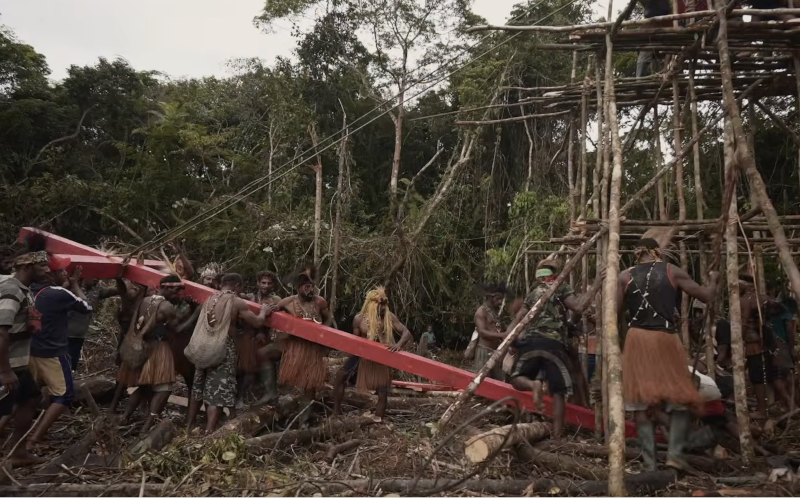
West Papua’s Indigenous communities are using hundreds of red crosses as symbols of resistance against rainforest destruction, land-grabbing and militarised development, as Indonesian authorities try to suppress a documentary exposing the damage.
The Indonesian Government is furiously trying to outlaw a local film on the massive destruction of West Papua rainforests by a mega-rich company with political links. The ban failed once a video was posted online. Now the police are chasing the directors for allegedly abusing participants’ privacy; military spooks may be driving the slur campaign.
Gerakan Salib Merah has a name like the global agency, but it’s not the International Red Cross most know and respect.
In West Papua, the Red Crosses Movement is hostile to the development policies of the Jakarta government, big business and the Indonesian military.
Powerful symbol
Hundreds of red crosses have become a sign of resistance. They’re usually about seven metres tall, red-painted hardwood crucifixes erected along jungle tracks to warn intruders to keep out.
Tragically, the trespassers pay little attention, driving their huge machines into the forests, smashing all ahead and behind.
Activist and filmmaker Dr Cypri Dale, a Swiss-educated Indonesian social anthropologist currently at the University of Wisconsin-Madison in the US, is the person the military in his homeland would be happy to see fall under crawler tracks.
They’ve been trying to shut down the film Pesta Babi (Pig Feast) about the impact widespread clearing is having on the local culture and the lives and livelihoods of the Indigenous Papuans – all Indonesian citizens with the same rights as people living in Jakarta.
Dale made the film with Indonesian journalist Dandhy Dwi Laksono, co-founder of the Jakarta-based documentary producer Watchdoc.
Common in most repressive societies is an awkward fact: banning a film ensures its promotion.
This is what’s happening with Pesta Babi, which has drawn hundreds of thousands of viewers since it premiered in New Zealand in March.
Earlier attempts at screenings in Indonesia were dashed by the army and police slamming hall doors, arguing that the film lacked official permits and would “provoke civil unrest against territorial integrity and social harmony.”
Also forbidden were notices of where the film might appear.
All a great waste of time and energy, as the video is now free to download.
Thousands are now aware of the exploitation of Papuan land, the loss of incomes and the destruction of forests and wildlife.
Early scenes are splashed with colour – the yellow cabs of scores of new excavators, lush jungle green, red paint on tree barks and the crosses – hauled upright through an ingenious system of pulleys and person power.
Dr Dale has written that the Red Crosses Movement “blends elements of custom, Christianity, and law to resist land-grabbing and deforestation carried out under the banner of Proyek Strategis Nasiona.” This is the campaign for food and energy production, targeting an area of 2.5 million hectares.
“At least 1,800 customary barricades and red crosses have been erected over the past few years,” said Dr Dale
“This is clearly a socio-religious movement with economic, political, and ecological dimensions. It aims to defend land and territory, identity, and the right to determine one’s own future.
“Eclectic in nature, the movement blends elements of tradition, religion (both indigenous and Christian), and law as the foundations of indigenous struggle.”
He quotes Hendrikus Frangky Woro, one of the leaders of the Red Crosses movement:
“God gave it to our ancestors and us to care for. We will protect it and pass it down to our children and grandchildren. We don’t want companies to take this land away.”
Powerful drivers
The biggest company involved in the destruction is the palm oil and agro-forestry conglomerate Jhonlin Agro Raya. It produces biodiesel, which the government hopes will supplant imported fossil fuels.
The business is owned by South Kalimantan entrepreneur Andi Syamsuddin Arsyad, 49, aka Haji Isam (Haji is a title for a Muslim who has prayed at Mecca). He’s been dubbed “the new poster boy for Indonesia’s oligarchy”.
One of a family of 14 kids from two wives, Haji Isam claimed no tertiary education; he worked as a timber truckie before opening coal mines exporting to China.
Also known as “crazy rich”, he was reportedly one of Prabowo’s major 2024 presidential election financiers, donating more than US$ 130 million.
Prabowo has since given Jhonlin the job of starting a one-million-hectare “food estate” rice project in West Papua – hence the clearing.
Soldiers defending commerce
Pesta Babi shows hundreds of Indonesian troops, mainly from Java, being imported to suppress the Indigenous freedom movement and protect the invaders. In one take, an armed soldier rides the roof of an excavator as it trundles through the jungle.
Then came a road block; Yasinta Moowend, aka Mama Sinta, one of the women featured in the film, officially complained that she’d never permitted her appearance in the 95-minute doco. The cops swooped; they’re probing still.
She’s been pictured with a lawyer allegedly associated with Prabowo’s Gerindra (Great Indonesia Movement Party). Her opposition came weeks after the film was released.
Dandhy told journalists he was “disappointed” with Sinta’s complaint, worried it would “distract attention from the real substance of the problems” raised in the film.
“We hope for public support and attention to the issues, as we continue to show solidarity in efforts to resolve this significant problem in Papua.”
He said he suspects “interested parties” are influencing Sinta’s complaint. “The only thing that seems clear is the strategy to gradually make us lose focus on the issue of colonialism.”
The BBC has been monitoring Sinta’s movements in Jakarta. It reported that she’s suspected of having “digital footprints and shady ties to the State Intelligence Agency.”
The western part of the island of New Guinea was colonised by the Dutch in the late 19th century. It was taken over by Indonesia in 1969 after 1,026 hand-picked “representatives” unanimously voted to be run by Jakarta.
Papua Barat has now been sliced into six provinces.
Apart from its botanical wealth, the region has the largest gold mine and the third largest copper mine in the world.
An estimated 2.5 million indigenous people across 300 tribes live in the provinces. They are ethnically and culturally Melanesian. The largest ethnic group in the Republic is Javanese, who mostly follow Islam.
About 95 per cent of Indigenous Papuans are Christian.
Fighting between the poorly armed guerrilla group Organisasi Papua Merdeka (Freedom) and the well-equipped Indonesian military flares regularly.
According to the OPM, apart from burning homes and hounding people from their land, the Indonesian army is allegedly murdering, raping, torturing locals, and using chemical weapons – all charges rejected by Jakarta.
Western journos are banned.
Each denial that makes the news helps spread the news about our neighbour.

Duncan Graham has been a journalist for more than 40 years in print, radio and TV. He is the author of People Next Door (UWA Press). He is now writing for the English language media in Indonesia from within Indonesia.
Duncan Graham has an MPhil degree, a Walkley Award, two Human Rights Commission awards and other prizes for his radio, TV and print journalism in Australia. He lives in East Java.