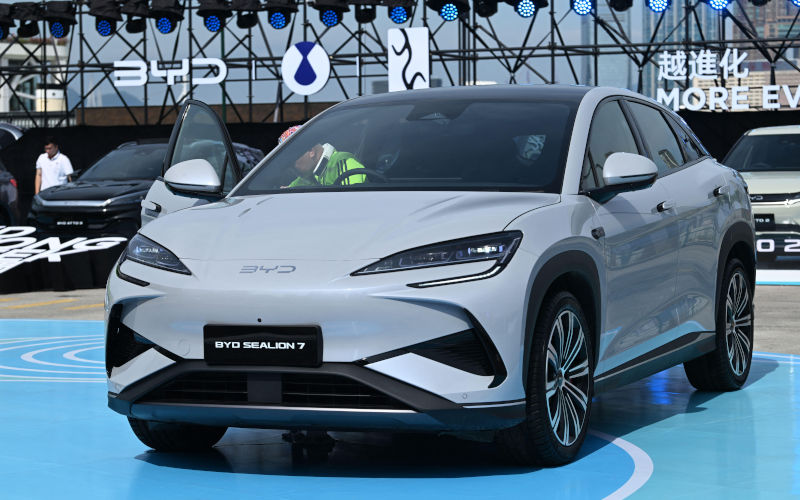
Electric vehicles will not save the planet on their own but anti-EV rhetoric conveniently ignores the problems caused by petrol and diesel vehicles.
A recent article in The Australian warns that electric vehicles may ‘feel right for the wealthy’ but will ‘destroy our planet’. The script is familiar: EVs require minerals; their interiors contain plastic; some manufacturing uses coal-fired electricity; China makes many of them; Pauline Hanson mentioned it. Case closed. It manages to sound environmentally concerned, while showing little interest in environmental comparison.
Let us start with the part that is true.
Electric vehicles are not magic. They do not float out of a eucalyptus forest after being assembled by morally pure koalas. They require mining, factories, shipping, tyres, batteries and electricity. Some mineral supply chains are environmentally damaging. Indonesia’s nickel industry, cobalt mining in the Congo, lithium extraction in dry regions and the broader politics of critical minerals deserve scrutiny.
But this is where the useful discussion ends and the performance begins. The problem is not that the article mentions the environmental cost of EVs. The problem is that it treats those costs as if they exist in isolation, while petrol and diesel vehicles apparently arrive from a more innocent universe, perhaps grown organically behind a regional servo.
Oil does not appear as an industry. It appears only as absence. There is no comparable tour through offshore drilling, oil spills, refinery pollution, tanker routes, fracking, fuel security vulnerabilities or the daily combustion of imported liquid fuel. We are invited to stare very hard at a lithium mine, while pretending the oil well behind us is a decorative fountain.
Is this analysis, or selective lighting?
The core difference is simple. EVs have a large upfront material cost. Petrol and diesel vehicles have a continuing fuel dependency. The minerals in an EV battery are embodied in the vehicle. They can degrade, be reused, recycled or eventually recovered. Petrol is burned – gone – and then replaced by more petrol, which must be extracted, refined, shipped, sold and burned again.
One system has a materials problem that must be governed. The other has a combustion problem by design.
The article cites the International Energy Agency’s finding that EVs require more minerals than conventional cars. Fair enough. But citing the IEA on minerals, while ignoring its broader conclusion on lifecycle emissions, is like quoting a doctor on the side effects of surgery, while skipping the part about the tumour.
Then there is the claim that, in a future EV world, batteries would be updated ‘every few years’. A classic bedtime story for people who find battery chemistry frightening. Modern EV batteries are designed to last far beyond a few years, often into the range of a normal vehicle life. But that lacks the necessary smell of apocalypse. So we get the apocalypse instead.
The article asks readers to imagine two billion vehicles being replaced by EVs, as if global transport decarbonisation means taking every existing private vehicle, preserving the same car-dependent urban model, adding a plug and calling it civilisation. This is a useful fantasy because it makes the transition look stupid.
In reality, serious transport policy is not built around one-for-one replacement of every combustion vehicle with a giant battery SUV. It includes public transport, smaller vehicles, freight efficiency, urban planning, cycling, shared mobility and electrified buses. First one has to describe it honestly.
There is also a neat temporal trick. Climate models projecting future damage are dismissed as imaginary doomsday thinking. But the article’s own projection of an EV mining catastrophe decades into the future is treated as sober realism. Apparently the future is unknowable when scientists model emissions, but perfectly visible when the article imagines Chinese nickel mines eating the Earth.
The politics becomes clearer when the article moves from rainforests to Chinese EV market share and alleged kill-switch fears. One moment we are meant to care about poor nations. The next, we are back in the theatre of national security panic. The rainforest has served its purpose. It has delivered the reader safely to Beijing.
There is a serious conversation to be had about connected vehicles, data governance and cybersecurity, especially when companies operate under different legal and political systems. But those questions deserve a technology-neutral regulatory framework, not a sudden outbreak of national security concern that appears only when the badge is Chinese.
That is not technology regulation. It is political reflex.
The same applies to subsidies. EV subsidies can be poorly designed: they can benefit wealthier households. Road user charges will become necessary as fuel excise declines. Large electric SUVs should not be treated as environmental saints simply because they have no exhaust pipe. These are legitimate policy questions. They do not prove that EVs are worse than petrol cars. They prove that policy should be smarter.
A mature argument would say this: EVs are not enough. They must be smaller, cleaner, more recyclable and powered by a cleaner grid. Critical minerals must face environmental and human rights rules. Public transport should improve. Petrol dependence should be treated as the strategic vulnerability it is. But that would require treating the transition as a governance challenge rather than a morality play.
The anti-EV genre prefers something simpler. It takes a real problem, removes context, adds China, sprinkles in class resentment, waves at Hanson and announces that the old technology was the environmental choice all along.
Very neat. Very weird.
Electric vehicles will not save the planet on their own. No serious person believes they will. But they are part of a broader transition away from a transport system that burns fossil fuel every kilometre and then calls itself practical – even as every flare-up in the Middle East reminds us how imported fuel can expose our economic and national security vulnerabilities.
The article is right about one thing, though. Carbon dioxide is not the only thing worth conserving. So are evidence, proportion and serious analysis. Some of the louder corners of our media may wish to check the supply chains of their own arguments.

Fred Zhang
Fred Zhang has worked across major, community, and industry media outlets in Australia for a decade. He has a keen interest in multicultural communications and strategic public engagement.