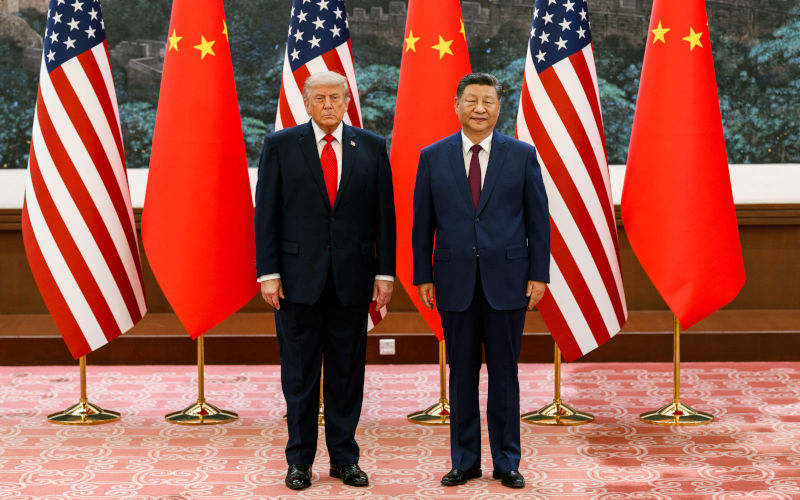
As Washington and Beijing reshape the Indo-Pacific order through direct negotiation, Australia risks remaining strategically reactive instead of positioning itself as a trusted diplomatic bridge between the two powers.
Trump just left Beijing. The pretalk happened in Seoul. Australia watched from the couch. Again.
Last week, US Treasury Secretary Scott Bessent and Chinese Vice Premier He Lifeng met in the VIP lounge of Incheon International Airport to finalise the agenda for the Trump-Xi summit. Seoul was chosen as neutral ground: equidistant enough from the battlefield, credible enough to both sides, with an airport lounge big enough for history to happen quietly.
Australia wasn’t in the room. Wasn’t near the room. Wasn’t in the building.
This keeps happening. And it keeps costing us.
Australian foreign policy has long prided itself on being rational. Sometimes transactional. What it has mostly been, if we’re being honest, is reactional.
When tariffs were slapped on our barley and wine, the previous government didn’t de-escalate, instead it performed outrage and waited. When the relationship with China froze, it seemed to regard the ice as a feature rather than a problem. When it finally thawed, it was because a new government chose consistency over chest-beating, and our patient diplomats quietly did the work the headlines never covered.
That thaw was earned. It deserves to be built upon. But the structural problem remains. For too long, Australia has calibrated every statement against the morning’s threat assessment, waiting for our sheriff’s signal, waiting for our largest trade partner’s next move. When the two diverged spectacularly between 2020 and 2023, we wore the damage.
Nobody asked our permission. Nobody offered compensation.
The Trump-Xi summit last week is a reminder that the world’s two largest economies are negotiating the shape of the next decade without us. We were not at the table. We were not asked.
Seoul was chosen for specific reasons: geographically neutral, logistically sophisticated, politically credible to both parties – and carrying none of the hot-button associations that activate the grievance machinery on either side.
No Taiwan Strait. No South China Sea. No wartime history lurking, ready to derail the communiqué before lunch.
Australia has all of those qualities. And several Seoul doesn’t.
The flight time from Washington to Sydney is comparable to Washington to Seoul. The time zone gap between Beijing and Sydney is smaller than it looks on a map. Both sides land tired, but equally tired, which is a great diplomatic equaliser. More importantly, Australia sits entirely outside the region’s active fault lines. The Korean Peninsula carries North Korea and seventy years of armistice. Japan carries history neither Beijing nor Washington can fully manage. Singapore is embedded in Southeast Asian dynamics that bleed into every conversation held there.
Australia is, in the most useful diplomatic sense, a clean slate. Far enough from the front lines to be calm. Close enough to the Indo-Pacific to be relevant.
Some will point to AUKUS. It is worth being clear-eyed about what AUKUS actually represents in strategic terms. A handful of submarines, arriving decades from now, contributing negligibly to any realistic military balance against what will likely be the world’s largest navy by then – this is not what keeps Beijing’s strategic planners awake at night.
The case for hosting is not merely idealistic. If we take another look, it is self-interested.
A country that hosts the dialogue table is considerably harder to punish than one that watches from the sidelines. The barley and wine episode was a lesson in how quickly economic leverage can be devastating when a bilateral relationship has no structural architecture beneath it: nothing to absorb the shock, no institutionalised channel to de-escalate through. A recurring trilateral mechanism changes that calculus entirely.
And where leaders go, opportunities follow. Both delegations could arrive with business communities in tow – investors, trade representatives, deal-makers who take their cues from the temperature in the room. A summit hosted in Sydney or Melbourne is not just a diplomatic event. It is a trade fair with better security and more interesting canapés. The economic spillover alone, in investment signals, in contracts initiated, in relationships begun over a meal, would be measurable.
There is also the question of strategic relevance. A Canberra that hosts great-power dialogue earns its place in the Indo-Pacific’s architecture, not as an American forward base or a Chinese trading partner, but as a node in its own right. That is a more durable form of security than any defence treaty alone can provide. And it is an insurance policy for Australian farmers, exporters, and businesses who have repeatedly absorbed the costs of great-power friction they did nothing to cause.
Windows close. Once Seoul or Singapore establishes itself as the venue of choice for this kind of dialogue, diplomatic inertia takes over. Venues become habits. Australia doesn’t get a third invitation.
Across the political spectrum, experienced voices have argued consistently that a middle power with deep economic ties to China and deep security ties to the United States has a specific role in keeping those two forces from colliding. Not cheerleader. Not adjudicator. Bridge-builder. What has been missing is not the argument, it has been made, repeatedly, and well. What has been missing is the ambition to act on it.
This political window is narrow. A government with credibility in both Beijing and Washington is a rare thing. It exists now and for now, which is exactly why now is the moment to give our diplomats something worthy of what they have rebuilt.
The next step is to convert a repaired bilateral into something more durable: a stable trilateral framework, a recurring summit, a barbecue that happens every few years with enough consistency to become an institution rather than an event.
None of this requires a White Paper. It requires intention, followed by quiet diplomacy in both directions: making the case to Washington that a country straddling the Western alliance and the Asian economic order is an asset, not a liability; and making the case to Beijing that a venue far from every territorial dispute that loads diplomatic interaction with implicit threat is worth something to both parties.
The most important diplomatic photograph of the next decade could be taken here: in a garden somewhere between Sydney Harbour and the Blue Mountains, with three leaders eating something grilled and no one shouting about anything.
Unrealistic? Before February 1972, so was the idea of Richard Nixon shaking hands with Mao Zedong in Beijing.
History is full of ideas that sounded unrealistic until someone, somewhere, actually hosted the meeting anyway.
We’ve been reactional long enough.
It might be time to host.

Fred Zhang
Fred Zhang has worked across major, community, and industry media outlets in Australia for a decade. He has a keen interest in multicultural communications and strategic public engagement.