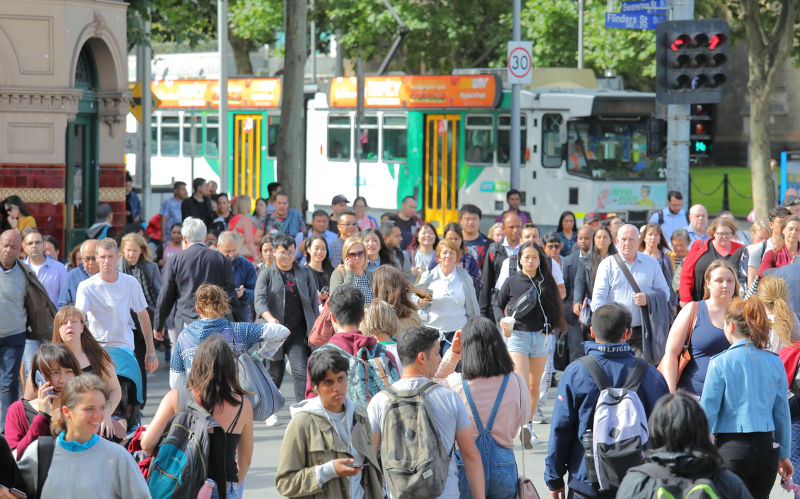
Every Australian family was once the newcomer; some arrived generations ago, others arrived last week. Yet, every generation seems to forget that fact just in time to fear the next one.
What if we stopped seeing people as migrants, refugees, asylum seekers or foreigners and started seeing them as newcomers – people beginning the same journey our own ancestors once began?
It’s such a simple shift in language, but I think it changes everything.
‘Migrant’ and ‘refugee’ are administrative categories that define how someone arrived. ‘Newcomer’ defines where they’re going. It places the emphasis on the future rather than the past and invites us to see possibility rather than difference.
Modern Australia has been shaped by successive generations of newcomers. Every wave, whether from Italy, Greece, Vietnam, Lebanon, Sudan, Afghanistan, Syria, Gaza, China, India or elsewhere, has at some point been viewed with suspicion by part of the population. There were warnings that they ‘wouldn’t fit in’, that they would have different values, take our jobs, strain our housing and change our way of life.
Over time, those communities became woven into the national fabric, enriching Australia economically, culturally and socially. They opened businesses, raised families, created jobs, paid taxes, volunteered, cared for their (and our) ageing parents and introduced foods that are now part of everyday Australian life. Australia has never been culturally static; it has continually been enriched by the people who chose to build their lives here.
The Vietnamese story is one of the most powerful examples because it challenges so many stereotypes. After the fall of Saigon, thousands arrived as refugees, many having lost everything. Some came with little English, few resources and no certainty about what their future might hold. They carried memories of war, displacement and loss.
Within a generation, Vietnamese Australians had built businesses, entered professions, become academics, teachers, doctors, public servants, artists and respected community leaders.
I saw this firsthand while working alongside South Vietnamese colleagues. They were among the most hardworking, diligent and intelligent people I have known. They carried themselves with quiet determination, embraced other cultures within their organisations and placed enormous value on education, family, responsibility and community. They didn’t simply build new lives in Australia; they helped build Australia itself.
Whenever I hear people say multiculturalism has failed, or that Australia should become a monoculture, I think about those colleagues and the countless contributions made by people who arrived here seeking safety, opportunity or simply a better future for their children.
Of course, multiculturalism isn’t perfect, but then no society is. There will always be challenges in building cohesion, strengthening shared values and creating opportunities for people from different backgrounds to learn from one another. There’s always room for greater understanding and stronger connections. However, there’s a profound difference between building cohesion and demanding sameness.
If monoculture means a shared commitment to fairness, respect, democracy, equality before the law, compassion and mutual responsibility, then I’m completely in favour of it. Those are values worth protecting. Compassion isn’t weakness. Responsibility isn’t a burden.
If monoculture means forgetting your language, your heritage, your traditions and your individuality, that’s not unity. That’s conformity.
Recently, I completed a DNA test through Ancestry.com. Like many people, I expected it to reveal a neat and tidy story about where I came from. Instead, it revealed something far more interesting. My ancestry stretched across countries, regions and continents. What I discovered wasn’t a single origin story but a map of movement – a story of people leaving, arriving, adapting, surviving and beginning again.
The experience left me wondering: who among us is really monocultural? Almost everyone, if they go back far enough, descends from movement, migration, displacement, trade, marriage, exploration or diaspora. Human history is, above all else, a history of movement. Borders change, languages evolve and identities shift, but movement itself is one of humanity’s oldest stories.
The idea of cultural purity begins to look rather fragile when viewed through the lens of history. The more we examine our ‘collective’ past, the more we discover that movement is not the exception but the rule. Perhaps that’s why the word newcomer feels so important. It reveals to us that every family story starts somewhere else. Some of those journeys happened generations ago and have been softened by time, while others are unfolding right now.
When we look at people fleeing war, persecution and violence, difficult questions inevitably arise. What obligations do stable and prosperous countries owe those seeking safety? How do they treat people who are trying to belong?
These aren’t simple questions, but they are worth asking because they challenge us to think about who we are, not just as individuals, but as a country.
Australia is one of the world’s most multicultural countries and its story is still being written. Every newcomer adds another chapter and every generation must decide whether it will close the door a little tighter or open it a little wider than it found it.
The next time someone asks us, “Who belongs here?”, perhaps we could all answer with this:
If our DNA tells a story of movement, migration and shared humanity stretching back through countless generations, if our family trees are filled with departures, arrivals and new beginnings, then who among us wasn’t once a newcomer?
Meg Schwarz
Meg Schwarz holds a Postgraduate Diploma in Counselling and Psychotherapy and brings over 35 years of experience championing social justice, advocacy and consumer engagement. Based in South Australia, Meg has dedicated her career to working alongside diverse communities, including refugees, people with disabilities and individuals with complex trauma backgrounds.With a strong passion for equality and human rights, Meg specialises in fostering meaningful communication, empowering voices through advocacy and creating inclusive spaces for dialogue. Her skills in stakeholder engagement, strategic communication and community development have earned her recognition as a trusted and compassionate leader in her field.