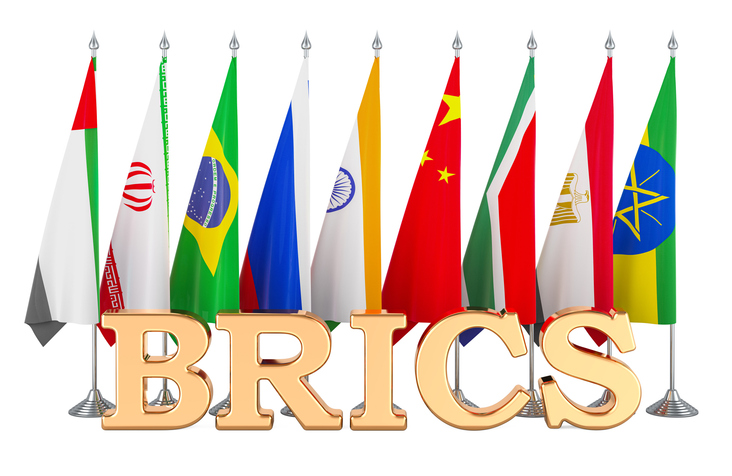
The world’s economic centre of gravity is moving from the Atlantic toward Asia. This reflects the rise of China and India and the dynamism of the BRICS.
The international economic and monetary system is in a period of profound turbulence and structural uncertainty. Chinese analysts describe the present moment as da bian ju – a “great upheaval” – which captures the sense that long‑standing assumptions about global order no longer hold.
For much of the post-Cold War era, scholars, mainly Western, characterised the system as unipolar, anchored by US hegemony and a liberal institutional architecture centred on open markets, multilateral governance and Western leadership. Yet over the past two decades, this order has been increasingly contested, subtly of course, reflecting the power in quiet efficiency over bellicose populism. Economic power has shifted toward Asia and the wider Global South, confidence in Western‑led institutions has eroded, and new coalitions have emerged seeking to reshape the distribution of influence in global governance.
The BRICS group of countries, initially Brazil, Russia, India, China and South Africa, but now with several more, have long-held grievances about western dominance – some consider arrogance – in global governance. They have a collective desire for greater representation in international institutions: an understandable quest if economic power, trade domination and population shares are considered adequate credentials.
Exasperated by the exclusionary practices of the West, in 2023, Xi Jinping, President of the People’s Republic of China, during a rare moment of disclosure, said rather than BRICS members being concerned with issues of democracy versus autocracy, as is the case for the west, they were interested more in development, poverty, food, energy, health, climate change and peace. The subtlety of this warning was, as usual, lost among the liberal-democratic powers, and so, BRICS continued its strategy of creating alternatives to the institutions created at Bretton Woods in 1944.
Through the BRICS New Development Bank (NDB) members pursued developments in Africa, South America, the Middle East and elsewhere, They offered unconditional loans, unlike the World Bank, that focussed on new, green infrastructure options that would provide benefits to the people into the future.
BRICS began using alternative currency arrangements in cross-border trading arrangements instead of paying gatekeeper fees to the US treasury. Brazil and China signed a currency swap agreement in 2013, allowing for direct exchanges between the Brazilian real and the Chinese yuan that did not rely on the US dollar as an intermediary currency. Similarly, Russia and China established closer monetary arrangements and now conduct more than 99 per cent of their bilateral trade using either the ruble or the yuan. The two countries are working to link their banking systems, including enabling direct central bank-to-central bank transfers.
In response to these initiatives, the US President threatened to impose 100 per cent tariffs on countries using alternatives to the US dollar. The New York Times recently reported that the Trump administration, concerned for the ‘safety of the US dollar as the world’s reserve currency’ is considering the use of ‘swap lines’ or currency swaps, where it offers an ally the opportunity to purchase US dollars in exchange for the ally country’s currency. Ostensibly, this would ameliorate any need for the ally country to conduct business with another country in an alternative currency.
While BRICS has expanded its financial interests in the Global South through its NDB, it has also pursued cultural and education initiatives throughout Asia. For example, the annual BRICS Sport Games sees thousands of athletes from member countries gather for almost two weeks of competition. And a five-day BRICS Film Festival presents films from a dozen member and partner states. The BRICS Network University, which recently celebrated its 10th anniversary, is a collaborative initiative that brings together leading higher education institutions from the wider membership and provides a multilateral academic platform to foster inclusive, innovative, and sustainable development. All are intended to display alternatives to the West’s primarily-US-saturated, media, cultural and educational activities.
At the economic level, BRICS countries, driven largely by China and India, have achieved, from a very low base, so far in the 21st century 14 per cent growth in GDP terms, while the EU and the US have sustained declines. Of special note is the outstanding growth in merchandise exports, where the BRICS overall increased its global share in the period 2000–2025 by around 900 per cent, driven largely by China’s dominant manufacturing exports. These economic results, combined with an upward trend from the mid-1980s, confirm that the global economic centre of gravity has shifted steadily eastward over the past 40 years, moving from the Atlantic toward Asia. This reflects the rise of China and India and the broader economic dynamism of the Global South.
There has also been a change in how people feel about their lives. Analyses of various international indicators, such as the UN’s Human Development Index, the Social Progress Indicator and the Global Peace Index, all point to another shift, an upward trajectory in wellbeing of the citizens of many BRICS countries and a decline in the same metrics in western states. China and India achieved the fastest human development improvements as seen in the very high wealth-to-social progress correlation. In contrast, the US has experienced a noticeable fall in social performance this century: while it maintains the highest incomes per capita, this is quickly gobbled up by the costs of healthcare due to the limited state supply, and the need for domestic security measures to cope with an increasingly violent society.
So, BRICS nations are not only rapidly closing the economic gap but also the living standards gap. China is among the safest societies in the world.
Looking ahead ten years to 2036, the trajectories from the World Bank, PwC and others, reveal a world where the global economy will have shifted completely away from a Western-centric framework. The BRICS bloc is projected to command nearly 40 per cent of global GDP, while China will firmly hold the #1 global position, with its GDP share around 20 per cent. The US and EU’s economies will continue to decline, with their share of global GDP (currently 37 per cent), projected to fall appreciably.
In ten years, the population gap between India and China is expected to become a significant economic divide, with India’s population peaking near 1.55 billion, which will include a substantial young working-age demographic. This will elevate India’s economic position and cement its spot as the fastest-growing large economy. China’s population decline, referred to as its “demographic cliff”, will see it contract to about 1.35 billion but, more importantly, its working-age population will shrink rapidly, perhaps forcing its historic growth model to further pivot toward automation, AI, and robotics. The EU will face systemic fiscal strain from an ageing demographic, and the US will grow slowly reaching 365 million, almost entirely from immigration needed to stabilise its labour pool.
As China’s GDP growth moderates, its rapid gains in human development will plateau, turning the focus from poverty alleviation to the massive economic burden of elderly care. India’s primary battle in 2036 is likely to be its inequality – if wealth remains concentrated, its overall human development gains will be heavily depleted. Should the US continue its negative social progress trajectory, even with an estimated GDP per capita exceeding $110,000 in 2036, the daily quality of life, public safety and healthcare access for average Americans could continue to worsen and detract from its wealth index.
The recent economic, population and human wellbeing data and forecasting trajectories all point to a shifting global order where BRICS may not yet have buried western dominance but is already writing the epitaph.

Peter Day
Peter Day is a third-age Australian, educated at Flinders University of South Australia with an extensive working history in public and private sectors, and a long interest in foreign affairs, politics, ethics, economics, and public policy, He is concerned about unaccountable, unrepresentative governments, media bias and declining quality of life.