Australia can use low-cost Chinese clean-energy technology to accelerate decarbonisation, strengthen energy security and build domestic industry without pursuing costly self-sufficiency.
Australia is widely seen as facing what we call a ‘clean-energy trilemma’. It wants rapid and affordable decarbonisation, secure and resilient clean-energy supply, and domestic industrial development and value capture.
The conventional argument is that Australia can’t have all three.
Cheap Chinese solar panels, batteries and electric vehicles can accelerate decarbonisation but weaken local manufacturing and create strategic dependence. Reducing this dependence, however, would make the transition more expensive and require substantial public subsidies.
But this apparent trilemma rests on two questionable assumptions: that reliance on imported clean technology resembles reliance on imported fossil fuels; and that Australia must manufacture renewable energy equipment itself to capture substantial value from the energy transition.
Australia must urgently challenge these assumptions. If we don’t, Australia risks missing the substantial national-security benefits available through strategic engagement with China on the energy transition.
Australia’s dependence on imported petroleum means that fuel flows must be replenished continuously. A disruption can therefore quickly affect transport and economic activity.
Clean-energy equipment and products are different. Solar panels, batteries and electric vehicles are durable capital goods. Once a Chinese-made panel is installed on an Australian roof, it can generate electricity here for decades. A battery becomes part of Australia’s energy-storage capacity. An electric vehicle reduces its owner’s continuing exposure to imported petrol. As others have put it, treating dependence on imported clean-energy products as equivalent to dependence on imported fossil fuels risks confusing ‘renting’ with ‘owning’: fossil fuels are flows that must continually be replenished, whereas clean-energy products become productive assets once installed.
That does not mean there are no risks. A prolonged disruption of trade with China could delay new projects or make replacement components more expensive. Cybersecurity risks associated with connected energy equipment also require serious attention.
But these risks are different from, and generally less immediate than, dependence on a continuously imported fuel.
There are also reasons to doubt that China could easily restrict clean-technology exports for strategic purposes. Chinese manufacturers depend heavily on international markets. Restricting exports would damage firms already experiencing excess capacity and weak profitability, while encouraging customers to develop alternative suppliers.
Australia should manage this risk, but not exaggerate it.
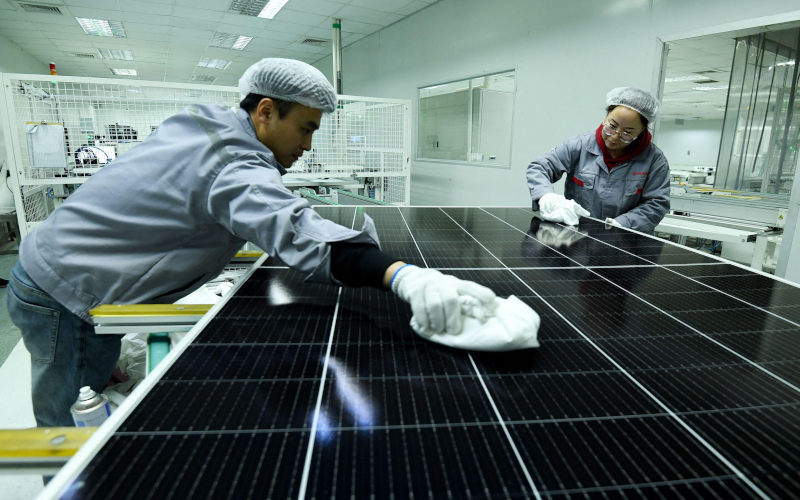
Chinese clean-technology products are exceptionally cheap today. China’s own regulators are trying to restrain what they call ‘involution-style’ competition. In solar manufacturing, rapid expansion and fierce price wars have pushed prices below sustainable levels, with even leading manufacturers reporting heavy losses.
China’s clean-tech dominance is not due solely to subsidies. It also reflects technological learning, enormous economies of scale, integrated industrial clusters and intense domestic competition.
For Australia, the key question is not whether China has ‘overcapacity’ in some abstract sense. It is how to use today’s low prices while managing the risks of dependence on one dominant supplier.
Australian households and businesses already benefit enormously from affordable Chinese solar panels and batteries. These technologies reduce electricity bills and Australia’s exposure to global fossil-fuel shocks, including those intensified by America’s war with Iran. But today’s unusually low prices may not last as China consolidates production and restores profitability.
Australia should seize this moment and turn today’s price advantage into durable local productive capacity.
Taking advantage of inexpensive imports does not mean abandoning Australia’s own ambitions for transforming and strengthening its domestic industries. Enhancing Australia’s local manufacturing capabilities can contribute to energy security, technological capability, and economic advancement. But support for local manufacturing should be strategic rather than indiscriminate. Australia should not assume that manufacturing more clean-energy components locally is always the best – or only – way to capture value from the energy transition.
Solar panels and batteries create wider economic ecosystems around them. Considerable value can be generated through project development, installation, financing, grid integration, maintenance, energy-management software, virtual power plants, recycling, and the productive use of inexpensive renewable electricity.
Australia should therefore judge industrial policy by how much Australian value each imported panel, battery or EV enables, not simply by the proportion of Australian content inside the product.
The same principle extends to mineral processing, green metals and other energy-intensive industries. When China’s industrial investment, scale and competition drive down the cost of renewable energy equipment, they drive down the cost of producing green energy in Australia. This can help reduce production costs for Australia’s energy industries and make them globally competitive.
Capturing more value from the clean-energy transition also requires Australia to think strategically about the assets it brings to the relationship.
As one of us argues in a recent book, energy resources and capabilities can become sources of international political influence and underpin energy statecraft.
Australia possesses critical minerals, exceptional renewable resources, technological expertise, reliable institutions and an attractive market. China possesses formidable clean-technology manufacturing capabilities.
Australia’s challenge is to combine these complementary strengths in ways that create shared value while allowing Australia to capture more of the value domestically.
The solar supply chain shows how. Australia does not need to recreate China’s enormous manufacturing ecosystem. It can benefit from inexpensive Chinese modules while strategically developing capabilities where it has genuine advantages. Green polysilicon is one promising opportunity. CSIRO’s and ARENA-backed studies identify Australia’s renewable-energy resources and mineral endowment as a potential advantage in polysilicon manufacturing. Cheap imported solar equipment could help build the renewable-energy capacity needed to support low-emissions polysilicon production for domestic and export markets. There is also a case for retaining some domestic solar manufacturing capability more broadly – not to pursue self-sufficiency, but to maintain a strategic reserve and support technological learning.
Australia can also use access to its market, investment opportunities and critical resources to encourage foreign firms to contribute to domestic capability and resilience. Government procurement, consumer incentives and access to major projects could therefore be made conditional on commitments to maintain spare parts and service capacity in Australia, train local workers, meet cybersecurity and interoperability standards, and participate in research, recycling or commercially viable local production.
Such targeted requirements would strengthen resilience more effectively than general local-content rules that raise equipment costs without necessarily addressing critical vulnerabilities.
The same principle extends to Chinese investment, technology and demand. Green iron is one example. Chinese capital, technology and demand could help Australia capture substantially more value from its iron ore, potentially contributing to a broader ‘great rebalancing‘ in the economic relationship. But projects should not become dependent on a single overseas buyer or vulnerable to a deterioration in the bilateral relationship.
Institutional design can help. A Clean Commodities Trading Initiative (CCTI), for example, could use government-backed long-term offtake to help green iron projects reach financial close, while creating scope for output to be sold across a diversified range of domestic and international markets. If demand from China were disrupted, this could provide a buffer and time to redirect supply elsewhere.
The aim is not to reduce trade and investment with China, but to make deeper economic engagement more resilient. The choice is not between passive dependence and manufacturing everything at home. Australia can use China’s low-cost hardware to accelerate its transition, convert imported equipment into resilient domestic energy capacity, and turn cheap clean energy into a competitive advantage for Australian industry and exports.

Hao Tan
Hao Tan is a professor of management at the University of Nottingham Ningbo China. Prior to this, he spent two decades in academic roles at Australian universities. His research focuses on China’s energy transition and its global implications from management and policy perspectives. He is the author of China’s International Energy Relations: The Impact of Transition from Fossil Fuels to Renewables (Cambridge University Press 2025). He is also a co-founder of the Green Energy Statecraft Project and co-author of Green Energy Statecraft for Comprehensive National Security (AP4D / Harvard Kennedy School 2024) and Developmental Environmentalism: State Ambition and Creative Destruction in East Asia’s Green Energy Transition (Oxford University Press 2023).

Elizabeth Thurbon
Elizabeth Thurbon is Professor of International Political Economy, Deputy Head of School and Director of Research in the School of Social Sciences at UNSW Sydney. She is also Director of the Green Energy Statecraft Project, a collaborative initiative between UNSW Sydney, the University of Melbourne and the University of Sydney.