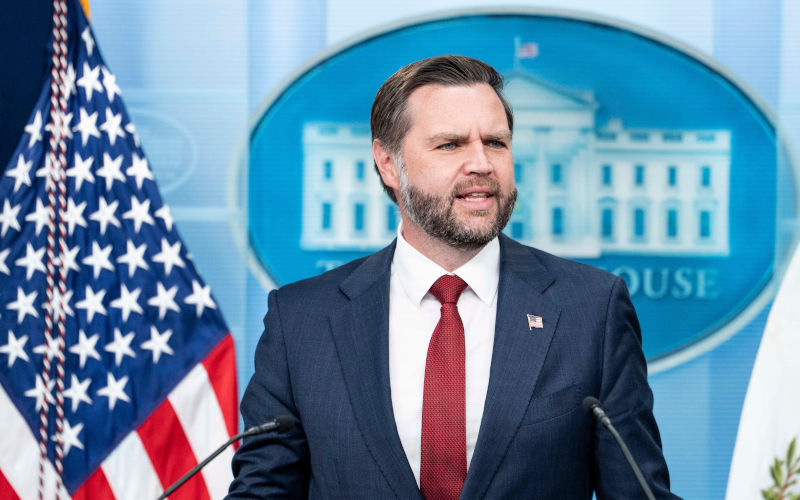
JD Vance’s increasingly apocalyptic religious rhetoric, and his relationship with billionaire Peter Thiel, raise questions about the theology shaping the US Vice-President’s politics and his growing distance from Vatican teaching.
For a time during the early days of the Trump presidency, as Trump was showing his colours, a few people (including the author) had the thought that if Trump died or became totally demented, JD Vance would then take over and bring some sanity to the administration.
History since then has demonstrated just how wrong that view was.
Forward, the US progressive Jewish newspaper, recently exposed many of Vance’s most extreme and ridiculous moments in an article by Mira Fox.
Perhaps the most ridiculous Vance intervention in public debate was his comment that Pope Leo XIV should be careful when he talks about theology. This was in response to the Pope’s comments about the Iran war: “I think it is very, very important for the Pope to be careful when he talks about theology. You’ve got to make sure it’s anchored in truth and that’s one of the things I try to do and it’s certainly something I would expect from the clergy,” Vance said.
Vance is a recent convert from a childhood in an evangelical household where he read the Bible daily and was a regular watcher of the televangelist Billy Graham’s programmes.
However, today what is really alarming and ridiculous is his own commentary on theology.
Forward reports that he told the Christian YouTube Brice Crawford Podcast that “he would not be shocked if the anti-Christ was walking among us”. Apparently, he didn’t mean Donald Trump, although many might think that.
There is a skerrick of justification for Vance’s view, as Catholicism does discuss the idea of a Second Coming, although it seems less apocalyptic than some other groups’ beliefs.
Forward said: “Numerous Catholics online reacted to Vance’s statements with confusion and frustration, saying ideas about the apocalypse are not central parts of Catholicism.”
Vance is also under the influence of the billionaire Palantir founder, Peter Thiel, who is obsessed with the anti-Christ and delivered a series of speeches at several Catholic institutions on the subject. They were not well received by the Catholic authorities.
Thiel has also been a mentor, donor and former employer of Vance.
Thiel’s thinking, Forward says, borrows many of his beliefs from Schmitt, a lapsed Catholic who argued that “a satanic unification of the world” would be brought about by a globalist anti-Christ. Schmitt was also a supporter of Adolf Hitler.
Admittedly there are deep divisions within the Church. Supporters of Vatican II in the 1960s updated many of the Church’s teachings, while other forces have over recent decades sought to re-establish traditional thinking, oppose progressive policies, endorse Christian nationalism and spread antisemitism.
Mira Fox concludes that “Vance’s stated breaks with the Vatican and Catholic teaching are not overtly about religious tolerance or liberty. But they are a sign of increasing acceptability of rejecting, or simply ignoring, the teachings of the Vatican and the Pope and perhaps looking to other sources, like Thiel, for theology”.
Vance also thinks God is involved in everything – citing failed assassination attempts against Trump while simultaneously arguing that successful ones such as Charlie Kirk were also some sort of message from God.
Vance has also published a book – Communion: Finding My Way Back to Faith – which elaborates on what he believes.
It is, of course, customary for potential presidential candidates to produce a book – written by some ghostwriter – to lay out the candidate’s electability and principles. They all include their love of God and how that would guide their presidency. Vance has got in early with his and probably another one will come before the next presidential election.
Whatever the later book will contain, we can rest assured it won’t focus on the fact that in the past 2,000-odd years, religions of many colours and associated religious violence between competing religious groups have probably been the second biggest source of deaths and destruction in the world. Only disease exceeds the deaths from religion.
Noel Turnbull has had a 50-year-plus career in public relations, politics, journalism and academia. He blogs at http://noelturnbull.com/blog/