
Paul Ham’s book, The Soul, A History of the Human Mind, is a stimulating challenge to our human ingenuity, which we must value in the face of soulless artificial intelligence systems and their narcissistic champions.
In The Soul: A History of the Human Mind, Australian historian Paul Ham probes the history of human thought and the central question people ask about the meaning of life: do we have an everlasting soul? He starts controversially with the factual assertion: “In the beginning, God did not create Heaven and Earth, because the human mind had not yet created God. A primate with a brain capable of conceiving of a god or gods would not appear for billions of years.”
Every culture in every epoch develops a belief about the existence of life and the human spirit. The notion of an everlasting soul is a product of the human mind, its existence a matter of faith that cannot be ‘proven’. The comfort of having an authoritative ‘explanation’ of what it all means ranges from Christ and the resurrection to existential angst, despair about the future and an over-weening belief in ‘the self’ and its right to do as it pleases. We now face a future where technology may take over this quest for meaning.
Worship of enduring phenomena, the sun and moon, morphed into veneration of everything in nature, the universal life force of rocks and streams, then from multiple gods who need to be placated by gifts and human sacrifice to the notion of only one God in both Christianity and Islamic thought.
Ham’s book gives a detailed account of how such beliefs developed into rigid institutional rules and attempts to free the self from the shackles of religious power. One cannot logically challenge beliefs or the faith in a culture’s chosen god(s) whose power over human thought and action is all-encompassing.
But the ‘self’ has always tried to decipher its own place in the world, from Socrates’ injunction to ‘know thyself’, to Descartes’s injunction ‘I think, therefore I am’, to Freud’s focus on the traumas of self and the clash between ego, id and the super-ego of private consciousness. The Augustine notion of original sin gave way to Locke’s tabula rasa, where a child’s innocence is gradually moulded by social experience, and Rousseau’s belief that the self was the product of memory, not a god.
The triumph of individualism in our modern age is reflected in our growing angst, loss of faith, loneliness and our becoming victims of our own arbitrary algorithms. Psychology has swamped the validity of sociology in a welter of ‘mental health’ issues and a loss of agency over our own wellbeing. The self has become the new God, asserting its unique sanctity and ‘right’ to exercise free will against societal injunctions. At the extreme of self-centred vanity is Donald Trump’s posting himself as a god-like healer, although there have been similar pretenders such as Hitler, Mao-Tse-Tung and Stalin, who held sway over millions who blindly accepting their fate.
Hegel’s view of self-consciousness leading to the benefits of cooperation, of mutually conscious selves coexisting in a world governed by reason, has given way to indifference to suffering. Look at how Trump, Elon Musk, entrepreneur Peter Thiel and others pursue their own will and ride roughshod over the needs of the masses.
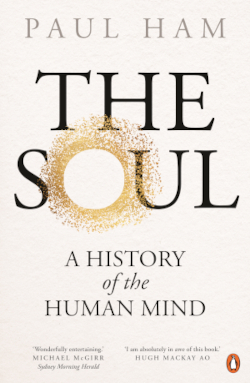 This massive book (864 pages) gives a clear history of the Jews, hated for their insistence on superior exclusiveness since the Bronze Age to the Exodus from Egypt led by Moses, their paradigm-shifting insistence on one God leading them to the promised land (Canaan, ancient Palestine) and the Zionist-led slaughter of Palestinians and their supporters today. It also gives an insightful history of discrimination against women and the refusal of men to recognise women as intelligent homo sapiens capable of reason and creative potential.
Ham offers a lengthy history of the Egyptian belief in an afterlife, of how the peace-loving Mohammed’s version of Islam divided into Sunni versions and the splits between Orthodox Christian and Roman church theorists. It is a shocking story of how rigidly held belief systems have driven human history.
Ham’s main point is that none of this agonising over the existence of the human spirit/soul derives from an absolute God. It is humanity’s search for meaning in a complex world. Creation myths advanced where reason failed, “born of a yearning to explain where we’d come from, to render bearable our isolation in the universe, and to comfort our passage through life and into the valley of death”. This search leads to endless debate over whether the soul continues after the body dies, the evil inferiority of women, how one wins a place in heaven through good deeds or the purchase of ‘indulgences’, why God allows suffering and hardship as the elect accumulate capital, what ‘sin’ and leading a ‘good life’ mean, whether ‘free will’ exists.
Ham documents how the state usurped the dominance of God in Hitler’s Germany, Stalin’s and later Putin’s Russia and the colonial outposts of Europe, in Japan under its Emperor worship. This undermined individual free will and attempts at democracy. War was the natural order, thousands were slaughtered in the name of religious patriotism. The Crusades slaughtered thousands on both sides. The totalitarian state suppressed the mind and sense of self, quashed any originality of thought and bred a hatred of everybody outside the master race. Force became the first law of society. Resilient groups like the Jews were to be exterminated. Contempt for the Japanese allowed the first atom bombs to be dropped on non-combatants, echoed now in Trump’s war against Iran and its civilian infrastructure. Moral considerations were set aside in Mao’s little red book and central tenets of Confucianism destroyed, with millions dying as the Cultural Revolution and Great Leap Forward were implemented.
Are we seeing the same thing with Trump and his tech oligarchs, whose solution to the world’s problems is an escape to Mars for the chosen few? Capitalism and the free market have become a new belief system, with no interest in the public’s general wellbeing. Paul Ham asks: “Are we entering a new dark age of religious hysteria? Or are we descending into a modern Sodom of sexual depravity?”
He sees the race towards artificial intelligence as a “moral battle for the soul”, the closest we have come to a new god, who knows everything and everyone, which is supported by evangelicals and intolerant thugs who look forward to the promised apocalypse. They ignore the existential despair of the majority who suffer economic injustice.
The mind-body duality – between our “bio-selves and digi-selves” – fragments society. Faith gives way to a guilt-ridden, crippling neurotic condition. A ubiquitous technology run by an oligarchy of knaves rules the world. “Government becomes the executive arm of their deity.” It crushes dissent and vilifies those who fail to conform. Only the id is allowed to thrive in a welter of rage and sexual depravity; the ordinary ego and the conscience of our superego are suppressed in a fantasy of belief in personally crafted algorithms.
In this process, Ham claims, “neuroscience and genetic science have consigned the soul to oblivion. So, farewell to the spirit that animated thousands of years of human history …Goodbye to the forge of belief, the crucible of conscience, the whip hand of history … the very soul of faith.”
This rather bleak message is somewhat undermined by Ham’s lengthy outline of the ingenuity of the human mind in its search for meaning. The irony of AI is that if we ask it who designed or created life, it will say: “You did, you created the programs and the database through which I now rule the world.” Or, as Ham puts it, “An artificially intelligent system that mimics God may not appease the faithful when they realise their messiah is a soulless machine.”

Don Edgar is a sociologist, the author of several books on Australian society, including The War Over Work; the future of work and family. He was founding Director of the Australian Institute of Family Studies.