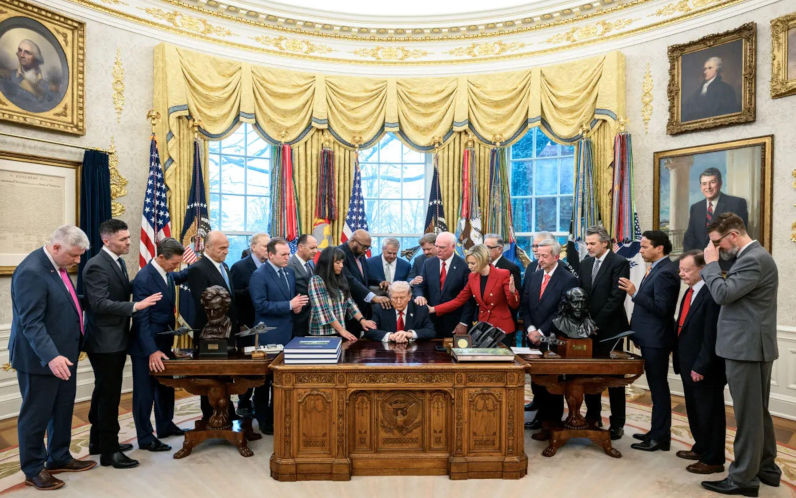
Trump’s extreme Christian nationalism poses a dual threat. By dragging the US and the West further toward the ideological right, he is both fuelling civilisational tensions and deepening fractures within the Christian faith. Christians should join Islamic and Confucian proponents of the ‘middle pathway’ to resist such extreme religiosity.
On Easter Sunday, President Trump issued a chilling ultimatum, warning that Iranians would soon be ‘living in Hell’ and a ‘whole civilisation will die tonight’ unless a deal was reached. Tehran met the threat with defiance, vowing to defend their ancient Islamic-Persian heritage to the death.
The ongoing US–Israel war on Iran, steeped in the dangerous language of a ‘clash of civilisations’, now casts a long shadow over the upcoming Xi-Trump summit. China has countered Trump’s belligerence with a sharp retort: civilisational conflict is not inevitable. At last month’s Islam-Confucianism Civilization Dialogue (ICCD) in Beijing – a pillar of Xi’s Global Civilization Initiative – delegates pledged a future of mutual respect and harmonious coexistence, sending a clear counterpoint to rhetoric about civilisation superiority emanating from Washington.
At the Munich Security Conference in February, Secretary of State Marco Rubio argued that the West must reclaim its dominance in order to restore world order – a stance rooted in a conservative, theologically inflected worldview that elevates Christianity as the primary civilisational force. This vision goes beyond a strategic recalibration: it amounts to a deliberate ideological call to reassert a Western-led system shaped by its Christian heritage.
This rhetoric will reach a crescendo in July when the US celebrates its 250th anniversary and Trump seeks to recast American identity in explicitly Christian terms. Central to this effort is ‘Rededicate 250’; a massive religious gathering of conservative Evangelical leaders designed as the White House’s flagship commemoration event.
The Trump Administration push to centre Christianity in both the international and domestic order has reignited longstanding concerns about the erosion of the separation of church and state. This shift is amplified by the rhetoric of Trump’s inner circle; specifically, spiritual advisor, Paula White-Cain, whose comparison of the President with Jesus has cloaked his presidency with ‘quasi-religious’ power and authority. This tension reached a bizarre peak last month when Trump posted an AI-generated image of himself in a Christ-like pose – widely interpreted as a reaction to criticism from Pope Leo XIV about the war in Iran.
Pope Leo has emerged as one of Trump’s most outspoken critics, warning against the ‘delusion of omnipotence’ driving the US campaign. Indeed, by the standard of the Catholic Church’s ‘just war’ theory – which mandates use of force only as a last resort – the US–Israel attack on Iran appears less an unavoidable necessity and more like a calculated war of choice. In response to the criticism, Trump dismissed Pope Leo as being ‘liberal’, ‘weak on crime’ and detrimental to ‘foreign policy’.
The clash between Trump and Pope Leo reveals a deeper, intractable fault line running through religious traditions: liberal versus conservative, left versus right, doves versus hawks. Both sides instrumentalise theology to justify their beliefs and perspectives, which is why the divide never closes.
Amid these polarisations, the ICCD has turned to alternative guides: the Islamic doctrine of Wasatiyyah and the Confucian principle of Zhong Yong. These frameworks, delegates argued at the meeting, offer a way to counter extremism across the ideological spectrum. True coexistence, they emphasised, is found not at the margins but on a ‘middle path’ – one grounded in moderation, tolerance and a genuine commitment to harmony.
In the US, however, this balance has been eclipsed by a rigid ‘good-versus-evil’ binary. Figures like Defense Secretary Pete Hegseth have portrayed Christianity as the singular foundation of global order, framing the war with Iran in apocalyptic, religious terms. By suggesting such violence aligns with a divine purpose, Hegseth has drawn critiques for mirroring the religious extremism he claims to oppose – leading some commentators to label him an ‘American jihadist’ and pointing to his ‘crusader’ tattoos as evidence of a militant Christian nationalist ideology.
As ‘Operation Epic Fury’ continues without an end date, the conflict has become the central focus of the high-stake Xi-Trump meeting. Last week, in a pivot to ‘Operation Economic Fury’, US imposed sanctions on Chinese companies responsible for 90 per cent of Iran’s oil trade. Analysts view this as an attempt to seize leverage before the Beijing summit, while also trying to revive flagging domestic support by implicating China in the unpopular war.
The American sanctions drew a sharp response from Fu Cong, China’s UN envoy, who described the US–Israel attack on Iran as “a stark manifestation of rising unilateralism” that is “dealing heavy blows to the rule of law in international affairs”. Earlier, also addressing the Middle East crisis, President Xi warned that the world cannot afford a regressive return to the law of the jungle.
Xi is not the only world leader challenging Trump; Pope Leo has risen as a formidable moral counterweight. He has condemned Trump’s threat to wipe out a ‘whole civilisation’ as ‘truly unacceptable’ and his historic visit to the Great Mosque of Algiers last month served as a profound act of solidarity with the Muslim world. Furthermore, he has denounced the administration’s mass deportations as an ‘affront to God-given human dignity’. In a final symbolic rift, the first American-born pontiff has declined an invitation to attend the US 250th anniversary celebration this July.
When the Islam—Confucianism Civilization Dialogue convened in Beijing last month, delegates pledged to pursue a ‘middle-pathway’ towards peaceful co-existence. It is now time for like-minded Christians to align with their Islamic and Confucian partners within the Global Civilization Initiative framework. Together, they can resist the weaponisation of religion and chart a course toward a more harmonious balance.
