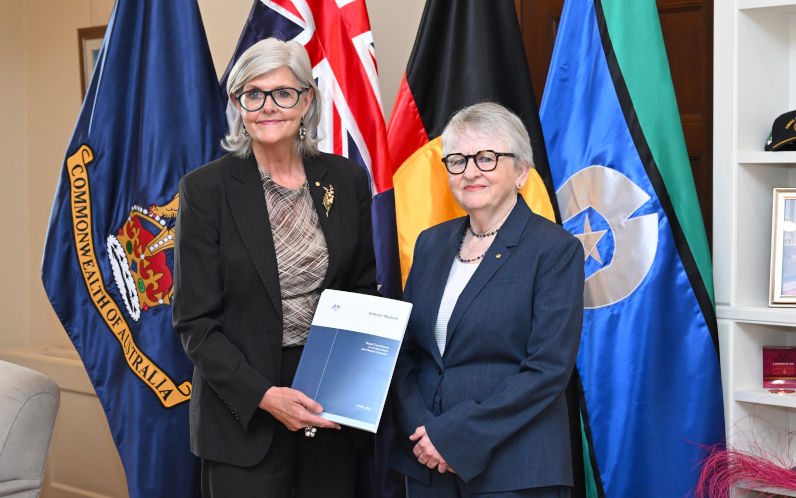
The antisemitism inquiry interim report finds Australia already has extensive terrorism laws, while urging governments to move faster on long-delayed national gun reform.
Royal Commissioner Virginia Bell’s antisemitism inquiry interim report says many things, but a couple of findings and recommendations are particularly welcome. The interim report says that there is not a need for politicians to rush off and pass even more anti-terrorism and security laws. And gun law reform must be implemented sooner, rather than later.
In her interim report Commissioner Bell sets out in some detail the range of legislative tools at the disposal of Commonwealth and state agencies in the terrorism and hate speech space. Even a cursory reading of the chapter on this issue in the 160-page report tells you how, since 9/11, politicians and governments have never stopped filling the pages of statute books with laws that give enormous powers to law enforcement and surveillance agencies.
As the report observes: “Australia’s Federal counter-terrorism laws were substantially overhauled following the 11 September 2001 terrorist attacks in the United States of America.”
Then the report lists some of the measures enacted over the past 25 years. There have been ‘comprehensive new Commonwealth terrorism offences’, and ‘[s]pecialised powers have been conferred on law enforcement and intelligence agencies to prevent, detect and respond to terrorism. These include the Australian Security Intelligence Organisation’s (ASIO) compulsory questioning powers, counterterrorism police powers, and powers to apply to courts for control orders and other post-sentence orders for high-risk terrorist offenders.’
It is well over 100 pieces of legislation.
Whenever there is a terrible event involving Australians and/or in Australia that is terrorism related, we see media commentators and politicians call for ‘new laws’ or ‘more powers’. But a seasoned former High Court judge is best placed to look at the sprawling legislative matrix and say that needn’t happen in the aftermath of Bondi.
The conclusion Commissioner Bell reaches is unambiguous: “there is no suggestion that any urgent legislative reform is required to prevent, detect or respond to an attack like the Bondi attack.”
The sad reality is that no matter how many laws you have in place, appalling events happen. Lives are lost, communities suffer and the nation grieves. This is the nature of the world.
That is not to say if there are gaps in the law they should not be examined and, if necessary, filled. But perhaps one matter which might fall out of Commissioner Bell’s findings about the legal landscape in the terrorism and hate crime areas is whether we need to examine their complexity. You can’t have over 100 pieces of legislation dealing with a particular societal problem and not have confusion.
The other aspect, from a law reform perspective, which is pleasing about this interim report is that Commissioner Bell is telling the Commonwealth and states to finalise firearms reforms. She recommends that the “Commonwealth and states and territories should prioritise efforts to finalise and implement an updated and nationally consistent National Firearms Agreement.” And that they should “prioritise efforts to implement the proposed National Gun Buyback Scheme.”
It is ironic this call comes in the same week as memorial events to acknowledge 30 years since the Port Arthur Massacre – an event which led to former Prime Minister John Howard’s finest moment in staring down the firearms lobby and reaching agreement with states and territories on these weapons.
While it is important to ensure that the National Firearms Agreement and legislation emanating from it is carefully considered to ensure balance between community safety and freedoms, there is urgency in this area of law reform.
While legislation can’t necessarily prevent tragedies like Bondi, the fewer guns in the community the better.
Commissioner Bell’s recommendations will hopefully remind some governments of the need to ensure uniformity across Australia.
Tasmania is a prime example. Despite Port Arthur, it has the second highest rate of gun ownership in Australia. And yet it is dragging its heels on reform since Bondi. The Police Commissioner Donna Adams pleaded with the Liberal government in February to impose a cap on the number of firearms individuals could own. Sensible, one would think.
But Ms Adams was ignored. The Premier Jeremy Rockliff and his deeply conservative Police Minister Felix Ellis said no to caps. As AAP reported earlier this week, this puts Tasmania out of step with NSW, WA and the ACT, which “have either implemented or are pondering gun caps for individuals.”
There should be uniform gun laws, not simply an agreement which allows states and territories opt out clauses.
Gun law reform should not be allowed to be captured by the Shooters and Fishers Party and One Nation.

Greg Barns SC is a former National President of the Australian Lawyers Alliance and Deputy Chair The Information Rights Project