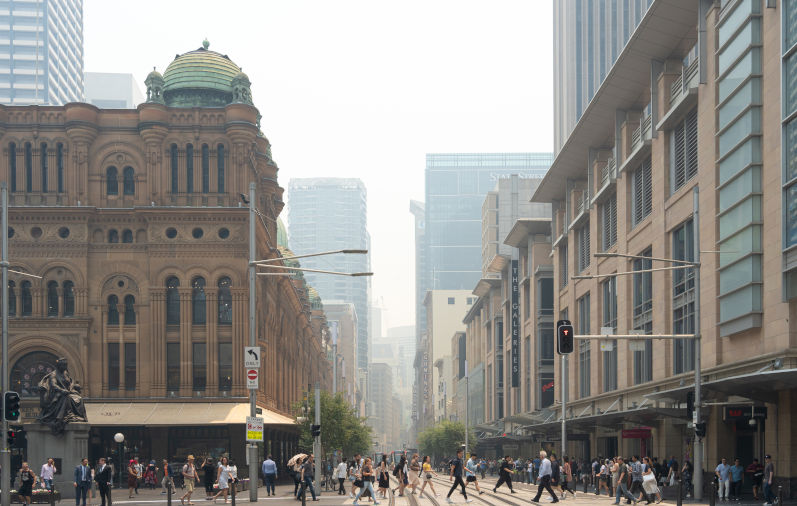
Outdoor and indoor air pollution cause one in eight deaths, mainly in low income countries, climate change is bringing heatwaves and droughts together in hot-dry extremes, and the market has no incentive to save humanity.
Air pollution, a major health problem that’s still with us
While it’s easy (and reasonably correct) for people in Australia to think that air pollution is not the problem it used to be, it continues to be a major contributor to poor health and premature death globally, second only to high blood pressure.
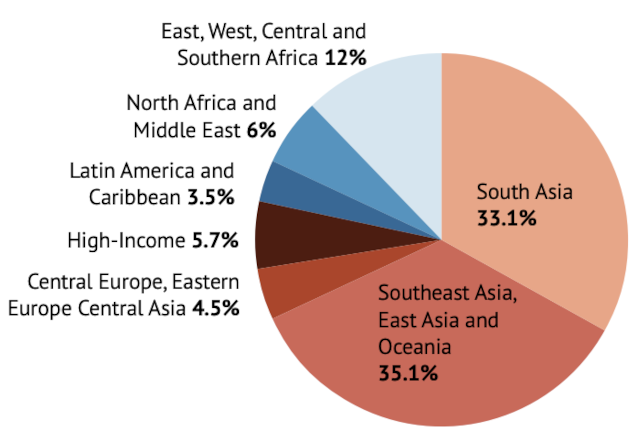
In 2023, 7.9 million deaths worldwide were attributed to air pollution, that’s one in eight of all deaths. Most of the deaths occur in low and middle income countries, with over two million of the deaths in each of India and Pakistan.
Almost 85 per cent of the deaths that are attributable to air pollution result from it causing or exacerbating noncommunicable (or chronic) diseases.
After a spike in air pollution-related deaths in children under one year, the number of deaths stays low until middle age when it starts to increase rapidly and peaks among 70-90 year olds.
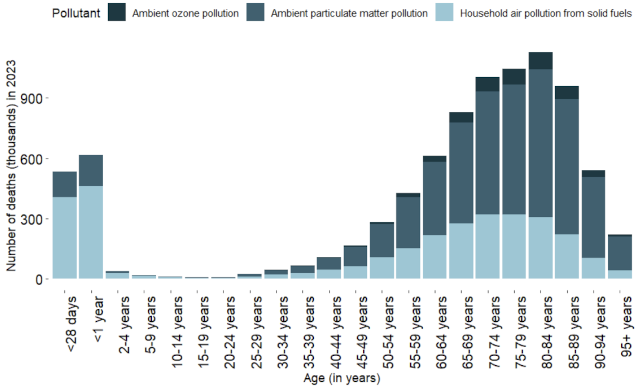
The air pollutant that causes most deaths (62 per cent) is very small particles of pollution (Particulate Matter or PM2.5) in outdoor air. PM2.5 originates in vehicles, home fuel use, coal burning power plants, agricultural and industrial activities, waste burning and bush fires, for example. The levels of PM2.5 are highest in Asia and Africa. Alone, it accounts for eight per cent of all global deaths. In 2020, the health impacts associated with PM2.5 were estimated to be equivalent to 4.7-6.5 per cent of global GDP.
Household air pollution, largely due to indoor cooking with solid fuels in low and middle income communities accounted for most of the remainder of the deaths (35 per cent). In PNG and much of Africa over 70 per cent of the population still cook with solid fuels. Household air pollution is responsible for almost five per cent of all global deaths. Air pollution that originates in the household is also a significant contributor to pollution in outdoor air.
I think that there is a tendency for people to think that noncommunicable diseases result from ageing and personal behavioural choices (whether to smoke, drink alcohol, eat healthily, etc.) but air pollution is also a major cause of many noncommunicable diseases, including heart disease (where it caused over two million deaths in 2023), respiratory disease (almost two million deaths and for which it is the top risk factor), stroke, dementia, lung cancer and adult onset diabetes.
Air pollution continues to have devastating health effects worldwide. While global warming is causing more wildfires which lead to temporary but high spikes of air pollution, there is much scope to reduce levels of the more traditional causes of air pollution in developing countries, particularly through better collection, coordination and use of data regarding pollution and its health effects, and more widespread adoption and implementation of the WHO’s Air Quality Guidelines that recommend ‘safe’ levels of pollution, noting that only zero air pollution is truly safe.
Just for the record, PM2.5 still causes over 3,000 deaths each year in Australia.
Compound hot-dry extremes are worse than the individual parts
Global warming is causing extremes of both temperatures and droughts to intensify. Both have widespread, serious consequences for, for instance, industrial and agricultural productivity, economic growth, wild fires, vegetation cover, water availability, human health and mortality and political systems. For instance, the yields of staple crops have already declined by 5-10 per cent for each degree of warming and are projected to decline by up to 10 per cent more for each additional degree of warming.
Global warming is also increasing the frequency and severity of occasions when the two occur together. Compound hot-dry extremes produce outcomes that exceed the cumulative effects of each individual component – indeed, relying solely on precipitation to define a drought has serious limitations. The frequency of hot-dry events has already increased globally and as warming further increases such events will affect a growing number of people.
If global warming reaches 2.7oC by 2100, which it is projected to do under current global policies, 28 per cent of the global population (about 2.6 billion people) will face more frequent and more intense compound hot-dry extremes. Compared with the present day (2001-2020), the frequency of such extremes will increase 2.4-fold and maximum durations will be 2.7 times longer.
The graph below shows the distribution of hot-dry compound events in the past (1850-1900), the present, and a future with 2.7oC of warming. The horizontal axis (Frequency) refers to the total number of hot-dry days in a year and the vertical axis (Max Duration) is the duration of the longest continuous hot-dry spell that year.
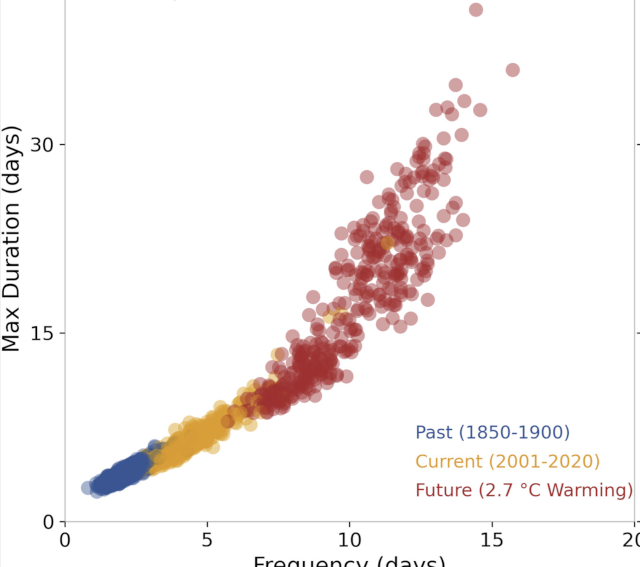
Should warming reach 3.6oC, 41 per cent of the global population would experience heightened hot-dry extremes and Australia would be included in the threatened regions. (At 3.6o, that won’t be Australia’s only problem.)
As a consequence of geographic location, poorer socio-economic conditions, higher levels of warming and limited adaptive capacity, tropical island nations and low income countries will suffer the most – what a surprise. The report’s authors stress the obligation of high-income/high emission countries to uphold the UN principle of “common but differentiated responsibilities and respective capabilities” to limit global warming to 2oC and pursue equity-focused policies that address the socio-economic disparities exacerbated by climate change.
The authors also demonstrated that anthropogenic greenhouse gas emissions are the principal driver of the more frequent, more intense hot-dry extremes.
(For my methods-obsessed readers, the study used 152 computer simulations. A hot-dry event was defined as a day when the daily maximum temperature exceeded its 90th percentile and the rainfall index for the previous month indicated a “moderate drought”.)
Japan’s cherry blossoms are peaking earlier
Believe it or not (I do), the day of peak cherry blossom in Kyoto can be traced back for over 1000 years.
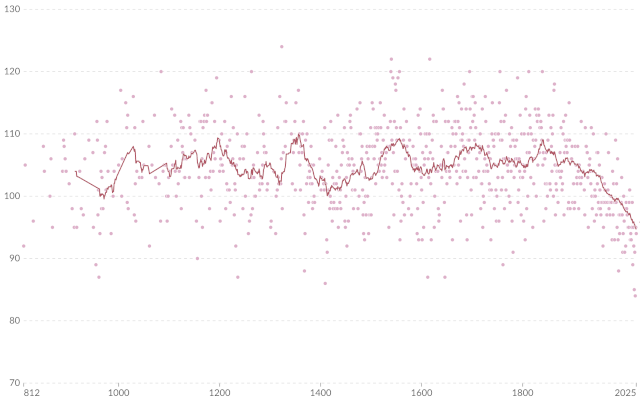
Cherry trees need a period of cold followed by the warmer days of spring to trigger blooming. Notwithstanding lots of year-to-year variation, for 1000 years peak blooming tended to occur in mid-April but since about 1840 peak cherry blossom has been getting steadily earlier, with 2021 and 2023 being the earliest on record, around 26 March, three weeks earlier than the long term average.
In the graph below, each dot represents the peak cherry blossom day for that year and the red line represents the average of the previous 30 years. For all of the 1200 years until 1970, the 30-year average has been between the 100th and 110th day of the year (April 10-20th). Since 1971, however, it has never been as late as the 100th day and by 2025 it had got to the 95th day (5 April). Four of the 13 years when peak blossom has occurred in March have occurred since 1990.
It’s puzzling why this might be happening, don’t you think?
No natural market for saving humanity
I’ve had a few rants over the years about carbon removal, carbon credits, carbon offsets and carbon markets. To summarise my position, when global warming reaches a truly desperate level (say 2.5oC), we may “need” carbon removal to stabilise and then reduce the temperature but there’s no prospect at present of it making a significant contribution to that goal; carbon credits have some attributes if carefully used; and the last two are basically scams.
I can’t help being amused, then, by the following statement by Hannah Bebbington, head of deployment (whatever that means) at Frontier, a coalition of companies that buys carbon removal credits with the intention of nurturing “an industry that could make a big difference down the road”:
“We know the world is going to need permanent carbon removal at scale to meet global net zero goals, and yet carbon removal doesn’t necessarily have a natural buyer. Without a clear source of demand, it was hard for carbon removal companies to attract investment, great entrepreneurs. Basically, it was hard to start a carbon removal company.”
What the market refuses to realise is that meeting the palliative “global net zero goal” is not the real goal. Rather, the real goal is preventing our collective stupidity creating a world that is too hot for us to live on. Common-sense tells me that goal has an eight billion-strong natural constituency. (The market does realise that global net zero is not the real goal, of course, but sees it as an effective way to keeping the eight billion preoccupied with an anodyne sham goal.)
Maybe the problem lies with the commitment of people like Ms Bebbington and organisations like Frontier to the market. Maybe relying on the market and its focus on making a profit and accumulating wealth (for a few) to solve the world’s climate problem isn’t the way to go. Just because there isn’t a natural buyer for carbon removal credits in the capitalist marketplace doesn’t mean there wouldn’t be anyone keen to pay for carbon removal (if it ever became a reality).
The current roadblock to research and development in carbon removal technology is that those who are supposed to represent the interests of the eight billion and are entrusted with the power and responsibility to stop the world overheating – national governments and various global intergovernmental agencies – prefer to behave in extremely unnatural and un-nature-ly ways to keep the profits flowing rather than respond to their natural constituencies’ needs.
Just to be clear, I have not become a born-again carbon removalist. Nor am I suggesting that the private sector and governments should be throwing money at it to stimulate research and development. I am pointing out the unreliability of expecting “the market” and investor altruism to make something happen that, rightly or wrongly, some people believe to be needed.
Whenever it happens, it always looks great
Rokkakudo Temple in Kyoto.


Peter Sainsbury is a retired public health worker with a long interest in social policy, particularly social justice, and now focusing on climate change and environmental sustainability. He is extremely pessimistic about the world avoiding catastrophic global warming.