The choice between high- and low-enriched uranium submarines will shape Australia’s nuclear security, waste and non-proliferation obligations for generations.
The trilateral AUKUS agreement commits Australia to acquiring a fleet of nuclear-powered attack submarines. While public discourse focuses heavily on sovereign risk, capability, cost and delivery timelines, a fundamental technological choice about uranium carries profound lifecycle, industrial and non-proliferation consequences.
The choice is between a Low-Enriched Uranium (LEU) planned-intervention design, such as the French K15 reactor (or the South Korean reactor development, as required by the US) and a High-Enriched Uranium (HEU) sealed reactor system, like the US Navy’s S9G installed in the Virginia Class stop-gap submarines and the baseline chosen for SSN AUKUS. The decision dictates not only how a submarine is maintained but how a nation must ultimately dispose of the uranium.
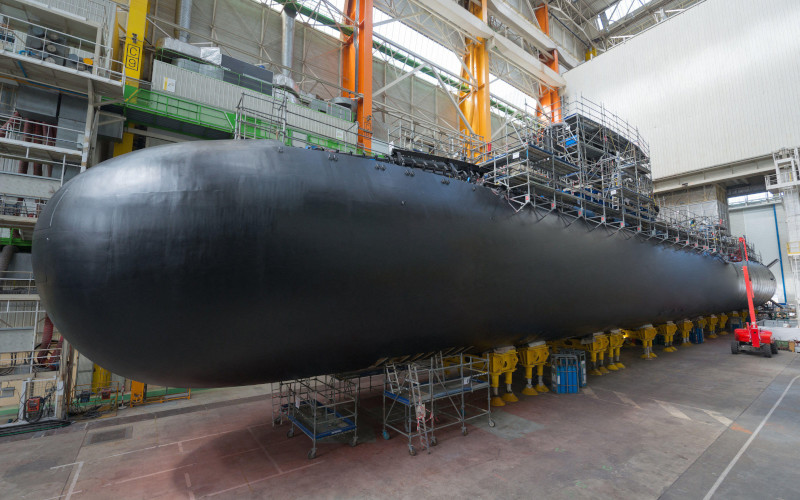
As Australia navigates this commitment, we must prudently evaluate an AUKUS Plan B – acquiring the French Suffren-class, an existing, operationally proven nuclear-powered submarine that is already at sea. In contrast to the yet-to-be-designed SSN AUKUS and its yet-to-be-proven PWR3 reactor, the Suffren offers a compelling alternative. It is approximately half the size, requires a smaller crew, is significantly cheaper to build and own. Beneath these platform differences lies an even deeper reality regarding reactor design and fuel selection. There is far more than meets the eye when comparing LEU and HEU systems, particularly how they shape our long-term responsibilities as a sovereign nuclear steward.
The operational and structural characteristics of a naval nuclear reactor are governed by the enrichment level of its fuel. The French K15 reactor, which powers the Suffren-class, operates on LEU enriched to less than 6 per cent Uranium-235. This lower enrichment level means the core must be opened and refuelled approximately every 10 years. To facilitate this, the submarine is engineered with a dedicated logistics hatch, located above the reactor compartment.
When refuelling occurs, a specialised containment compartment is lowered over the hatch, sealing the reactor compartment to provide a secure, airtight working environment for the remote handling of fuel rods and internal components. This decadal refuelling operation is synchronised with a mandatory ten-year platform maintenance and docking window, resulting in no additional operational downtime. It allows regular, direct inspection of internal components that maintains a predictable safety margin across the platform’s service life. If sustained high-speed operations deplete the fuel ahead of schedule, the core can be refuelled early during scheduled maintenance without affecting the hull’s total service life.
Conversely, the S9G reactor fitted to the Virginia-class SSN and chosen as the design baseline for the PWR3 reactor to be fitted to SSN AUKUS uses a sealed reactor design. Operating on weapons-grade HEU, it is engineered to run continuously for roughly 33 years without opening. No logistics hatch is fitted. While this removes the requirement for mid-life refuelling, it creates a closed system. If sustained high-speed operations deplete the HEU core prematurely, there is no routine industrial mechanism to refuel the vessel. Australia could be faced with early asset retirement.
This divergence in core physics also dictates the security and logistical risks of the initial build process long before a vessel reaches salt water. Because the K15 can be fuelled in situ within the hull, the reactor can be installed completely empty during construction. This allows all the platform sub-systems to be fully set to work safely during the build process, with the non-weapons-grade LEU core inserted as late as possible, when operationally required.
By sharp contrast, the HEU-fuelled PWR3 reactor must be shipped from its manufacturer in the UK to South Australia as a fuelled, intact nuclear unit. The reactor installation is required early in the build sequence: its presence transforms the submarine on the slipway into a high-value target for those wishing to disrupt operations or obtain weapons-grade uranium. This security and proliferation vulnerability continues systemically throughout the operational life of the class and long after decommissioning.
The differences between these two architectures becomes most acute during end-of-life decommissioning. Before a submarine can be recycled, the spent nuclear fuel must be safely extracted. The French LEU pathway leverages its built-in access features, using the routine dockside procedures and specialised containment housings exercised during its operational life to extract the fuel. Once defuelled, the empty reactor compartment is cut out, sealed and stored on land for 20 to 40 years. This allows short-lived gamma-emitting isotopes, principally Cobalt-60, to decay naturally by over 90 per cent, after which the compartment can safely be segmented using automated tools into standard waste packages.
The sealed HEU design requires a far more intrusive engineering intervention at the end of its life. Because the platform lacks built-in access paths, a temporary opening must be cut directly through the high-strength steel pressure hull plating to create a vertical lift path. To manage this hazard, shipyard teams must install a radiological containment superstructure over the hull cut. The reactor compartment is then flooded with borated water to act as a radiation shield allowing specialised, overhead cranes to extract the highly radioactive, spent fuel elements via remote tools.
Once defuelled, the entire HEU reactor compartment is cut out intact as a single structural block. Heavy steel plates are welded onto the ends and internal voids are filled with engineered grout to lock in place loose surface contamination from the reactor shell and primary loop. This creates a massive monolithic transport package weighing between 1,130 and 1,680 tonnes. Disposing of these units requires specialised heavy-lift docks, maritime transport and heavy-haul land vehicles capable of moving thousand-tonne structures to a custom-engineered open-air burial trench.
Beyond the industrial mechanics, the choice of fuel introduces distinct long-term sovereign regulatory and non-proliferation obligations. International safeguards focus on standard, high-level radioactive waste management rather than military proliferation risks. Spent LEU fuel remains well below the 20 per cent Uranium-235 proliferation threshold, meaning it is classified as non-weapons-usable material. It can be reprocessed or stored under the same conditions as used power station fuel. In contrast, spent HEU fuel retains highly enriched, weapons-grade material. For Australia, this means the spent fuel will require permanent, high-level defensive infrastructure, stringent physical security and specialised verification protocols to mitigate long-term proliferation risks.
The AUKUS agreement provides Australia with an unprecedented naval capability and binds the nation to an intensive industrial and regulatory pathway. The HEU sealed-reactor strategy avoids the short-term requirement for domestic refuelling infrastructure but demands the eventual creation of an advanced industrial infrastructure to handle thousand-tonne monolithic waste packages.
By contrast, the LEU model can yield a more manageable, standardised end-of-life disposal, with significantly lower non-proliferation overhead. This would be a relief to our near neighbours as well as all Australians.
A transparent understanding of these technical trade-offs is essential if Australia is to successfully execute its responsibilities as a sovereign nuclear steward. I have no doubt which is the best option to leave our grandchildren and their children. It is high time Australia took a serious look at the Suffren; the differences are indeed more than meets the eye!

Peter Briggs
Peter Briggs retired from the RAN in 2001 after a 40-year career, specialising in submarines. This included two submarine commands, command of the RAN Submarine Squadron, director of Submarine Policy and Warfare and Head of Submarine Capability Team, established to rectify Collins introduction into service issues. He was the president of the Submarine Institute of Australia from 2006-09 and is a frequent contributor to public debate on Australian submarine matters.