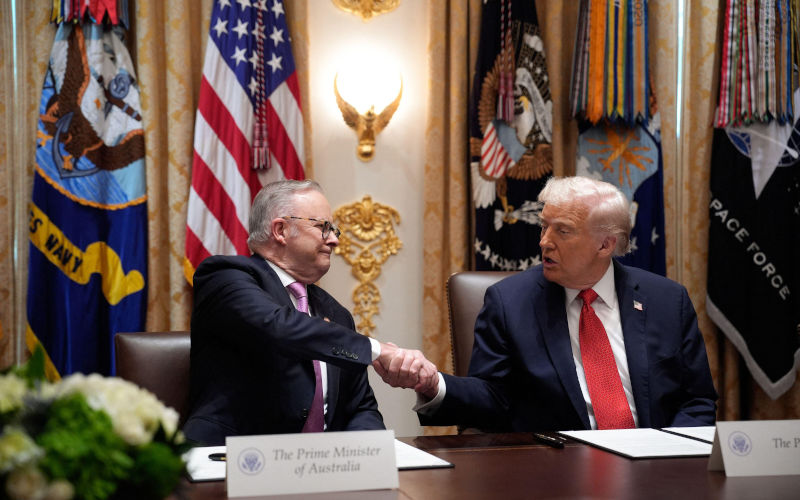
Australia’s support for the US-Israeli war on Iran has again exposed the reflexive subservience of Australian foreign policy, tying the country to another failed American military adventure that did nothing to serve the national interest.
It may be a while before the full dimension of the military defeat of the United States and Israel by Iran can be assessed. The re-evaluation of relative positions of power in the region, including the impact on Israel and its political leadership and its habit of perpetual war against its neighbours will also take time, if only because President Trump and prime minister Netanyahu are still in states of denial, even as those immediately about them readily admit the complete failure of strategy and tactics, the fact that Iran has emerged relatively better off than it was before and the probable end of the US blank cheque for all Israeli warfare, and resupply of guns and munitions.
Australia will, as usual in recent times, be hoping that most of the rest of the world will forget that we were a participant in the war, one far more active than we pretended. No NATO states, and no other nations usually disposed to America, gave more assistance, whether to the US or Israel, or both. We supplied “defensive” missiles to the Gulf states in case of Iranian attacks, surveillance aircraft to give early warning of missile, ballistic missile, and, later, drone attacks on Gulf states and Israel from Iran. US bases and “joint Australia-US” facilities such as Pine Gap also provided Israel with early warning, and telemetry, on Iranian missile attacks.
The Gulf states gave passive support to the US-Israeli attacks but did not attack Iranian centres. But they paid a high price for allowing US bases and assets in their territory, because these, as well as some of their industrial and oil infrastructure (and airports) were attacked by missiles and drones, causing considerable damage. The extent of the damage to US bases is still highly classified, but according to American military commentators, has been very serious.
Prime Minister Anthony Albanese identified Australia with American war aims of preventing Iran’s development of nuclear weapons, punishing Iran for interference in the affairs of neighbouring countries, punishment of Iran’s alleged commissioning of a terrorist attack on a synagogue and Australian Jews, and the protection of tens of thousands of Australian citizens in the region as well as Australian (and American) allies located in the Gulf.
Australia’s knowledge of Iranian connivance at terrorism on Australian soil is said to have come from no doubt disinterested Israeli intelligence tip off to the head of ASIO. Albanese also attached himself to the idea of regime change – a hope that the brave citizenry could shake off their authoritarian and repressive theocracy. This was pretty much the full house on President Trump’s announced war aims, although Australia made it clear it did not intend to participate in active strikes on Iran, or get Australian troops involved on Iranian territory.
No one – not a single ally or friend – responded to Trump’s call to arms other than Albanese
Our coming forward did not start a stampede. NATO and European nations, for example, noted that Trump had not consulted them about his military plans, and said they would not get involved, even to the point of allowing military overflights or use of bases. They proved quite unwilling to be coerced into establishing a naval task force to clear the Strait of Hormuz for traffic. Their “you break it, you fix it attitude” exasperated Trump. He included Australia in his list of countries that had been unhelpful.
Usually, Australian help to American military adventures is not well known to most of the world. Even most Americans are unaware of Australian involvement in the war in Vietnam in the 1960s, in Korea in the 1950s, or (some would say, in the Pacific War against Japan in the 1940s, where American reportage and histories focused exclusively on their own troops. As ever, Australian troops, flight crews and sailors were involved in the wars in Afghanistan, in Iraq and in Syria in the first 15 years of the 21st century, but it attracted little foreign notice, other than over war crimes. President Trump made disparaging remarks about the assistance the US received from its allies in Afghanistan and had to be told that his comments had caused offence in Australia.
Each of these adventures was an embarrassing – but entirely predictable – military defeat, political failure, and social and environmental catastrophe, Australia might not have minded its low profile, or the fact that our involvement has escaped most of the history books. Nothing Australia has done militarily with the US over the past 60 years has made life better, or safer, for those who lived in the country invaded or otherwise ”helped”. Nor has it made the “helped” nation any more grateful or better disposed to us. There may have been effective Australian military action in minor clashes and battles, but there has been nothing that made a lasting difference to outcomes, military or political. Apart from the legacy of war crimes, of course.
But leaders in neighbouring nations, such as Indonesia and China, were aware of Australia’s involvements and its apparent lockstep with the US. They were struck, as ever, by the alacrity with which Australia identified America’s interests as our own, by the lack of interest by Australia’s leaders in where Australian national interest lay, and by only token pretence that Australia’s interventions had anything to do with the welfare of the people involved. Beyond their resentment of America’s self-appointed role of being the world’s policeman – often a lawless one – was their amazement at Australia’s willingness to act as its regional deputy sheriff.
Once again the most powerful nation was humbled by a smaller one
It is open to the US to withdraw from the Middle East, the Indian Ocean and the western Pacific. Some understood that under President Trump, America would be much more reluctant to get involved in endless and often pointless foreign wars far away from its shores. They understood that America wanted to retain influence and goodwill, and effective trading relationships, and they also understood that a “trust but verify” superpower would maintain its military might against any who might undermine it. Yet we did not expect that its leadership would declare a “might is right” doctrine, to assign to itself the right to invade nations such as Venezuela, to declare its intention to annex Greenland and Canada, and to set arbitrary tariffs and trade barriers as an instrument of trade coercion.
Australia is not a party to the peace deal. That’s par for the course when Australia goes to war with the US. It is neither in the councils of those making war, plays no role in setting strategy and tactics, and is not consulted when things go bad. Nor, historically, has it been consulted about the terms of withdrawal, or the peace. Anthony Albanese has assumed no obligations on our behalf in the peace, or effective surrender, terms signed by Trump.
But Australia must take some responsibility for tidying up the mess left behind. We want a return to normality, particularly with energy shipments. We want to see Iran’s cities and civilian infrastructure rebuilt. (Just as we also want to see the destroyed Palestinian infrastructure rebuilt at Gaza and on the West Bank, and damage to Lebanon repaired, primarily by those who caused the damage and the atrocious loss of life.)
The need for the reconstruction of Iran is not from any moral obligation, as such. But it is now for the entire region, including Australia, to settle things down. And not only in terms of returning to stable petrol prices, but in terms of helping to maintain the regional peace, and in helping Iran rebuild its cities and economic infrastructure after the Israeli and American assault.
It is, alas, now impossible to make such aid conditional on political improvement. It is unlikely that a triumphant Iran will be accepting much advice from Australia about liberalisation. Australians may not have to panic in the short term at least about Iran’s building a nuclear bomb. But we have no reason to expect that Iran will end its jihad with Israel, or the practical support that it gives its Hamas and Hezbollah allies. At most Iran might be recommending to them some change of tactics.
Even Donald Trump’s enemies have no reason to take pleasure from his drubbing and his humiliation. He should not have attacked Iran. Nor should he have encouraged Israel to do so or responded to the pressure that Israel put on him to engage in the foolish intervention. Nor should he have believed Israeli claims that Iran’s development and deployment of a nuclear weapon was imminent. Until this war began, Trump had, after all, been insisting that his campaign last year had destroyed Iran’s capacity to make a bomb, certainly in the short term. There was little or no evidence that the Iranians had resumed any efforts they were making. Israel, itself a nuclear power which developed its weapons clandestinely, may have its own reasons for wanting to destroy or seriously weaken Iran’s nuclear capacity, but they were not as pressing as its general desire to “mow the grass” by weakening the state’s leadership, and its military and civilian infrastructure. Iran has not been the clear and present danger to world peace that Trump and Netanyahu pretended.
Nothing Albanese did served the national interest
That does not mean that Australia is better off by the survival of a medieval theocracy which seriously oppresses its citizens and denies them basic freedoms. Had the United States been more patient, and less instantly responsive to Israeli pressure, the dictatorship might have already toppled as the domestic disturbances at the beginning of the year intensified. But the prospects of this happening vanished once Iran faced a formidable external threat. Many of the Iranian population, at home and abroad, rated support of their nation’s leadership against attacks from Israel and the US as more important than regime change. Even after many of the ruling elite had been killed in the attacks, and a new, and as it happened, more extreme and hardline leadership emerged.
Americans have often gone to war with hopes that they will be greeted as liberators, able to assist the locals in restoring basic rights and liberties, democratic processes, and new market economies operating in peace. They have expected or hoped also that the liberated population will set aside all domestic differences, including religious and tribal ones, and unify around a local general good.
That this never happens is no accident. No one could match America’s regard for itself, its “greatness” and the nobility of its purpose. No nation has leaders, of the left or right, who devote so much time to telling each other how wonderful their republic is. But not many other countries are so impressed, even if they understand that America is very rich, very powerful, and rather clumsy and dangerous when it is wielding power. Even in Australia, historically a friend of the US, more Australians regard America as a bigger threat to world peace or peace which Australians can enjoy, than China, the nation the US has designated as our notional enemy.
Under Trump, America has dropped any pretence that its defence and foreign policy is focused on some sort of detached world order. The US, it has made plain, is in it for itself. It acts to promote its own interests, not the interests of broader alliances, or imagined communities of like-minded peaceful nations.
Under Trump, indeed, it has made economic and ideological war on its allies with much more ferocity than against nations it has traditionally regarded as hostile, including Russia. In any terms, Trump has been a baddie in appeasing Russia and failing to give Ukraine sufficient help. His unstinting support for Israel in its genocidal campaigns, now on many fronts, against Palestinians, make him a complete accomplice to the war crimes involved. His allies do not trust him. And, as the outcome in Iran demonstrates, his enemies do not fear him. Most of the rest of the world does not respect him, or the nation of which he is president.
Except for the Albanese government in Australia, that is. Albanese may have learnt to say no to Trump when he asked for some assistance in his Iran struggle, in part because the rest of the world, including all of America’s other allies, had already said no, and Australia had neither the means nor the desire to go it alone. The official Australian reflex remains one of subservience and hope that dumb dog-like adoration and obedience will earn the nation, or its leaders, a reward some day. It’s time Australia made some new friends.

John Waterford AM, better known as Jack Waterford, is an Australian journalist and commentator.