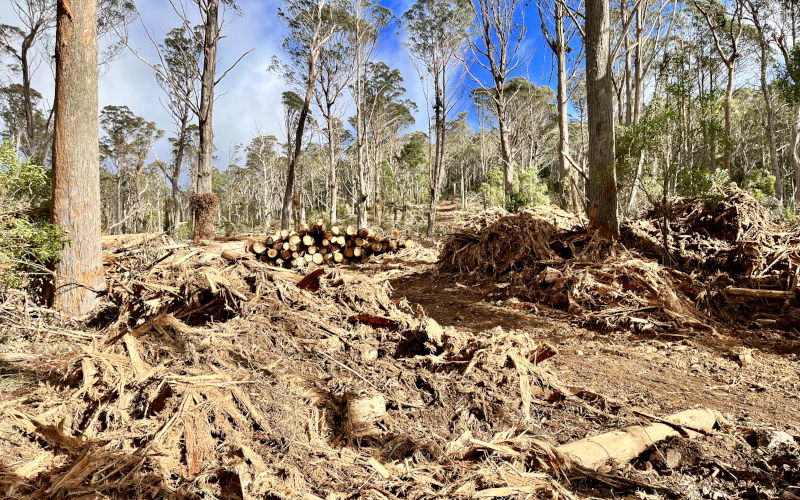
Carbon offsets have rightly earned distrust, but the new Improved Native Forest Management method could protect native forests, store carbon and penalise future logging rather than delay decarbonisation.
Carbon offsets are highly controversial. At their simplest, they are a mechanism that allows polluters to increase their emissions if they pay another person to reduce theirs. Textbook economists will tell you this will ensure emissions are reduced at least cost. However, a large scientific literature has repeatedly shown that, in most cases, offsets do not lead to real and genuine emission reductions.
The repeated practical failure of carbon offsets, both in Australia and elsewhere, has led many people to reject them outright. This is an understandable perspective. For too long, governments and other administrators have seen offsets as a dodge; a way to delay decarbonisation under false pretences.
While scepticism is warranted, not all carbon offsets are bad. For example, in Australia, there are over 300 carbon offset projects involving environmental plantings, where the aim is to restore previously cleared ecosystems using native species. Our long-term research and monitoring shows that these projects both sequester carbon and provide important biodiversity benefits in often highly modified farming landscapes.
Last month, a new set of rules (known as a ‘method’) was made under the Australian carbon credit unit scheme that provides opportunities for state governments to earn credits for stopping native forest logging. Like environmental plantings, this new ‘Improved Native Forest Management’ (INFM) method creates an opportunity for genuinely good carbon offset projects that help protect and restore native forests degraded through decades of commercial logging.
Under this new INFM method, state governments will need to define their projects as encompassing all the public native forests designated for commercial forestry use across a whole forestry region. These regions are areas that generally incorporate two or more million hectares of forest. They then need to specify one or more ‘carbon protection areas’ within the region, where harvesting will be prohibited for a minimum of 100 years. If they do this, a state government will be given carbon credits based on the extent to which they reduce the logs cut from across the whole forest region.
Issuing carbon credits for stopping logging makes sense from a scientific perspective. This is because native forest logging generates large amounts of greenhouse gas emissions by releasing the carbon stored in the trees and soils into the atmosphere. Logging also prevents the forests from continuing to grow and sequester increasing amounts of carbon. When a forest estate is repeatedly logged, its carbon stores will generally be around 50 per cent of their potential. Stopping logging allows forest carbon stores to be replenished.
All carbon offsets come with risks. The architects of the INFM acknowledge this and have worked hard to limit the potential for perverse outcomes. For example, although native forest logging has supposedly ceased in Victoria and Western Australia, it is actually continuing in both places, and particularly Victoria, under the guise of fire and Indigenous management. Under the INFM method, logging is prohibited in carbon protection areas and must be completely stopped for 100 years. If harvesting occurs at any time over the 100-year permanence period, it can result in the deregistration of the project, a requirement to relinquish carbon credits, and the imposition of civil penalties. To make sure of this, the method explicitly prohibits the removal of biomass from carbon protection areas. This means there can be no burning of forests to generate energy and no harvesting dressed up as something else.
In the past, when state governments have converted state forests into reserves, it resulted in the intensification of harvesting in other native forests, particularly other state forests. The INFM strongly disincentivises this by placing harvest limits on other public and private native forests in the state in which the projects are established.
There are three harvest limits for these purposes: one over the forest region in which the project is established; one across all other public native forests in the state; and a third over private native forests in the state. If logging exceeds these limits, the state loses credits – the exceedance is deducted from the credits they receive. After 15 years when the project stops receiving credits, if logging exceeds these limits, the state must buy credits and relinquish them to cover the impacts of the exceedance.
In other words, a financial penalty will be applied for 100 years for excessive logging in native forests – creating a disincentive to increasing the amount of logging.
The incentive the INFM method provides to stop native forest harvesting is a major positive step forward. For the first time, state governments and state forest agencies will be rewarded for forest protection and penalised for forest degradation.
In the past, when native forests have been protected from logging, there has been a fear that future governments could undo the progress and resume logging in protected areas. The INFM method will help prevent this by requiring the forests in carbon protection areas to be protected for 100 years and for logging across the project area to be kept below prescribed limits. If future governments want to reverse the decision to stop harvesting, they will need to buy their way out by purchasing and relinquishing ACCUs.
Despite the positive aspects of the INFM method, critics argue it will encourage more offsetting by big polluters, further delaying decarbonisation. A closer look at the numbers shows this is not the case. The number of ACCUs associated with the INFM is small. The first INFM project, slated for north-east New South Wales, is likely to account for less than 1 per cent of credits issued under the Australian carbon credit unit scheme through to the end of this decade.
Even if the INFM method takes off, and multiple other INFM projects are established elsewhere, at best (or worse – depending on your perspective), the credits issued to the projects would amount to around 5 per cent of issuances. These volumes are not big enough to have a material influence on the carbon price faced by big polluters. And if the credits do not have a significant influence on the price, basic economics tells us they should not lead to additional offsetting by the big polluters. In another positive move, the NSW government has recently worked to prevent the sale of carbon credits to the fossil fuel industry from carbon credits associated with the Great Koala National Park.
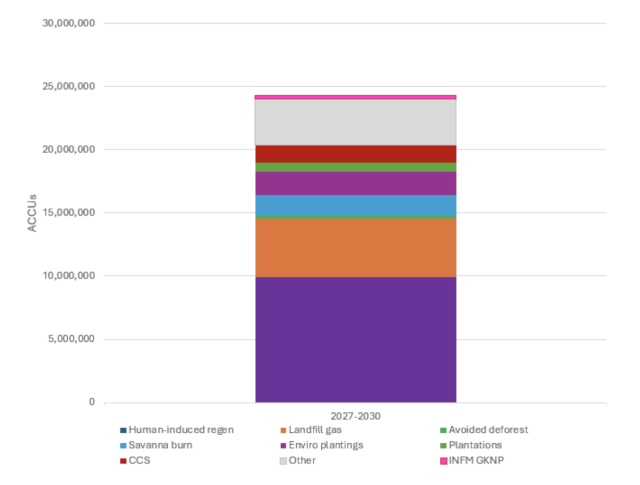
Concerns about low-integrity offsets suppressing the carbon price are real. But the cause of this problem is the bad offset projects in the ACCU scheme, typified by ‘human-induced regeneration of even-aged native forest’ (HIR) projects (including where forests don’t naturally occur!). These projects cover around 40 million hectares of land, mostly in the Australian outback. They are being credited primarily on the basis they are regenerating even-aged native forests mostly on uncleared lands through grazing control.
The premise of the HIR method – that forests can be ‘regenerated’ on uncleared lands through grazing control (and without the planting of any seedlings or seeds) – conflicts with decades of science on the impacts of grazing on tree cover. Consistent with this, four peer-reviewed studies have now shown that HIR projects have had little impact on regeneration. But despite this, HIR projects have received 60 million carbon credits, worth more than $1 billion. Last financial year, HIR projects accounted for almost 40 per cent of issued credits.
Frustration with the Australian carbon credit scheme is justified but it should be directed at HIR projects and other similar low-integrity methods, like soil carbon, not the INFM method.
A lot of effort has gone into ensuring the INFM method has high integrity and is free of the problems that have plagued other types of offsets. There is no doubt the INFM method will result in a significant boost in protection for native forests – that is protecting not only large amounts of carbon but also protecting large amounts of biodiversity. And it will achieve this without undermining the efforts to decarbonise the economy.
I fully understand the instinct to distrust carbon offsets. Most of them deserve it. But the INFM method is different, and treating it the same as HIR or soil carbon schemes will cost us the chance to stop native forest logging through a mechanism that will actually work. Failing to take this chance is a serious mistake we cannot afford to make.

David Lindenmayer
Professor David Lindenmayer is a distinguished Australian scientist and academic, specialising in landscape ecology, conservation, and biodiversity. His research focuses on integrating nature conservation with agricultural production, improving biodiversity conservation in forestry and plantations, and enhancing fire management practices. With over 1000 peer-reviewed papers and 50 books, David is one of the most published ecologists globally. He leads large-scale, long-term research programs in south-eastern Australia. A Fellow of the Australian Academy of Science, he has received numerous prestigious awards, including the ESA Whittaker Award, multiple Eureka Prizes, and the Australian Natural History Medal.