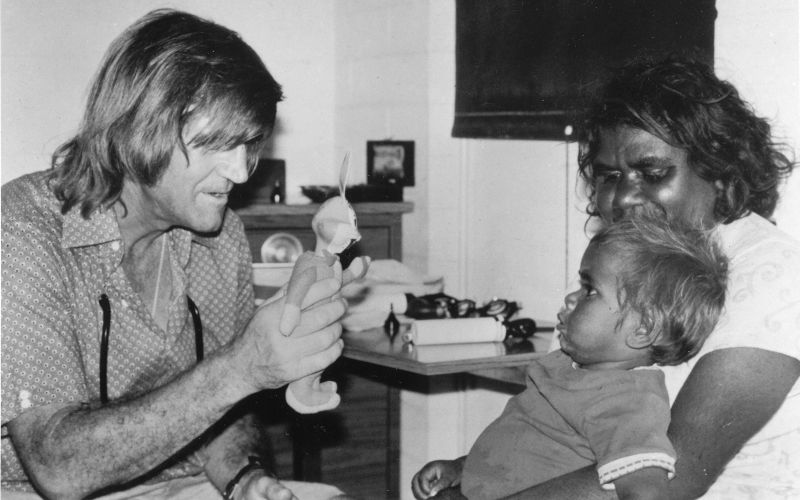
Fred Hollows’ trachoma program exposed appalling Aboriginal health conditions and helped drive the growth of community-controlled health services.
In 1975, an Aboriginal friend in the federal health department, Gordon Briscoe invited me to ask his department questions about the prevalence of trachoma in Aboriginal Australia, and what was being done about it. He suggested that I get some preliminary information from an ophthalmologist, Professor Fred Hollows, at the University of NSW. He and Hollows, he said, had put in a submission for a national campaign to attack trachoma, but it was languishing in departmental in-trays.
I was being used, but I knew it and it seemed a noble enough cause. Gordon was one of the founders of the Redfern Aboriginal Medical Service, the first such service in Australia. What particularly galvanised the development of the service was his convincing Fred Hollows to get involved as a founding president. Hollows scrounged equipment from the Prince of Wales hospital and pushed doctors, young and old, to work as volunteers. An Aboriginal nurse, Naomi Mayers, who died earlier this year, became the chief executive and an array of Aboriginal helpers, including the immortal Mum Shirl, began establishing and developing services controlled by Aboriginal people and focused on diseases and conditions affecting them rather than out of a public and private health system operating for Australians whose health was generally good, and for whom illness was an occasional uncomfortable incident. By contrast many Indigenous health conditions were endemic, and in many cases quite treatable other than for cultural and economic reasons.
Hollows gave me his estimates of the prevalence of trachoma and other eye conditions, including blinding ones, in remote parts of Australia. His figures were based on work he had been doing in Bourke, NSW, and at Hooker Creek and Wattie Creek, now known as Lajamanu and Daguragu respectively. This was at the scene of the Wave-Hill walk-off of 1966, when Gurindji went on strike against pastoral controls.
The health department asserted that Hollows’ figures were exaggerated but allowed that it had somewhere in its system a submission for a plan to do something about the problem, which was serious whatever it was. (In fact, Hollows’ figures turned out to be major underestimates, not least in areas where the federal health department had a primary responsibility.) Soon after, the Whitlam government announced it would be funding Professor Hollows to lead a team into all mainland states to examine and deal with the problem. But before anything happened, the Whitlam government fell and the program seemed to lapse.
But the new prime minister, Malcolm Fraser, revived and funded the idea, and the Royal Australian College of Ophthalmologists who would have responsibility for managing the funds got into action. They came in a pioneering block grant that assumed those being seen would be receiving a GP and specialist service, which was not being bulk billed but estimated and paid annually. In later years, if there were disputes about what the program was doing, Hollows issued a veiled threat that he would walk out of the funding agreement and operate a bulk-billed service, in something of the manner of the Sydney AMS. That would have given the program more money, and greater freedom of action.
One of the remarkable aspects of the program design was Hollows’ plan to engage as many ophthalmologists as possible in program activities. He invited college members to volunteer for several weeks work with mobile teams, concentrating on doing the referral work on people identified as having major eye pathology. For many of them, the sort of conditions they were to encounter were quite novel, because these had been wiped out in white Australia with the development of good housing, water, sewer and drain, and antibiotics. And for all the hard work, it was an exhilarating holiday, the better for some sense of achievement about doing good.
Teams started in Aboriginal settlements and towns in lower South Australia and worked their way north. Aboriginal and non-Aboriginal folk, particularly children, were screened for their visual acuity, then had their eyelids everted for signs of trachoma and conditions.
Trachoma is a form of infectious conjunctivitis affecting children, caused by a chlamydia bug. At the infectious stage, follicles develop on the inner eyelids, which, when blinking, operate like windscreen wipers on the cornea of the eye. The condition will usually resolve itself, particularly with antibiotic or good standards of hygiene. But it leaves no immunity, and, in many parts of Australia, more than 50 per cent of young Aboriginal kids were infected at any one time. They were being constantly reinfected by the sheddings and secretions of others in the community. Much the same was happening with middle-ear disease, and with the sort of respiratory conditions indicated in children by the persistent yellow running nose.
In older children and adults, the pattern of constant infection was causing scarring on the inner surface of the conjunctiva, the actual scraping of skin on the cornea, and, in older cases, the complete collapse of the eyelid and the turning of eyelashes directly onto the eye. That almost inevitably led to blindness. In about half of mainland Australia more than one in every four Aboriginals over 60 was legally blind, whether from this condition (called trichiasis) or cataract. Cataract, as the modern Hollows foundation is demonstrating in some of the poorest countries of the world, is a cheaply treatable condition when resources are applied to it.
The program repeatedly found that many Aboriginal people in remote Australia had never had access to eye health care, even when, on paper, it was available. This was because most health care was organised from clinics, with little effort being made to go into houses in the community. In one town, a regularly visiting ophthalmologist declared confidently that there were no blind people because of his regular visits: the program, which scoured houses through its field workers, saw 18 in one day.
When the program entered the Pitjantjatjara country in late 1976, it found that the prevalence of very poor health, in both children and adults had expanded dramatically. Trachoma rates were up to 100 per cent among infants in some communities. There was no plan or action afoot likely to change anything. Health services were poor, but so was what Hollows called health hardware – the sort of everyday facilities which reinforced good health, and the absence of which made it worse: housing, water, waste disposal systems, even electricity when it was necessary to wash clothes and bedding. Overcrowding in the housing that existed (mostly humpies) produced a reservoir of sheddings and spreading, poor ventilation, and a continual close contact with unhealthy foreign protein on the ground.
Hollows spoke of “pools of infection”, as if everyone was standing in infected water, constantly infecting and reinfecting others. In some settlements, heroic efforts were being made to keep children alive by urgent air evacuations, whereby children were rushed to Alice Springs hospital, pumped full of drugs and revived, then discharged back into their communities where they would become sick again. In one fairly average (bad) community, the program found that the average infant was receiving 16 courses of antibiotics in their first two years of life. It wasn’t making them healthier but it was saving them from actually dying.
Particularly appalled by what he saw in the Pitjantjatjara nation, Hollows used his Aboriginal liaison officers to call a meeting of senior people – the first time there had been such a meeting between outsiders and the local communities. He outlined the team’s findings and the urgent need for the community to take charge of its own health, given that existing systems were not improving anything. The elders accepted that trachoma was serious, but their primary problems involved general health care, including against sexually transmitted disease. Hollows, with some finagling with Redfern AMS was able to promise the first doctor to be placed in the region, to work with a community-controlled service. The elders had been reluctant to send people for treatment to Alice Springs, because most who went were elderly and many died there. It was thus feared because of the malign presence of souls not able to return to their own country, as well as a place which had never inspired confidence.
That led Hollows to an idea that was later replicated in a number of communities. He said he would try to bring hospitals to them, instead of hundreds of kilometres away. In due course, he persuaded the Army that their health exercises should involve real health care rather than practices of setting up mobile hospitals in suburban Australia. An Army hospital at Amata, near the top of South Australia, was later a great success. It provided surgery and post-operative care for about 60 people, and was seen to be delivering on a Hollows promise of no surveys without service.
There had been a long history of doctors and others going to Aboriginal community for research on Aboriginal health for medical degrees, but no follow-up or lasting services for the research subjects. Epidemiologist Peter Moodie once said gloomily that there was a wardful of disease in every Aboriginal body; I once speculated that there was at least one paper in the medical literature for every Aboriginal person.
Early in the program, Hollows invited me to come and see the trachoma teams in action. I took a month’s leave. I saw the team’s work in Areyonga, Hermannsburg, Papunya, Haasts Bluff and Yuendumu, mostly sitting beside Hollows as his scribe on report forms while he described the conditions he was seeing. I was blown away by the appalling health I saw, but also by the appalling living conditions. I had grown up near Aboriginal missions and settlements and been marginally involved in some early 1970s political campaigns about land rights and discrimination, but this was the first time I was to confront the chasm – the gaps between the realities of life for Aboriginal Australians and the rest. It was a bigger chasm then, but it is still closer to then than it is to the hope of closing the points of difference.
It changed my life. I was soon planning to return to a place where action and advocacy might actually make a difference to people’s lives. Despite the efforts of those who knew what was going on, it was not obvious that Aboriginal Australians were going to win the argument. But it was critical that they did.
I took extended leave for further work with the Hollows team and then took a job at the Central Australian Aboriginal Congress where I worked on submissions for community-based Aboriginal healthy services in the Pitjantjatjara homelands, at Utopia and Papunya. I later worked on establishing a service in Broome, in the Kimberley, and when it was refused federal funding found, to the government’s embarrassment, funds from a Protestant organisation in Germany. Today, there are about 150 AMSs around Australia. The history of most comes from out of the push started by Hollows and the Redfern service.
I returned to direct journalism in 1980, having worked on preparing the team’s report to government and communities, but remained engaged as Hollows and others went international with their work, particularly on cataracts, as the Hollows Foundation. The focus of foundation activity has not been on bringing life-saving professional help in places such as Nepal, Vietnam and Eritrea but in equipping them for sustainable operations, including lens factories, and on training the local doctors who would deliver the work. Now the foundation is training trainers. Many of those who worked with the trachoma program, including David Moran went on to devote years of their life travelling abroad furthering foundation work and ideas.
It was on the program that I met my wife, Susan Bennett, who organised mass treatments involving more than 30,000 people and more than 2,000 surgeries in the wake of trachoma team visits. I formed friendships that have endured through my life, ones sustained these days by funerals as most of those involved move into their 70s and 80s.
The contribution of Aboriginal team members, such as Trevor Buzzacott, Lionel Turner, Reg and Rose Murray and Jilpia Baldwin, Mick Miller and Clarrie Grogan made all the big differences. Veterans were cheered, recently, by statements by Professor Hugh Taylor, who worked on the program. He has written a report saying that trachoma in Australia is definitely on the way out.
On the way, but there is still urgent work, if more for engineers and builders rather than doctors and nurses, to kill the bug off for good. This has happened in all the rest of the industrial world since about 1950 and most developing countries. It has been a long and fitful road, but how satisfying, for someone whose field has been government, to be associated with something that worked, that could be called a success, that actually made a difference to people’s lives.

John Waterford AM, better known as Jack Waterford, is an Australian journalist and commentator.