Australia taxes and spends less than most comparable developed countries, while essential services remain underfunded. Restoring the budget and meeting future needs will require more revenue.
We are living in difficult times, buffeted by stubborn inflation, rising interest rates and a slowing economy.
At present, however, we are relying too heavily on increasing interest rates to get inflation down. With an underlying budget cash deficit of $22.3 billion, or 0.8 per cent of GDP, a clear priority for fiscal policy should be to get the budget back into balance on a structural basis.
That would also spread the burden of fighting inflation more fairly. The present reliance on higher interest rates means that this burden largely falls on the one-third of households with a mortgage and businesses with a loan. The spending power and living standards of the other two-thirds of all households are much less affected.
But that then raises the question of how best to get the budget back into balance. Should we rely on cutting expenditure, or should taxation be increased?
The opposition insists that our economic problems are all due to Labor spending too much. This year, Australian government payments were projected in the most recent budget to represent 26.8 per cent of GDP – the highest level, except for the two Covid years, in the last 40 years.
However, this higher level of government expenditure can be entirely explained by the ageing of the population. For example, if we go back to the first Intergenerational Report released by the Howard government back in 2002, we find that in that report demographic factors were forecast to lift government spending by 2.2 per cent of GDP by 2026-27, and that demographic lift more than accounts for the increase in government spending relative to GDP in 2026-27 compared to the Howard government spending in 2001-02.
Nevertheless, the opposition would like us all to believe that they would spend much less. The problem, however, is that they refuse to say where and how they would spend less. Furthermore, the last time the Coalition seriously tried to reduce government spending was the Hockey budget back in 2014, and all Hockey’s significant spending cuts were rejected by the parliament. There has been no serious attempt to make a significant reduction in government outlays ever since.
Labor, for its part, has sought to rein in the most rapidly increasing expenditure program – the National Disability Insurance Scheme (NDIS) – although that required some difficult negotiations with the Coalition.
Labor also refers to how it has cut income taxes five times in three ways, starting with a rewrite of the Morrison government’s stage 3 tax cuts. And Labor would like us to believe that it wants to lower income taxes for the average worker further in the future, with promises to further reduce workers’ taxation next year.
Labor has also acted to close a few tax loopholes, reforming the taxation of capital gains, negative gearing and now trusts, but so far it has refused to consider other ways of obtaining more revenue.
Furthermore, it is difficult to see why Labor is encouraging expectations that income taxes should be lower. According to OECD data, Australia’s net average tax rate in 2025 was 23.5 per cent, the 14th lowest in the OECD, against an OECD average of 25.1 per cent. The gap was even bigger for a one-earner couple on the average wage with two children, where Australia has the 11th lowest tax rate at 21.2 per cent, compared to the OECD average of 26.2 per cent.
The case for higher taxation
What this political debate, with its priority for lower taxation, is refusing to recognise is that governments raise revenue for a purpose. Without sufficient revenue, we will not have access to the services and assistance that the taxation is intended to pay for.
Of course, just like a household, if the country cannot afford all the government services that it wants then we must learn to tighten our belts.
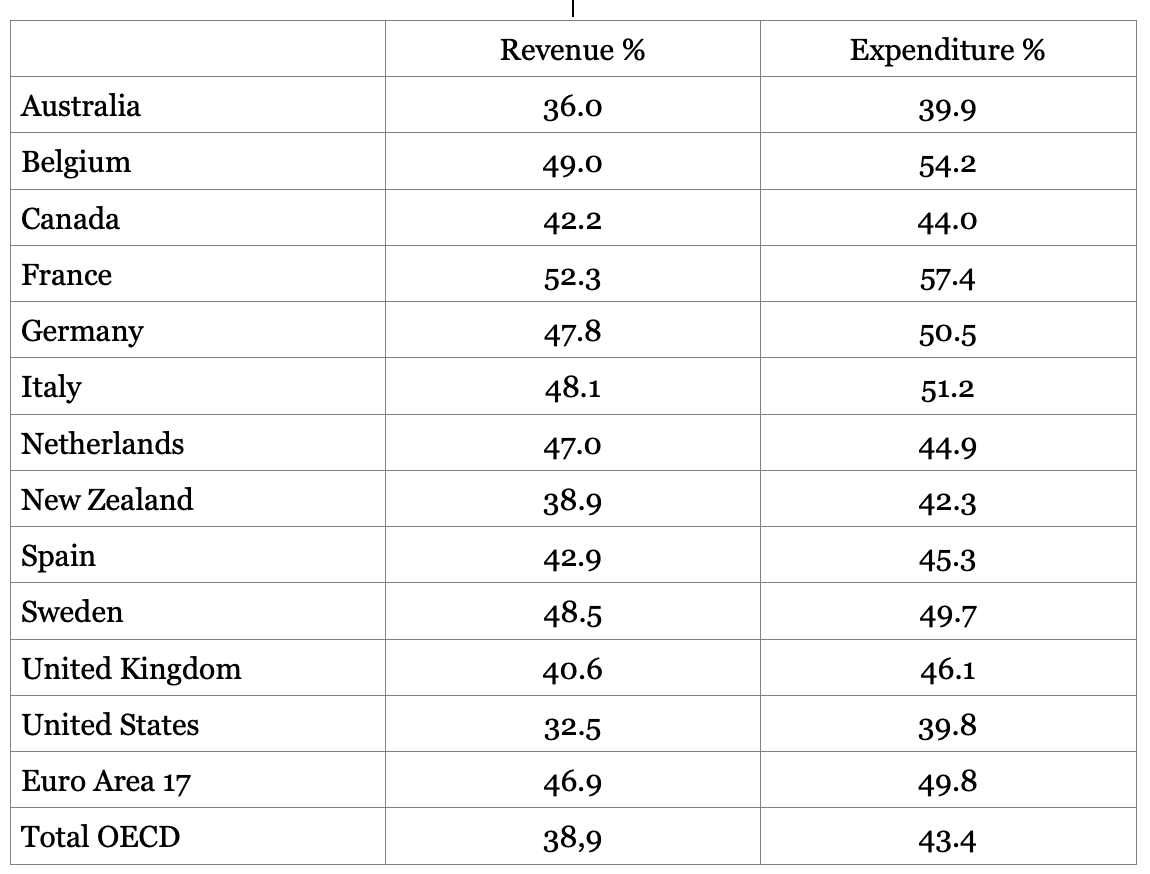
But taxation, and consequently government spending, is lower in Australia than in almost all other developed economies (see Table 1). Indeed, no other developed economy has lower government expenditure than Australia, but the higher levels of taxation in other similar countries have been affordable and have not damaged their economic growth in the past. So the evidence shows that Australia could raise more revenue if we need it to pay for adequate government services.
Table 1 Comparison of revenue and expenditure as proportion of GDP in 2025
Furthermore, although Labor has moved to improve health and care services, there are constant newspaper reports of services that are still under-funded. Some of the more important examples of this under-funding follow.
The queues for emergency care at hospitals are too often too long, partly because of bed-block caused by an insufficient number of aged-care beds, and home-care packages are often delayed for more than a year.
Universities Australia reports that average funding per Commonwealth-supported student place in universities has fallen six per cent in real terms since 2017. Universities have therefore been forced to rely on the fees paid by foreign students to cross-subsidise their Australian students. But now the opposition wants to cut the number of foreign students, thus further damaging Australian universities, and in the long run that will damage the economy too.
Real funding for the CSIRO and research and development has also been reduced, further damaging economic growth.
The Gonski reforms to ensure adequate funding of all Australian schools have still not been fully implemented more than a decade after these reforms were initiated. As a result, the most disadvantaged schools, in particular, are still under-funded, thus damaging the life prospects of young people from lower socio-economic backgrounds.
Realistically, the government’s present policy approach to reducing carbon emissions will require additional expenditure if we are going to achieve net zero in time. In addition, there is general acknowledgment that we need to spend more on defence and foreign aid and diplomacy to enhance our national security. The investment in, and access to, public housing is a fraction of what it used to be.
My rough estimate is that to adequately fund government services and assistance, while also restoring budget balance, the Australian government needs to increase its tax revenue by around four per cent of GDP. That would still leave Australia as a lower taxing country than most other developed economies in Europe, and also lower than Canada, and the per capita GDP growth rate of these other countries is just as good as ours.
Surely it is time for the Albanese government to grasp the nettle and try to change the terms of the taxation debate. Instead of paying lip-service to the unachievable goal of lower taxation, the government should start making the case for why we need to raise more revenue if we are to preserve our society and the services that underpin that society.
How we can do this while minimising the risks to our living standards will be discussed in Part 2.

Michael Keating is a former Secretary of the Departments of Prime Minister and Cabinet, Finance and Employment, and Industrial Relations. He is presently a visiting fellow at the Australian National University.