A personal Anzac Day reflection on service, sacrifice and the enduring lesson that war should be remembered, not glorified.
Another ANZAC day approaches I commemorate those who serve, especially my grand uncle Mick who rode a famous horse, ‘Bill the Bastard’ at Gallipoli in WWI.
Bill was a chestnut horse from New South Wales; hence they were called ‘Walers.’ No one then could ride Bill when they were at the Liverpool marshalling yards in Sydney, so he was called, ‘Bill the Bastard.’ Bill was one of 130,000 horses sent over for the war effort in the Middle East.
My grand uncle, Michael Shanahan, was born in Roma, Queensland. After the war, Mick was often known as ‘The Major.’ He went over in the Second Light Horse Regiment as a Lieutenant and came back as a Major. He met Bill in Egypt and wanted him for his own mount. Banjo Paterson (1864-1941) – yes, that ‘Banjo’ – was Mick’s superior officer in the Remount Group, and Mick managed to convince the Banjo to let him have Bill. The Major used to encourage Bill with liquorice-all-sorts, but apparently, you could never really tame Bill.
On 3-5 August 1916, Bill and Mick fought in the Battle of Romani. The Turkish, British, and Australian forces all desperately needed to take control of the water wells. Bill and his mates charged the Turkish machine-gunners and the wells were captured.
During this battle, Mick rescued four Tasmanian soldiers whose horses had been shot out from under them. He lifted them onto Bill’s back with him while Bill trudged back through the desert sand. It is amazing that Bill could carry these four Tassie troopers plus Mick. Bill was strong and courageous: he ran for six hours that day and had exceptional stamina. Mick was shot and later, had his left leg amputated at the military hospital in Cairo.
This courage earned ‘The Major’ a Distinguished Service Order (DSO). The citation for his DSO medal awarded on the 25 November 1916 reads:
‘Australian Forces – Major Michael Shanahan, Light Horse Regiment. For conspicuous gallantry in action. He organised and maintained the outpost lines with the greatest courage and determination. Later, he rescued several wounded men under very heavy fire. He was wounded.’
My dad always reckoned that Mick should have been awarded a Victoria Cross (VC), for his extraordinary valour at the Battle of Romani, as special as the DSO award is.
Bill died in 1924 and was buried at Walker’s Ridge Cemetery in Gallipoli, Türkiye. The plaque at Bill’s gravesite reads: ‘Bill. Australian Light Horse. 1914-1924. A Waler and One of the Best.’ The Major died in Brisbane on 12 October 1964 at the age of 94, exactly 40 years after Bill.
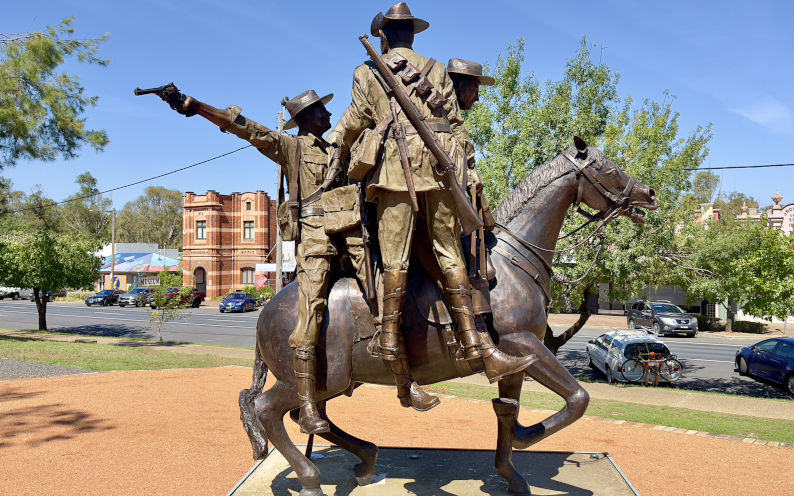
There is a life-sized statue of Bill and Mick rescuing the four Tassie troopers at Harden-Murrumburrah (NSW). Each year, the Battle of Romani is commemorated at Tabulam (NSW) where General Sir Harry Chauvel established the Australian Light Horse. I was fortunate to be asked to speak at that memorial dinner in 2023 and to be interviewed by ABC Radio since I had authored a book called Big Bill.
Bill was posthumously awarded the Blue Cross in 2018 for his valour as an animal in wartime. He was the first Australian equine to receive this award.
I was 14 years old when the Major passed away. I remember him fondly as my granduncle. We used to pick strawberries together at my grandma’s (Mick’s sister) and he would tell me to “whistle when you pick strawberries.” I didn’t know what he meant. Dad explained to me, “son, if you are whistling, you aren’t eating them.” I thought that was very clever.
I grew up knowing Mick had done something special in ‘that war’ but we were never allowed to talk to him about it or ask him how he’d lost his leg. I wish I had. The family, especially my cousin Terry Shanahan, have helped to piece together the story of Bill and the Major.
There were two main lessons that I learnt from grand uncle Mick. The first is ‘war is a bastard’ and the second is ‘serve when you must.’
War is a bastard
Mick spoke to my dad over a beer at night about the waste of war and that ‘war is a bastard.’ I once said to him ‘but you said Bill was a bastard.’ He replied, ‘but Bill was a good bastard.’ Mick would go quiet when Dad asked him about those he knew who had died. “So many, so many,” he would mumble, as he nodded off at the kitchen table. Sadly, the world is still at war – in the Ukraine, Gaza, Iran, Lebanon, Sudan … I’m sure Mick would agree that we haven’t learnt much at all about the tragedy of war.
Mick seemed to be ambivalent about ANZAC day – he was worried that people were promoting the so-called glory of war when all he wanted to do was remember and honour his mates. When we did go with Mick to the ANZAC day march in Brisbane, I saw how the younger diggers respected my grand uncle. They all knew what the DSO meant, and that Mick had ridden one of the most famous horses in Australia’s military history.
Serve when you must
While Mick had volunteered for the Great War, dad told me that Mick eventually thought we should never fight ‘in other men’s wars’ and yet he himself had done precisely that. For Mick, fighting the Japanese in WWII was OK because they had bombed Darwin and sent a midget sub into Sydney harbour. To fight in defence of your country was a good and honourable thing to do.
If Mick could give a few words of advice, I reckon he would say – keep the ANZAC tradition alive, but do not glorify war. Celebrate those who serve and who fight for us. Work tirelessly for peace, but not for peace at any cost. Fight when you must, and in battle, be the best you can be. Aussies, like my grand uncle Mick, have always been known for their prowess on the battlefield and in peacetime.
In my own extended family, my father-in-law was an artillery inspector in WWII who passed away aged 99. Also, my niece is a flight lieutenant in the Royal Australian Airforce.
I am grateful to all those who have served us, and who are serving us today. I am especially proud of my grand uncle ‘The Major.’ I reckon Bill was not a bastard but a hero on four legs.

Greg is a part-time university lecturer, a civil funeral celebrant, and a children’s book author. He was a management consultant for forty years, specialising in leadership, strategy and organisational behaviour. His PhD challenged the view that human beings at work were merely ‘human resources’. He is married and lives on the Sunshine Coast in Queensland. He has published previous articles in Pearls and Irritations on leadership, religion, and grief.