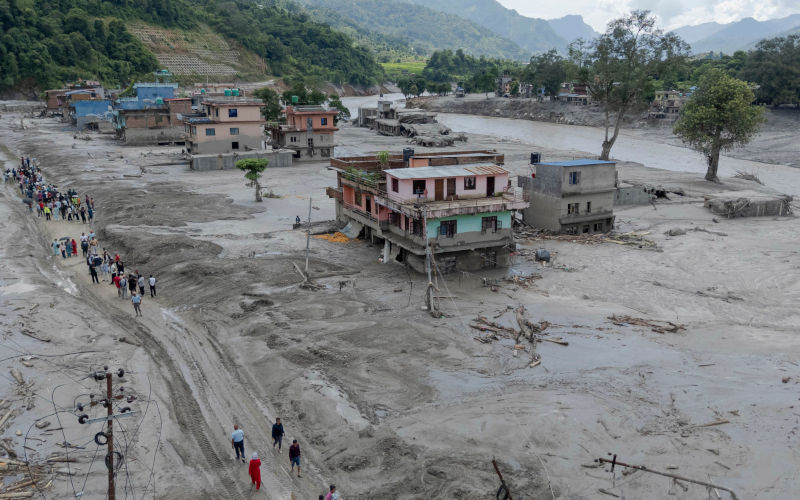
Nepal devastation the worst in its history. Plus: unusual response as Trump curries favour with Kim, Myanmar militias entrench cyberscam operations, China breaking Asia’s ‘flying geese’ industrial model; region seeks open-road AI pathway; and why women are forced to drink.
Mount Langtang Lirung, 45km north of Kathmandu, rises to an imposing 7,245m above sea level and has a tragic history. It now has an even more tragic present.
In 2015, an earthquake shook central Nepal, triggering an avalanche on its south face. Rock and ice plunged into a glacier below, burying a village and killing some 300 people.
On Wednesday, a 4.4 magnitude earthquake struck near the Nepal-China border at 8.37am local time, the Nepali Times reported. It coincided with an avalanche on the north face of the mountain. Debris from the avalanche blocked the Lhende Khola River that marks the border, forming a temporary lake. But the dam soon burst, sending a tsunami of mud and boulders racing down the Trisuli River.
The unimaginable scale of the catastrophe was becoming apparent, the paper said in an editorial. It said: “With every notice about a bank branch that lost all its staff, a police station without a single survivor, buses full of Janai Purnima [Nepal’s sacred Hindu festival] pilgrims swept away, and phone calls to this office from Indian families asking to locate their loved ones – we have had to come to terms with the tragically high cost in human lives.
“In terms of economic damage to infrastructure and property, it is the worst in this country’s history… The debris flow at Timure on the border [with China] was nearly 80m high and as the flood raced downstream it swept everything in its path. It spared nothing.”
By Friday, The Hindu reported the death toll had reached 469.
The Indian Express said authorities had reported differing numbers of missing people – up to as many as 1,300. A Reuters report said 667 tourists were among the missing, including 540 foreigners from 31 countries.
Some 35 Australians were missing, along with 65 Americans, 55 Malaysians, 53 Ukrainians, 33 British citizens and 25 Canadians.
Xinhua, the official Chinese news agency, said three people had been killed in Xizang (Tibet) and 588 were missing.
The flood hit at the beginning of the trekking season in Nepal, the peak season for tourism in Tibet, and two days before an auspicious full moon day for Hindus and Buddhists and those who follow animist faiths.
The risk of more devastation remains. The Hindu said Nepal and China had both warned of danger as two lakes had developed on either side of the border and threatened to burst.
Crowds gathered at army centres and hospitals in Nepal, as people searched for loved ones. The Kathmandu Post told the story of Shashikala Khatiwada, whose husband was trapped in a hydropower project tunnel. Her husband, Dipak Rimal, messaged her saying he was in the tunnel but the gate was blocked. With him were 35 other workers.
The flooding catastrophe was not a ‘natural’ disaster, the Nepali Times editorial said. “Nothing about it was natural,” the paper said. “[N]ot the glacier melting due to greenhouse gas build-up due to fossil fuel burning, not the location of expensive hydropower plants on trans-Himalayan rivers, not designing highways to follow rivers, not the settlements that have grown around them, not the corruption and greed, not the poor governance.
“No one could have predicted this disaster would happen when it did. But anyone could have said it was bound to happen one day.”
Two papers, same commentary slamming ‘megalomaniacal’ Trump
Donald Trump’s recent social media post currying favour with North Korean dictator Kim Jong-un and downgrading military exercises with Seoul’s forces provoked an unusual response from South Korea’s media: two English-language papers this week published the same harshly worded opinion piece, describing Trump as an ageing, raging president with a megalomaniacal belief in his own brilliance.
The commentary was written by Trudy Rubin, a columnist with The Philadelphia Inquirer, and distributed by the Tribune Content Agency. It was published in The Korea Times (South Korea’s oldest English-language paper) and The Korea Herald (the biggest-selling English paper). The identical texts are here and here.
“He’s become world-famous for embracing America’s enemies and backstabbing our allies,” Rubin wrote. “Yet, US President Donald Trump outdid himself on Aug. 16 – on the eve of joint military exercises with South Korea – when he announced the US was scaling back participation to avoid offending his great friend, the nuclear-armed North Korean dictator Kim Jong-un.”
Trump, she said, had an unshakeable belief that his great relations with Kim (along with Russia’s Vladimir Putin and China’s Xi Jinping) would convince them to do his bidding.
“He refuses to recognise that far from friendship, Kim, Putin and Xi are bound together in an axis of adversaries who are helping a fourth member – Iran – stand up to the United States,” she said. “Trump’s superhuman delusions aid all these adversaries, even as he dismisses allies who could help keep them in check.”
The Korea Herald took offence at Trump’s use of social media to announce his pro-North, anti-South change of heart, as well as his lack of consultation.
“An alliance can survive disagreement,” the paper said in an editorial. “It is harder to sustain when one side learns about a major security decision from social media.
“It is worrisome that Trump’s instruction came without any apparent advance consultation with Seoul.”
The Japan Times was also critical of Trump’s announcement. It did not affect Japan directly, the paper said in an editorial, but it signalled a worrying shift in US policy toward Kim, the Korean Peninsula and allies generally.
Trump seemed to be ready to follow up his first-term efforts to strike a nuclear deal with Kim, the paper said. There were fears a condition of these talks would be acceptance of North Korea’s nuclear weapons capability, a demand Pyongyang had made before it would resume diplomatic talks.
“This would do great damage to the global non-proliferation regime, shift the regional balance of power and undermine confidence in the US as a provider of security by accepting a check on its extended nuclear deterrent,” the editorial said.
Thousands trapped in border-region cybercrime hub
The Myanmar border area close to Thailand is an entrenched hub for cyberscam syndicates, despite a supposed crackdown by authorities late last year.
An NGO report said more than 13,000 people from Asia, Africa and South America were being forced to work at scam compounds near the border town of Myawaddy and near Three Pagodas Pass, about 200 kilometres to the south.
The operations are controlled by three Myanmar militias, two of which are linked to the ruling administration, according to a story in ucanews.com, the Asian Catholic news site.
It draws on a report compiled by the Civil Society Network for Human Trafficking Victim Assistance. The report is based on what it calls victim-led intelligence, which makes it possible to trace transfer routes between compounds, identify hidden compounds and support rescue operations.
Ucan says at least 13,760 people are trapped in the compounds – a number which has more than doubled since the NGO’s 2025 report.
The story says the operations are divided into two groups. One consists of eight compounds controlled by the Border Guard Forces and the Karen National Army and holding 8,370 people. The other, a group of four camps holding 5,300 people, is controlled by the Democratic Karen Benevolent Army.
“The BGF and DKBA have long-standing ties to the Myanmar military,” the story says.
The NGO report says the scammers use social media and dating apps to present fake personas to try to trick people into taking part in the scams. The most dangerous app was LinkedIn, as most of the large scam operations originated there.
Ucan quotes a source in the People’s Defence Force, the armed wing of the opposition National Unity Government, as saying organised crime syndicates have established an overwhelming presence in the Three Pagodas Pass area. “New buildings are going up and they are easy to spot,” the source says.
A UN report published this week says human rights abuses in Myanmar have plunged to a new low. A story in The Irrawaddy, the Burmese exile news site, quotes UN human rights chief Volker Turk as saying the report depicts a heartbreaking picture of suffering, misery and cruelty.
China undercuts Asia’s low-tech products
An old metaphor for industrialisation across Asia is the image of a formation of flying geese. It originated in Japan in the 1930s and was popularised in the 1980s. It holds that a ‘lead goose’ (in those times, Japan) would pioneer an industry, then exit it as rising wages made it unprofitable. A following ‘goose’ would take it up, only to leave it as their wages rose. It would pass the industry to the next ‘goose’.
But an analytical article in Singapore’s The Straits Times says the model is now breaking down because China has not exited labour-intensive industries in the way that Japan and the Asian Tigers – South Korea, Taiwan, Hong Kong and Singapore – had done in the past. Worse, it is then undercutting local suppliers through such e-commerce operations as Temu and Shein.
It says that across Malaysia, traders selling incense sticks are being undercut by Chinese-made products sold through Temu at roughly half the local wholesale cost.
The same pattern is being repeated in hundreds of low-tech product lines across South-East Asia, says the story, written by economic affairs journalist Vikram Khanna, a former Straits Times associate editor.
“It looks like ordinary price competition,” he says. “It is actually something more consequential: the slow collapse of the ‘flying geese’ model that explained, and enabled, decades of Asian development.”
He takes the textile industry as an example.
Chinese textile wages rose steeply in the recent past. Yet China has not given up labour-intensive manufacturing. Instead, he says, it has upgraded selectively, abandoning the lowest-value stages, like the stitching of garments, while tightening its grip on processes above them.
Between 2013 and 2019, China’s apparel exports fell 16.4 per cent but its exports of yarn and fabric – the inputs that go into clothing – rose by 14.9 per cent.
This is one part of the collapse of the model. The other is in distribution.
Khanna says South-East Asian manufacturers need domestic wholesale and retail chains to reach their customers. Chinese e-commerce platforms have deleted these intermediate steps, selling directly – and ultra-cheaply – to Asian consumers.
It would seem that the article poked someone senior in Beijing, as it prompted the extraordinary response of an editorial in Global Times, an official Communist Party newspaper.
The growth of Asian economies in recent years is enough to debunk the ‘China squeeze’ theory, the editorial says. If China were crowding out the development of neighbouring economies, the share of manufacturing of their production and their overall exports would be declining. “The reality is precisely the opposite,” it says.
The paper says, however, that China’s manufacturing sector is becoming deeply interconnected with those of other countries. The editorial says the fabrics used by garment factories in Vietnam, the soles used in shoe factories in Bangladesh, and the zippers used in backpack factories in Cambodia, all come from China.
Region likes China’s AI models but dodges its rules
Throughout South-East Asia, Chinese firms have laid fibre-optic cables, supplied 5G networks, and built smart-city platforms. This is part of the Digital Silk Road, the technological arm of the Belt and Road Initiative.
As viewed from Washington, the DSR aimed to export not just technology but also authoritarianism. A story in The Diplomat, said there was little doubt about China’s ambition to set the rules of digital governance, rather than simply build the infrastructure. But whether Chinese norms would take root was a different question.
The commentary, by Ilaria Carrozza of the Peace Research Institute Oslo, said the actual picture was complicated. Indonesian cybersecurity agencies enforced standards developed in Geneva; the Philippines modelled its privacy law on European regulation; Malaysia’s approach to AI borrowed from UN principles and regional frameworks.
“In three of the Digital Silk Road’s most important partner countries, Chinese hardware is widespread but Chinese rules are not,” Carrozza said.
“In cybersecurity, where the rules were settled long ago, the West’s standards won by default and China is locked out. And in the field of AI, where the rules are still being written, South-East Asia is drawing overwhelmingly on Western and multilateral sources, adapted through local values and institutions. China’s normative mode isn’t winning friends in either case.”
A story in Hong Kong’s South China Morning Post said that at a recent APEC forum, ministers supported open-source AI models. This was a rare point of agreement in a debate often framed as a US-China contest.
The story, written by academics Chenjie Song and Minghao Sun, said it pointed to an order that cut against the assumption of a contest with a single winner – an assumption that shaped Washington’s alarm over every Chinese AI breakthrough.
Leading Chinese systems were open-weight (free to download and use) and governments across Asia were building their own systems on open Chinese models.
But the Chinese systems were producing an AI order in which no single country or company owned the field.
“That openness matches what many states pursuing sovereign AI want: a multipolar landscape where they control their own capabilities rather than rent them from a foreign platform.”
Xi Jinping called on countries at last month’s World AI Conference in Shanghai to embrace open-source development, the story said. He had warned against hoarding technology behind national security.
“The message landed because it described a world that states were already building,” the story said.
Business dinners a trap for young female employees
Ten or so years ago Audrey Jiajia Li had a job that meant she was often invited to business dinners.
“Seating followed an unwritten rule, with the most powerful person taking the seat of honour, flanked by two young women,” she says. “Everyone knew what we were there to do: keep the conversation lively, entertain the guests and, above all, raise our glasses.”
Li’s memories of her former role were revived by news reports that a young female employee was forced to drink large amounts of alcohol after a business dinner in Hangzhou, in eastern China. She was then allegedly assaulted and injured at a karaoke lounge. Last week, two officials were detained, and removed from their positions, over allegations they had sexually assaulted her.
Li says she was a terrible drinker but, under pressure, she would force down a glass or two. Baijiu (a strong, clear Chinese spirit drink, of which Moutai is the best-known brand) is clear and she could sometimes spit it into a napkin without anyone noticing, she says in a South China Morning Post story.
“However, that didn’t always work. Once, I was told to drink what they called a ‘red apple’, or a full glass of red wine,” she writes. “There was nowhere to hide it. I drank it, blacked out later, vomited three or four times and spent the next day with a splitting headache.
“What I remember most vividly is not the physical misery. It’s a strange sense of shame. Why could everyone else drink but I couldn’t?”
The ability to drink was seen as an important professional skill.
The reported Hangzhou assault raises uncomfortable questions, Li says. “Why was a young female employee expected to be at that dinner in the first place?” she asks. “Perhaps she felt what I once felt. If your boss asks you to come, you come. If everyone drinks, you drink.
“That is one of the most insidious things about drinking culture. It doesn’t always need an explicit command. Power itself can function as an order.
“That is why I don’t think the Hangzhou case can simply be dismissed as a drunken indiscretion.”

David Armstrong is the Editor-in-Chief of Pearls and Irritations. David is one of Australia’s best respected reporters, editors and media executives, with more than five decades of experience in Australia and Asia. A contributor for more than 10 years, David writes a regular column on Asian media.