India’s Gen Z social mobility crisis, Tokyo’s new foreign intelligence agency, Chinese chip company’s blockbuster IPO, regional nations’ evolving security co-operation, central banker’s sudden resignation, and the PM’s melon-headed mockery.
The immediate trigger for India’s Cockroach Revolt was the leaking of questions for the National Eligibility-cum-Entrance Test, the amazingly competitive medical entrance exam. Almost 2.3 million students were competing for 137,000 places.
But, says a political risk expert, the underlying issue was a growing tension between rapid economic growth and declining confidence among young people in social mobility. The International Labour Organisation, says Adriel Kasonta, writing in Hong Kong’s South China Morning Post, has warned of a disconnection between qualifications and opportunities.
“India’s Constitution outlawed caste discrimination decades ago and affirmative action policies have expanded access to higher education,” he says. “[But] research suggests that family background and caste still strongly influence economic outcomes, limiting the equalising effects of education alone.
“This explains why the protests resonate beyond students preparing for medical school. What began as anger over exam irregularities has turned into a broader expression of frustration over unemployment, governance and accountability among India’s younger middle class.”
The entrance exam was held on 3 May but it was soon scrapped following allegations that papers had been leaked. On 6 June, the Cockroach Janta Party, originally a satirical grouping led by activist Abhijeet Dipke, staged a protest in New Delhi, demanding the resignation of then-education minister Dharmendra Pradhan, as detailed in a timeline published by Singapore’s The Straits Times.
On 20 June, the CJP began a sit-in protest at Delhi’s Jantar Mantar observatory, a recognised protest site. The protest crowds grew and on 20 July police charged, wielding batons and firing tear gas. On 25 July, Pradhan resigned.
A commentary in The Hindu newspaper describes the generational chasm in India as the WhatsApp generation being challenged by the Instagram generation. The analysis, by Varghese K George, the paper’s resident editor, New Delhi, says Narendra Modi’s Bharatiya Janata Party (BJP) has the tools to tame the WhatsApp universe but in the Instagram universe it is like a deer in the headlights. It is left with nothing but brute force.
“The WhatsApp generation were Hindutva natives while the Instagram generation is insurrectionary,” he says. “Parents who have sent a message to their kids on WhatsApp and noted that they don’t even see it will recognise a disconnect. Then they discover that their kids these days communicate on Instagram, Snapchat, etc…
“That is the disconnect between the WhatsApp generation and the Instagram generation. That is the disconnect that is mirrored in the disconnect between the BJP-controlled Indian state and the country’s youngest generation.”
Political scientist Pratap Bhanu Mehta says in an Indian Express commentary Modi’s government will never recover its untrammelled authority. But Mehta, a contributing editor, also sounds a warning.
“For this government, the loss of face, and the potential loss of power, is existential,” he says. “It may have retreated for the moment, but it will almost certainly return with renewed determination, doubling down on repression…”
Japanese minister’s ‘no taboos’ nuclear weapons debate
Japan is stepping up its drive to strengthen its national security and defence policies, moving to establish an independent foreign intelligence agency at the same time as a senior minister is pushing to loosen the country’s nuclear weapons restrictions.
The ruling Liberal Democratic Party this week approved a plan to overhaul the country’s intelligence system, with criminal penalties for illicit foreign interference and broader intelligence-gathering powers, as well as a new foreign intelligence service, The Japan Times reported.
It said this represented the second stage of reforms, launched in May, when the government announced a National Intelligence Council, chaired by the prime minister, and upgraded a cabinet intelligence office to create a National Intelligence Bureau.
The bureau began operating this week. It would co-ordinate and analyse information gathered across the government.
The new proposals focused on collection and counter-intelligence, areas long-seen as fragmented and lacking legal support, the paper said.
“With foreign espionage activities intensifying, the need (for a stronger intelligence system) is growing,” said Akihisa Shiozaki, secretary-general of the party’s intelligence panel.
The paper said in an editorial national intelligence reform had long been neglected but it was critical to the success of Japan’s defence modernisation effort. It quoted Prime Minister Sanae Takaichi as saying Japan faced a security environment that was the most severe and complex since World War II.
The Asahi Shimbun newspaper reported last week that Defence Minister Shinjiro Koizumi had broken with convention by calling for a national debate on whether nuclear weapons should play a role in Japan’s defence.
He said France was strengthening its nuclear forces and Finland was allowing nuclear weapons to be deployed on its soil. Japan, in turn, should debate all policies, without taboos.
The story said Koizumi’s remarks were a significant challenge to Japan’s three non-nuclear principles – not possessing, not producing, and not permitting the entry of nuclear weapons. Takaichi had long supported a review of the ‘no-entry’ principle.
The paper said in an editorial on Wednesday Koizumi’s remarks were likely a preliminary step to placing the principles on the agenda as the government revised, by the end of the year, the country’s three national security documents – the National Security Strategy, the National Defence Strategy and the Defence Buildup Programme.
“What message would be sent to neighbouring nations if Japan should now revise its three non-nuclear principles?” the editorial asked.
“That might heighten a confrontation of might against might and damage the peace and stability in the region…
“The international trust that Japan has built up in the postwar era by calling for the elimination and reduction of nuclear weapons under a non-nuclear policy must not be eroded.”
Chip companies record massive profits but markets twitch
The Asian chipmakers boom is continuing but with “downs” of edgy share markets interrupting the “ups” of staggering profits. Competition from China has stirred up nervous reactions, especially in South Korea, the leading producer of AI memory chips.
ChangXin Memory Technologies, a Chinese company known as CXMT, listed on Shanghai’s STAR (technology) market on Monday and it was Asia’s biggest IPO this year. The company began trading at 49.5 yuan (A$10.52) a share, 465.8 per cent higher than its offering price.
The trading valued CXMT at US$484 billion (about A$695 billion), making it the most-valued listed company in mainland China. It also outranked Intel (US$464 billion), Nikkei Asia, the online business and politics magazine, reported.
CXMT, it said, was the fourth-largest producer of dynamic random access memory (DRAM) chips, used in data centres supporting artificial intelligence.
But the listing sparked a negative reaction elsewhere. South Korea’s KOSPI market fell more than 10 per cent on Tuesday, triggering a 20-minute circuit-breaking pause. The Korea Times called it ‘black Tuesday’. It said CXMT’s blockbuster debut fuelled concerns over intensifying competition in the memory chip market.
On Wednesday, SK Hynix, the world’s second-biggest DRAM chipmaker, reported a record quarterly profit of 60.54 trillion won (more than A$60 billion) – a year-on-year increase of 557.2 per cent. But, The Korea Herald said, the company’s shares ended the day down by 9.61 per cent.
“The record results offered little support to SK Hynix shares amid a broader market sell-off,” the paper said.
South Korea stocks on Wednesday accelerated their recent declines, Nikkei Asia said.
Other East Asian markets had been losing steam because of mounting worries over Chinese semiconductor producers as well as uncertainty about the AI sector’s profitability and funding.
Samsung Electronics, the biggest manufacturer of DRAM chips, on Thursday reported a huge second quarter profit of 89.5 trillion won (about A$89.4 billion) This represented an increase of 1814 per cent from a year earlier, The Korea Times said.
Its shares finished the day down by 0.72 per cent.
The company dismissed market concerns over a potential memory chip glut, the paper said, and announced plans to begin work this year on a new US chip fabrication plant (known as a fab).
ASEAN and the Quad get together; Beijing notices
Donald Trump is still pondering the future of the US-China relationship and remains distracted by Iran. But no matter where US regional policy eventually lands, Asian countries, especially Japan, India and Australia, are slowly positioning themselves to organise Indo-Pacific security co-operation.
That’s the view of Ravi Velloor, senior columnist at The Straits Times. Like many columnists and commentators in Asian media, Velloor is exploring changing relationships in the region, with new links being forged away from the US-China spotlight.
Japan, he notes, cannot afford to wait until strategic clarity emerges from Washington. Statements by Prime Minister Sanae Takaichi linking Taiwan to her country’s security, plus nearby Sino-Russian military drills and close stand-offs near the dispute Senkaku/Daioyu islands, along with Chinese accusations concerning Japan’s ‘new militarism’, all point to a changed security environment.
Takaichi has revamped the concept advanced by her mentor, the late Shinzo Abe, of a free and open Indo-Pacific.
She has also made significant contacts with India and Australia and with the ‘Squad’ – an informal grouping swapping the Philippines for India from the Quad. It focuses directly, Velloor says, on regional maritime security and joint training. Takaichi is also working overtime to repair relations with South Korea.
India’s Narendra Modi recently visited Indonesia, Australia and New Zealand. Talks in all three countries featured defence co-operation and critical minerals.
An article in The Diplomat, the Asian online news magazine, says Japanese Foreign Minister Motegi Toshimitsu visited Manila last week for the Japan-ASEAN Foreign Ministers’ Meeting. But it was not just another round of ASEAN diplomacy. Rather, it was a clear, public manifestation of how Japan is shifting its engagement beyond traditional development assistance, toward practical security co-operation.
Motegi, the story says, described ASEAN as being at the core of Japan’s vision. He pledged closer co-operation on maritime security, economic security, energy resilience, artificial intelligence and disaster response.
Japan, the article says, is also trying to connect Southeast Asia with wider Pacific security arrangements. ASEAN countries attended for the first time, as observers, the Japan-Pacific Islands Defence Dialogue, held in February. The meeting was shaped by concern over China’s influence in the region.
Another story in The Diplomat says Quad foreign ministers (from India, Japan, Australia and the US), attended last week’s East Asia Summit in Manila and for the first time issued a joint statement with ASEAN foreign ministers. Areas of co-operation mentioned were: maritime and transnational security; economic prosperity and security; critical and emerging technologies; humanitarian assistance; and emergency response.
The article says it is significant that the statement was made at ASEAN’s premier forum, of which China is a founding member. For the Quad to hold its meeting there, in China’s own strategic neighbourhood, was a signal aimed at Beijing.
ASEAN’s acceptance of the Quad’s effort to insert itself as a regional stakeholder was important, as China viewed the Quad as an Asian NATO.
“The visible loosening of ASEAN’s reflex to keep the Quad at arm’s length will not be lost on Beijing,” the story says.
Concerns aroused over Bank Indonesia’s independence
Perry Warjiyo, governor of Bank Indonesia, resigned unexpectedly this week, citing unspecified personal reasons. He had been in the role for seven years and had two years to go before his term expired.
His resignation sent stocks and the rupiah falling, reflecting investor concerns about the independence of the country’s central bank, said a report in Nikkei Asia.
The story asked if his resignation had been related to the declining value of the rupiah. It had hit multiple record lows and had been Asia’s worst-performing currency this year.
President Prabowo Subianto had reportedly rebuked Perry in May for failing to protect the currency, the story said. Since then, the bank had raised its policy rate three times – by 100 basis points to 5.75 per cent.
But concerns over the bank’s independence had already been aroused by the appointment, in February, of Thomas Djiwandono to a deputy governor’s post, the story said. He is Prabowo’s nephew.
The Diplomat said Senior Deputy Governor Destry Damayanti would be acting as governor until a replacement was found. The replacement would be chosen by parliament from three candidates put forward by Prabowo.
The resignation came at a difficult time for the economy, the story said. The rupiah was now trading at a lower level than at any time since the Asian financial crisis of 1997-98.
“The bigger issue is how Perry’s resignation might compound investors’ growing skepticism about the Prabowo administration’s economic stewardship,” The Diplomat said.
“[The bank] has been under pressure to support Prabowo’s economic policy, which aims to achieve an annual GDP growth of 8 per cent per year for the rest of his term.”
Ratings agencies had expressed concern over Perry’s resignation – and over the inclusion, on the same day, of the state asset fund, Danantara, in the decision-making processes of the top-level Financial System Stability Committee, The Jakarta Post said.
It quoted Martin Petch, vice-president of ratings at Moody’s, as saying the change of leadership could have a bearing on credit implications, depending on the future credibility of monetary policy.
George Xu, Asia Pacific sovereign ratings director at Fitch Ratings, said the rupiah might come under extra pressures because of the latest developments.
Rain Yin, a sovereign analyst at S&P Global Ratings, said Perry’s resignation might contribute to greater monetary policy uncertainty.
Takaichi: the female leader nobody defended
When Anthony Albanese confessed in a podcast he would like to spend some very private time with Kylie Minogue, the public and political reaction was a swift, strong negative. Albanese apologised.
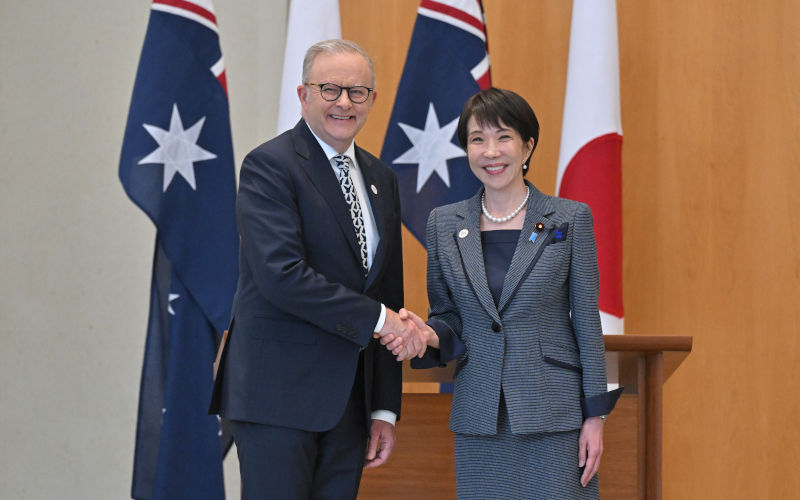
But in the same podcast, looking to please his host, comedian Nikki Osborne, Albanese made a joke at the expense of Japanese Prime Minister Sanae Takaichi.
He recalled that when Takaichi visited Australia in May, she had brought melons as a gift. Osborne made a crack about Pamela Anderson and Albanese grinned, cupped his hands in front of his chest, and said: “She brought two. As you do.”
Albanese mocked the first female prime minister in Japanese history and leader of Australia’s closest security partner in Asia. He did not apologise.
The disparity struck Japanese journalist and academic Waka Ikeda. “An Australian pop star’s dignity commanded a national conversation; a Japanese prime minister’s didn’t,” Ikeda said.
Takaichi’s gift, she said in a column in The Japan Times, had been chosen with diplomatic care – Crown Melons from Shizuoka (the Mount Fuji region), the most prized fruit in Japan.
“In Japan, a single Crown Melon can cost more than a fine bottle of wine,” she said. “Its perfection, based on the Japanese artisan spirit of takumi, is what you bring when you wish to honour someone.”
Ikeda said that what happened after the podcast was the real story – because almost nothing happened. Albanese had never spoken about the Takaichi joke; the Minister for Women, Katy Gallagher, had remained silent, and then-Victorian premier Jacinta Allan had brushed it aside as lighthearted.
Ikeda recalled that when Allan had been called a witch, Albanese had said it was “completely unacceptable to demean, objectify, belittle or offend women”.
Japan had also declined to comment. “Japan needs Australia on trade and security,” Ikeda said. “[T]he first female prime minister, fighting Beijing, cannot afford a quarrel over her own chest.
“[Takaichi’s] dignity was weighted against the alliance and found lighter.”
