Türkiye, Saudi Arabia and Pakistan’s new defence pact could reshape West Asian security, while China and Indonesia plan naval drills east of Taiwan. Also: Thailand’s welcome for Myanmar’s leader, Zhu Rongji’s legacy, the weak yen and India’s TV credibility crisis.
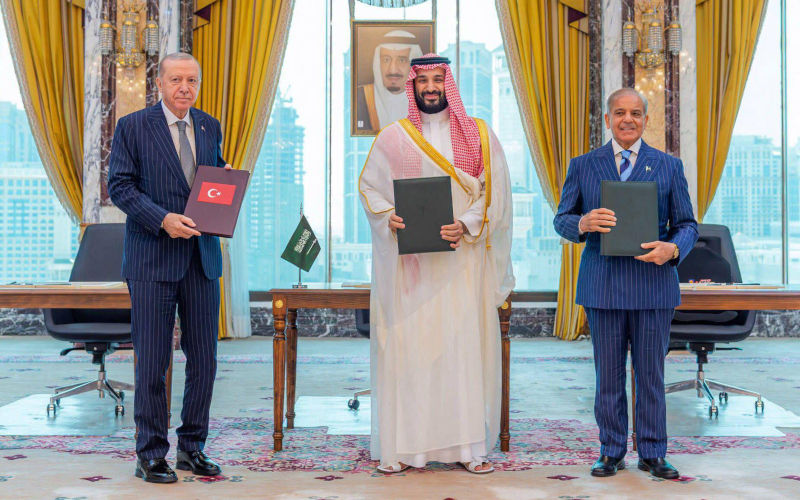
Türkiye, Saudi Arabia and Pakistan have signed a mutual defence pact that would treat an attack on one as an attack on all.
Türkiye is NATO’s strongest non-US military nation, with a big and growing defence industry, Türkiye and Saudi Arabia are the two largest West Asian economies and Pakistan is a nuclear power. All three are Sunni Muslim nations.
The agreement was signed last week in Mecca (or Makkah, the city’s official western-style name in Saudi Arabia.) Pakistan’s Dawn newspaper said the signing was a historic moment for the three countries.
It quoted former Pakistan federal minister Mushahid Hussain as saying the pact would be a big blow to Israel, an effective counter to Israeli expansionism.
The agreement came as Saudi Arabia faced pressure from Iran and its proxies, Nikkei Asia, the online politics and business magazine, said. It coincided with intensifying antipathy between Turkiye and Israel over Israel’s massive response to attacks across the region.
Experts expected the alliance could grow by attracting other Muslim countries.
It quoted Turkish Foreign Minister Hakan Fidan as saying the countries would set up a secretariat in Saudi Arabia and begin working on priorities, such as intelligence sharing, interoperability, logistics and defence industry co-operation.
A commentary in The Hindu said the signing of the pact could mark an important turning point in the geopolitics of West Asia. It highlighted the changing calculations of three of the Muslim world’s most important states.
For decades, West Asian security had depended overwhelmingly on the US, the analysis said. “The new pact does not terminate that dependence,” it said. “What the agreement suggests instead is a growing determination among regional powers to supplement external security guarantees with arrangements of their own.”
Zahid Hussain, a senior commentator with Dawn, said in a column the three countries spanned the Middle East, South Asia and Europe. He said it would be wrong to brand the triangular pact as a Muslim or Sunni defence bloc.
“It represents an emerging regional security architecture that reduces dependence on the US and pushes back against Israel’s expansionist agenda,” he said. “Questions have been raised about the reliability of the US as a defence guarantor for its Middle Eastern partners. Instead of ensuring security, the presence of US bases has made these countries… more vulnerable.”
Ravi Velloor, the senior columnist with Singapore’s The Straits Times, asked if the agreement could have been reached without Washington’s knowledge or tacit endorsement.
“Unlikely,” he said. “It probably makes sense to see the agreement as a sort of regional security layer taking shape under the shelter of an American security shelter.”
But, he added: “The desert sands are rapidly shifting.”
Taiwan condemns Beijing’s naval provocation
China and Indonesia are to conduct a joint naval exercise in the seas east of Taiwan, the first drill between China and a foreign country in these disputed waters.
Global Times, an official Communist Party newspaper, quoted Chinese military expert Zhang Junshe of the PLA’s Naval Research Institute as saying the exercise carried great significance, demonstrating China’s jurisdiction over the exclusive economic zone east of Taiwan.
The paper did not give details of the timing or the route of what it called a navigation exercise but said it would be conducted in mid-August. The PLA Navy ship involved would be the Honghe, a guided-missile frigate.
Taiwan’s top China policy agency, the Mainland Affairs Council, said it strongly condemned the Chinese Communist Party’s military provocation. “The move is… aimed at creating the false impression for the international community that the CCP has jurisdiction over waters east of Taiwan,” the council said.
A story in The Jakarta Post said Taiwan was now holding its largest military drills of the year, preparing the people for a possible Chinese invasion. Beijing regularly deployed warships, fighter jets and coast guard vessels around Taiwan to assert its claim of sovereignty over the democratic island, a claim Taiwan rejected.
The story said the Indonesia military did not respond to a request for comment.
Global Times said the China Coast Guard had conducted regular patrols in waters east of Taiwan, in response to a decision by Tokyo and Manila in May to launch boundary negotiations in the area.
Japan and the Philippines do not share a land border but their exclusive economic zones and continental shelves overlap. Taiwan sits almost directly between the two countries. The Japan Times said in a story in June any boundary would almost certainly pass through waters where the maritime entitlements of Taiwan, Japan and the Philippines overlapped. But Beijing considered those entitlements belonged to China.
Firstpost, an Indian news site, said the location of the China-Indonesia exercise was significant as China had been asserting its sovereignty claims.
It said the exercise highlighted the complicated position of Southeast Asian nations. Indonesia and the Philippines were both members of ASEAN and many governments in the region wanted to forge stronger security ties with major powers while trying to avoid being dragged into the China-US strategic rivalry.
Thai government’s business-as-usual with military strongman
The Thai government has hosted Myanmar leader Min Aung Hlaing on an official visit, giving him what a top political commentator has called undue red-carpet treatment.
It was one way in which Thai foreign policy was running amok in a manner inconsistent with its traditional crafty statesmanship, said political analyst Thitinan Pongsudhirak.
Thitinan, a senior fellow of Chulalongkorn University’s Institute of Security and International Studies, said Min Aung Hlaing stole power through a coup in 2021 and whitewashed his robbery through bogus elections last December and January.
Bangkok Post said that on 6 August Thai Prime Minister Anutin Charnvirakul and Min Aung Hlaing presided over a Thailand-Myanmar business forum in Bangkok. It was organised by the Thai Foreign Ministry and the Thailand-Myanmar Friendship Society. The visit was Min Aung Hlaing’s first trip to Thailand since the election.
Anutin said the two countries were opening a new chapter of economic co-operation, based on confidence, trust and mutual benefit, the paper reported.
Thitinan said the high-profile visit would divide ASEAN, which had sanctioned Myanmar’s military strongman by excluding him from ASEAN-related summits over the five years since the coup.
Writing in his Bangkok Post column, Thitinan said Anutin’s government had portrayed the visit by the dictator-in-disguise as ‘calibrated re-engagement’.
“With an official reception, meetings and a business forum, the visit looks less like calibrated diplomacy designed to win concessions and more like business-as-usual on Min Aung Hlaing’s terms,” he said.
“[T]he head of what is essentially a junta-backed government got what he wanted, from glowing legitimacy and post-coup personal vindication to business deals that will benefit his associates rather than the Myanmar people. This is the wrong way round.”
Benedict Rogers, a human rights columnist with ucanews.com. the Asian Catholic news site, noted that 8 August was the anniversary of the Myanmar military’s 1988 bloody crackdown on pro-democracy protesters. The date, when thousands of people were gunned down, had become known as 8888.
“[A]lmost four decades on… the military’s brutal repression has only intensified,” Rogers said.
“[S]ome in the international community appear to be beginning yet another cycle of engagement and legitimisation of this regime. Min Aung Hlaing’s visit to Thailand this week is an alarming sign that some in the region are ready to recognise him as president.”
Zhu Rongji: ‘re-educated rightist’ who moulded China’s economy
Zhu Rongji could trace his ancestry back to the 14th century and the first Ming dynasty emperor, Zhu Yuanzhang. He studied electrical engineering at Beijing’s elite Tsinghua University. This suggests a privileged background.
He joined the Communist Party in October 1949 – as Mao Zedong proclaimed the founding of the People’s Republic of China. But like many intellectuals he was later branded as a ‘rightist’, in his case for criticising projects in Mao’s Great Leap Forward. In 1958 he was sacked from the party and would be sent to a rural commune for ‘re-education’. His duties included planting rice, rearing pigs and cooking for villagers.
It would take 20 years before he was allowed back into the party but he eventually caught the eye of paramount leader Deng Xiaoping and would go on to become the driving force behind China’s economic reform. “Without him, China would not be the major economic power (it is) today,” said Tan Kong Yam, emeritus professor of economics at Singapore’s Nanyang Technological University.
Zhu died after a long illness on Wednesday – just two months shy of his 98th birthday. Several news outlets published long tributes to him.
The Straits Times said his bold economic reforms propelled China to become the world’s second-biggest economy.South China Morning Post called him China’s towering economic reformer Nikkei Asia said Zhu represented a more open era of engagement with the world, more so than the current government. And the party’s official obituary, printed in Global Times, said he was an outstanding leader of the party and the state.
Zhu was central bank governor from 1993 until 1995, vice-premier from 1993 and then premier from 1998 until 2003. The era of reform and opening up, which had started in 1978, had stalled after the Tiananmen crackdown but Zhu drove it forward, The Straits Times obituary said – restructuring the country’s state-owned enterprises and tax system and getting China to join the World Trade Organisation.
Zhu was known as a straight-talker who got things done, it said. He could not be faulted for timidity: he backed tough and far-reaching measures he believed were necessary, even when he knew they would be unpopular.
SCMP said Zhu was known for his determination to fight corruption and crush vested interest groups. He said at a news conference in 1998: “I’ll have 100 coffins prepared. Ninety-nine are for corrupt officials and the last one is for myself.”
The paper quoted Denis Wilder, senior fellow of Georgetown University’s Initiative for US-China Dialogue on Global Issues, as saying Zhu was one of the bravest and most forward-looking leaders of his generation.
Zhu was the first leader to recognise the massive corruption within the [People’s Liberation Army] that was distorting the Chinese economy,” Wilder said. “Going up against the incredibly powerful military, sometimes dubbed PLA Incorporated, was politically dangerous but necessary to keep the Chinese economic reforms moving forward.”
Hidden factor behind markets’ high ride
The international stock market boom is fuelled by two forces. One is the surge in artificial intelligence stocks; the other is the persistently weak yen, leading to yen-financed speculation.
Anthony Rowley, an experienced journalist specialising in Asian economic and financial affairs, said the Japanese currency could be expected to remain weak, despite co-ordinated intervention in foreign exchange markets by Japan and the US.
“International capital markets remain footloose and fancy free,” Rowley said in his South China Morning Post column. “They pose a threat to what remains of stability in the real economy.”
Financial markets were relying heavily on the weak-yen-induced boom, he said – through the yen-funded carry trade, where investors borrowed cheaply in yen to invest in higher-yielding assets. This was an important but hidden factor in enabling markets to ride so high for so long.
On 31 July Japan and the US carried out their first yen-buying intervention since 1998, helping to lift the yen from a near-four-decade low. The yen was as weak as ¥164 to the dollar in late July but it strengthened to ¥155 early this month. The authorities likely spent about US$34 billion (about A$48 billion) propping up the yen, The Japan Times said.
But on Monday the yen weakened by one per cent, ending trading at ¥159.29 to the dollar, the paper said. The decline wiped out half of the yen’s post-intervention rally.
On Thursday the paper reported the yen was testing the ¥160 to the dollar level, trading at ¥159.5 before settling at below ¥159.4. Investors were balancing fundamentals, which suggested weakening, with the possibility of Japan and the US again spending billions to support the currency.
But in an earlier story the Times said the US had limited firepower. Treasury Secretary Scott Bessent had said the US would do ‘whatever it takes’ but his main tool, the Exchange Stabilisation Fund, had holdings of less than US$220 billion (about A$311 billion).
As a gauge of comparison, it said, Japan had spent US$53 billion (about A$75 billion) on yen operations immediately before the co-ordinated intervention.
Cockroach revolt exposes TV’s credibility crisis
The vital role of social media in connecting, motivating and organising protesters in anti-government demonstrations in Sri Lanka, Bangladesh, Nepal and India has been well-reported. But an analysis of the importance of media in India’s Cockroach Rebellion last month points to a fundamental failure of traditional media – a mismatch between where public attention was focused and where much TV news chose to look.
Television had long claimed the authority to decide which events deserved prominence, the analysis said, but that authority was now being contested. The young people’s protests – over unemployment, organised cheating of highly competitive public examinations and the position of education minister Dharmendra Pradhan – showed that political communication had entered a new phase.
The commentary, in The Statesman newspaper, said: “The movement did not wait for prime time validation.”
The Cockroach Janta Party protest movement that led the demonstrations organised itself through social media and sustained itself through memes, livestreams, independent videos and peer-to-peer networks, the analysis said. By the time TV channels turned their cameras towards the agitation, the public conversation had already moved elsewhere.
“This is not merely a technological transition from television to smartphones,” the article said. “It reflects a deeper crisis of credibility.”
It said journalism should cover both the methods of protest and the grievances that inspire it. But instead of examining the economic anxieties that brought thousands of young people onto the streets, TV shifted much of the debate to clashes with police, security concerns and questions about the protesters’ legitimacy. Some anchors made their bias obvious.
For media, the significance of the Cockroach movement’s protests was that public opinion no longer waited for television to announce what mattered.
“The country’s political conversation has become decentralised,” the commentary said. “Institutions that fail to recognise this shift risk becoming spectators to events they once believed they controlled.”

David Armstrong is the Editor-in-Chief of Pearls and Irritations. David is one of Australia’s best respected reporters, editors and media executives, with more than five decades of experience in Australia and Asia. A contributor for more than 10 years, David writes a regular column on Asian media.