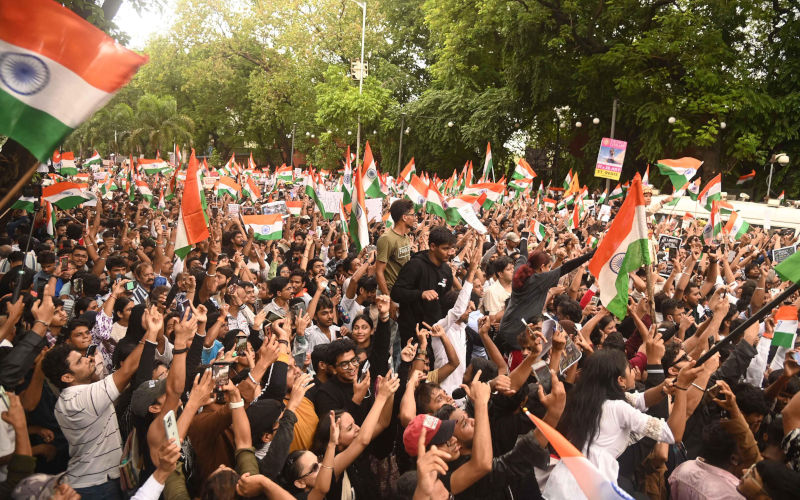
A protest movement born from anger over examination scandals has widened into a challenge over electoral rolls, institutional accountability and whether ordinary Indians can still trust the systems that shape their rights and opportunities.
In July, the cockroach bit Narendra Modi. Less than three months later, the government has discovered the bite was poisonous. What began as a satirical reply to a judge, who likened unemployed youth to cockroaches, has returned as a challenge to the institution that runs India’s elections. The first protest cost Modi an education minister. The second has turned central Delhi into a fortress. The government has changed its response. The cockroach has changed its target.
On 10 October, the world’s largest democracy barricaded its capital against a movement whose members proudly call themselves lazy and unemployed. Thousands of police and paramilitary personnel were deployed, dozens of metro stations closed and mobile internet suspended. Estimates of those detained range from about 2,000 to as many as 7,000. Police said the protest lacked permission.
Abhijeet Dipke, founder of the Cockroach Janta Party, did not even reach the streets. Police detained him and two senior colleagues, Saurav Das and Ashutosh Ranka, when their flight landed. They were released on Sunday, by which time protesters had returned to the streets and hundreds more had been detained. The authorities had prevented a mass gathering. They had not ended the protest.
In July, the movement demanded accountability for examination scandals. After weeks of protests, Education Minister Dharmendra Pradhan resigned and the government accepted the movement’s other demands. Modi had surrendered a minister to a movement with no parliamentary seats and a cockroach for a mascot. He hoped that would settle the matter. But the deeper grievance – that institutions were failing the young people who depended on them – remained unresolved.
This time the target is Chief Election Commissioner Gyanesh Kumar. The Special Intensive Revision of electoral rolls has removed at least 130 million voter names. The Election Commission calls it a routine clean-up of dead, duplicate and ineligible voters. Yet tens of thousands of people say they were wrongly removed, and opposition parties allege the exercise favours the Bharatiya Janata Party (BJP). The commission and the BJP deny any manipulation.
None of this proves an election has been stolen. Removing invalid entries is legitimate work. But an exercise on this scale demands more than assurances from the institution conducting it. Voters need to know how decisions were reached, whether mistakes can be corrected and whether the rules apply equally. A process defensible on paper can still become a political crisis once confidence in its independence erodes.
That confidence was hardly helped when The Indian Express reported that two of the commission’s three members had objected at least 14 times to decisions on the revision. The commission insists its decisions were unanimous, which may come as news to the two who objected.
This is where the cockroach has become more dangerous. Exam scandals and voter rolls seem to belong to different worlds, but both raise the same question: can ordinary Indians trust the institutions that decide their opportunities and rights? The movement has joined the frustration of young people who believe effort no longer pays with the anxiety of voters who fear their voice may not count.
For more than a decade, Modi’s advantage has rested on more than winning elections. The BJP has shaped the national conversation through friendly television, a formidable social media machine and the language of nationalism. Critics were branded anti-national and uncomfortable questions drowned out. Often, the government could simply change the subject.
The cockroach complicates that strategy. It is difficult to humiliate people who have already turned an insult into their identity, and difficult to dismiss questions that cut across party loyalty. A student worried about exam leaks does not necessarily oppose the BJP; a voter questioning the rolls does not necessarily support Congress. The movement’s strength lies in giving such grievances a common language.
The government’s response has only helped. The barricades kept protesters from Jantar Mantar, a designated protest site in central New Delhi, but the detentions became the story and demonstrators simply regrouped at Dilli Haat, Connaught Place and elsewhere. The UN human rights office expressed concern; India dismissed it as interference. The Supreme Court was harder to wave away. On the eve of the protest, a bench led by the very chief justice whose remark created the movement ruled against a total metro shutdown. On Sunday, at a special hearing, it ordered internet services be restored and an end to illegal detentions.
Governments are entitled to regulate demonstrations when public safety is at risk. But there is a difference between maintaining order and making peaceful assembly practically impossible. And when a demand for electoral accountability is met with a sealed-off capital, the method of enforcement becomes part of the argument. The protesters now have another question to ask: why does accountability require such an extraordinary security response?
The movement faces a test of its own. Pradhan’s resignation did not transform India’s exam system, and removing an election commissioner would not by itself guarantee clean rolls. The cockroach has shown it can mobilise anger. It has yet to show it can deliver lasting reform. And if it becomes just another arm of the opposition, it will lose the independence that made it so hard to attack.
Nor is Modi about to lose power. The BJP remains India’s strongest party; social media followers are not votes. But winning elections and controlling the story are not the same thing. A government can keep its parliamentary majority while losing the confidence of citizens who increasingly doubt that the system is fair.
That is the poison in the cockroach’s bite. An exam scandal can be dismissed as administrative failure, unemployment blamed on the economy and roll disputes presented as technical housekeeping. Together, they tell a more troubling story of citizens losing faith that the institutions deciding their future are accountable. Every heavy-handed restriction deepens that distrust.
In July, the government surrendered a minister and the protesters went home. In October, it barricaded the capital, detained the leaders and watched the protests continue the next day. The first confrontation showed that the cockroach could force a concession. The second suggests it has found a grievance that no single resignation can settle.
Modi remains in power but a government used to changing the subject is finding that some questions will not go away. A media machine can shape a narrative. It cannot manufacture trust.
The cockroach has not brought Modi down. It has carried the anger of examination halls into the argument over India’s ballot boxes. In July, the insect proved difficult to kill. In October, Modi discovered that its poison has been spreading.

Muhammad Amir
Muhammad Amir is a PhD researcher in International Relations at Deakin University, focusing on conflict resolution and regional politics.