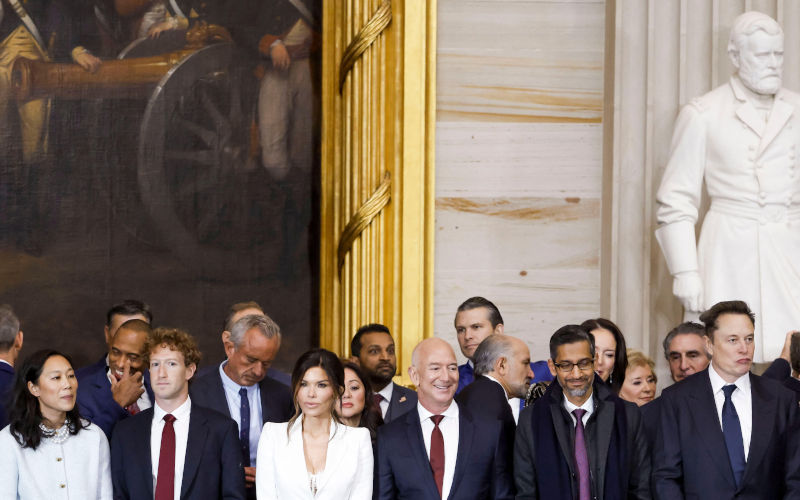
The danger of nuclear war does not begin and end with Donald Trump, but with a failing system of nation states, militarised power and corporate oligarchy.
The declaration by 26 US psychiatric doctors that the US President is unstable and constitutes a ‘clear and present danger to the world’ understates the case. Indeed, it hardly begins to recognise the greater peril facing all humanity.
Arguably, most of the men in charge of the world’s 12,100 nuclear weapons are mentally unbalanced. They include wanted war-criminals Netanyahu and Putin, and the notably irrational Kim Jong Un, who together command 5570 warheads.
India (Modi – 190 nukes) and Pakistan (Shebaz Sharif – 170 nukes) fought as recently as 2025. Britain (225 nukes) and France (370 nukes) have supine governments, which are frequently lured into other people’s wars. Among the world’s nine nuclear powers, only China (600) has not waged an external war of aggression or uttered nuclear threats in the past half century.
Arguably, nine tenths of the world’s nuclear weapons are already in the hands of psychopaths, or else people easily led by them. This is not reassuring, if humanity hopes to survive to see the 22nd Century.
Behind all this nationalistic machismo is a fact, far more sinister and dangerous than the overt lust for conquest and hegemony. A fact that still, somehow, manages to escape most geopolitical commentators and experts. It is the universal decline and fall of the nation state and its steady lapse into corporate-controlled oligarchy or outright autocracy. I have written of this in previous articles. The nation state has only existed for around 200 years and is already on the way out, as a mode of self-governance. It is a transient phase in human affairs – and this needs to be understood and recognised far more widely than at present.
As the nation state crumbles into insignificance, its ability to inflict gratuitous harm and random slaughter on the rest of humanity is, if anything, expanding as a new generation of leaders, more unbalanced than those of the past, seize the reins of power with the aid of vast corporations and lobbies which care only for their own profit and primacy – and nothing else.
It might well be argued from history that all future US presidents are as great a threat to world peace as Trump. While previous presidents might not all be adjudged as ‘mad’, nevertheless the US has been involved in 36 major wars and 469 overseas armed conflicts in 96 countries, only five of which were ever declared by its Congress and has been at war for 92 per cent of its existence as a nation. These cost $12 trillion, 1.34 million American and 13-23 million other deaths. Five hundred of these fights were sanctioned by presidential decree alone.
Every US president – regardless of politics – maintains the country’s militaristic and invasive posture along with its 800 overseas bases and its nuclear arsenal. It is how the country seeks to coerce or cow all others into supporting it. It is thus in the failure of its 18th Century governmental model that the US represents a clear and present danger to the human future – and a case study of the decline of the nation state.
The same argument applies equally to Russia, where bad rulers are almost a tradition and, potentially to China, where the balance between the party state and rising power of the military remains delicate, despite a hitherto peaceful emergence. Nobody can guarantee all its future rulers will be benign.
The fact is that, as long as ‘countries’ last, human civilisation will teeter on the brink of catastrophe – a universal holocaust spawned by the petty rivalries, jealousies, misunderstandings and bigotries to which nations are prey.
To start with, most ‘countries’ nowadays are controlled and directed, not by democratically elected or even self-appointed governments but by global arms giants, hi-tech and energy corporates. Sixty-five years ago, a US president, Dwight D Eisenhower, in his parting address, warned of the ‘military-industrial complex’, a tumour that has since metastasised into almost every national organ of governance on the planet.
Governments, wholesale, are abandoning the principle that governance is about improving the welfare of the people – and instead unleashing the ‘disastrous rise of misplaced power’ that Eisenhower most feared in which governance is now carried out on behalf of arms dealers, oil barons, ‘tech bros’ and other corporate bully-boys. In this new world of atrophying nation states, government has broadly forsaken the interests of the people for those of the greedy few.
A study by the UK group Global Justice found that 157 out of the world’s richest 200 financial entities are now corporations. Only 43 are countries. This starkly illustrates how global financial power is sliding rapidly away from nations and towards mega-corporates. The shift, in turn, enables corporations to buy more political influence and assert greater control over policy decisions by increasingly weak, corrupt and compliant governments.
The worst aspect of this trend is that there is apparently not a blind thing that the world’s 8.3 billion ordinary citizens can do about it*, since only about 17 per cent of all countries (31) now qualify as ‘free democracies’ whereas 100 per cent of the corporates are autocracies, ruled by fiat.
The transfer of power from nations to corporates is of significance to the nuclear arms race since, for the present, only nine nation states can afford to bear nuclear arms, and so imperil the future of all humanity. Yet many corporates profit from it.
It can be argued that the demise of the nation state is the most valuable contribution to world peace, as corporations rarely see much point in vast military expenditure to defeat their rivals, whereas nations are constantly bickering and shedding blood over petty slights and differences. However, the possibility of nuclear-armed mega corporates cannot be ruled out, as the century advances and AI robot nukes become as cheap as drones. Meanwhile most of the social control technologies are already owned by corporates.
Nor can the control of corporations by madmen be ruled out, as is already clear from the global surfeit of undereducated but over-opinionated billionaires. Being rich does not mean you are wise or know how the Earth works – only that you know how to deprive others of wealth. Corporations are not benign: indeed they kill more people even than nations do, but by different and subtler methods.
Furthermore, few corporations exhibit much interest in health, welfare, education, housing, science, roads, infrastructure, clean water, clean air and a healthy environment.
Thus, the transfer of power from nation states to corporate oligarchies betokens an ongoing decline and collapse in human social and physical wellbeing in almost every society, along with the consolidation of wealth and political control in the hands of the feudal elite. There are venial politicians aplenty in all countries now offering themselves as the lackeys and enablers of the new autocrats.
This, in essence, is the heart of the current human dilemma. If we stick with nations, they will almost certainly end up destroying us in wars. For no good reason.
And if we allow corporates to rule the planet, absorb governments and define the rules and goals of society, they will almost certainly wreck it, simply because they are not designed for the common good. It is against their religion.
Humanity is thus agonisingly poised between mad warlords and greedy scoundrels.
It is time humanity started to think beyond the fossilised structures of wealth and nationality that are destroying us, and into a future for one people on one planet. A future in which we are all Earth Citizens, ruling ourselves with wisdom, care for one another and for the planet we leave to our descendants.

Julian Cribb AM is an Australian science writer and author of six books on the human existential emergency. His latest book is “How to Fix a Broken Planet” (Cambridge University Press, 2023)