Canada is looking for ways to protect its independence from Washington. Australia has embedded itself so deeply in the US military system that it risks being drawn into America’s next war – whether we choose it or not.
These are tough times for middle powers. Canada and the European Union have demonstrated just how vulnerable they are to bullying from their erstwhile ally the United States. Not only has Donald Trump threatened to make Canada America’s 51st state, but Europe is routinely denigrated as freeloading, out of touch with reality and facing ‘civilisational erasure‘.
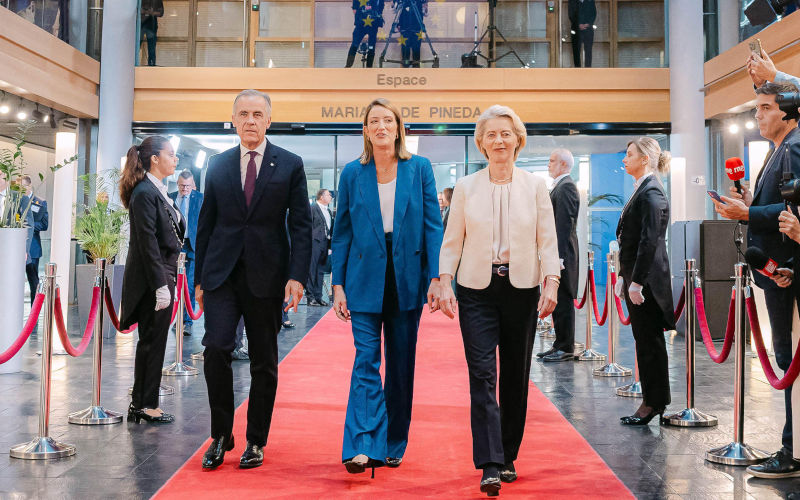
Little surprise that both Canada and the EU have been looking for new ways of preserving their independence by working more closely with similarly positioned, like-minded allies. The possibility that Canada will become an ‘associate member‘ of the EU is a creative response to a rapidly changing international order.
The reaction of the Trump administration was also unsurprising. Trump described it as a “hostile act” and threatened to impose yet more “heavy tariffs”, despite it being unclear precisely what form any such relationship might take. Whatever happens, though, it is another demonstration of the potential middle powers possess, if they have imaginative leaders. Canada’s Mark Carney has once again demonstrated what independent foreign policy looks like, much to Australia’s chagrin.
It is impossible to imagine Australia’s leaders doing anything similar. Despite the president of the European Parliament suggesting that Australia and New Zealand could also become associate members, Australia’s foreign policy elites can imagine nothing other than business as usual; no matter how much the Trump administration undermines the old international order that is rapidly disappearing.
Australia’s almost certain reluctance to take up the EU’s offer has nothing to do with geography or the somewhat unfortunate optics of joining a club of privileged, rich, predominantly white countries either. On the contrary, the biggest obstacle to Australia adopting a similarly independent policy position is that the Americans wouldn’t like it.
Australia finds itself in the unfortunate position of being hostage to a long-standing belief amongst strategic elites that it has no alternative other than to remain wedded to the US, despite America being “addicted to war“. The folly of this position has been repeatedly demonstrated by our participation in America’s wars of choice with enemies who posed no threat to Australia.
But the flipside of what the late Allan Gyngell called our “fear of abandonment” is “entrapment”, which describes a situation where fighting alongside a more powerful ally is seen as the cost of preserving the alliance. In Australia’s case, entrapment has been taken to extraordinary lengths: we literally have no choice other than do what the US wants because we have become its most important overseas base, especially in the containment of China.
As The Guardian has recently demonstrated, the US military has control of, or access to, more than 100 defence facilities in Australia, ranging from intelligence gathering and communications assets in places like Pine Gap and Northwest Cape, to prepositioned military assets including nuclear capable aircraft and the submarine base at Garden Island in Western Australia. Indeed, the woefully misconceived AUKUS project is emblematic of Australia’s strategic purblindness.
The point to emphasise about all these American-controlled or ‘joint facilities’ is that they are vital for America’s warfighting capabilities and plans, which are unlikely to coincide with Australia’s. After all, we are a country with no obvious enemies and a vitally important economic relationship with China, a country which poses no obvious threat to us – other than an understandable desire to eliminate all those American military assets in the event of a great power conflict, of course.
Indeed, we are at risk of nuclear attack only because we obligingly host vital pieces of the American military machine. Not only has our safety actually decreased as a result, but we are unable to act independently, strategically or even in foreign policy. The EU will be rebuffed as the risk of American displeasure is too much to contemplate for our pusillanimous leaders.
In the unlikely event that our political and strategic elites did realise that our sovereignty and independence was a fiction, however, and that the only way to restore it was to ask the Americans to leave and take all their military hardware with them, it is as certain as anything can be that they would simply refuse to go. Indeed, they might even organise a coup as they have in so many other parts of the world. This is the consequence of ‘invasion by invitation‘.
Australian foreign and strategic policy for the last 80 years or so has made Australia an indispensable and irreplaceable cog in the mighty American military machine. We are in short, entrapped and locked into whatever harebrained military folly the Americans decide to embark on next. Given that the US has been at war for more than 90 per cent of its history as an independent nation and that Trump is in the White House and Pete Hegseth is his secretary of war, it’s more likely than not.
But our leaders dare not even think about, much less discuss the consequences of our long-running, but profoundly misguided search for security. The net result is that we are no longer an independent, sovereign nation and far too timid to consider trying to become one.

Mark Beeson is an Adjunct Professor at the University of Technology Sydney and Griffith University. His latest book is Environmental Anarchy? International Relations Theory and Practice in the Anthropocene, (Bristol University Press: 2021) He has also written Environmental Populism: The Politics of Survival; in the Anthropocene Palgrave 2019