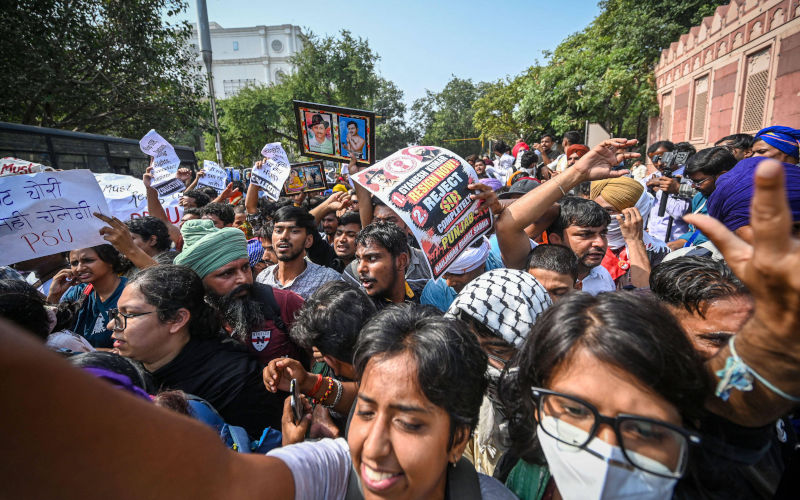
What began as a satirical response to an insult aimed at unemployed young Indians has grown into a wider movement against joblessness, inequality and alleged electoral manipulation.
Something is shifting in India. After 12 years of Narendra Modi’s rule, millions are rebelling against his government for ‘stealing democracy’. This is no flash in the pan. A widening coalition of dissenters is spreading across the Indian political landscape.
It began with an unholy union between a judge and a joke. When the chief justice of India contemptuously referred to unemployed young Indians as ‘cockroaches’, a student in Boston posted a pointed provocation: “What if all cockroaches come together?” Some 20 million responded. Thus was born the Cockroach Janta Party – the CJP.
On 20 July, the cockroaches stormed New Delhi. A generation of young Indians, furious and desperate about their future, poured into the streets. Their anger was sparked by a rotting education system and fuelled by the steady erosion of entrepreneurial opportunities in both private enterprise and the state-salariat.
By day’s end, the protest had grown far beyond its narrow catalyst. It ignited a nationwide revolt that has since drawn in even the opposition parties, previously somnolent and ineffective in the face of Modi’s Bharatiya Janata Party (BJP) onslaught. The CJP now stands at the heart of a rebellion against crony capitalism, corruption, grotesque inequality, and the erosion of democratic norms in India.
One critical flashpoint is the purging of some 130 million voters from electoral rolls. While most deletions may reflect legitimate ‘clean-up’, minorities and women are disproportionately affected, especially in constituencies where opposition parties are strong.
Indira Gandhi’s 1975 Emergency is the closest historical parallel. She suspended the fundamental rights to free speech, assembly, association and movement. It was authoritarian rule conducted through constitutional provisions rather than in place of them.
The Modi government’s approach is more insidious. It does not suspend rights outright; instead, it gradually subverts the constitutional institutions meant to protect them – such as the Supreme Court and the Election Commission.
Governments in democracies, flawed or otherwise, usually fall when a tipping point is reached, and major social and economic groups abandon ship. Two such groups stand out in India today.
First, the 300‑million‑strong middle class, whose share of the economic pie has been shrinking even as the cost of living rises.
The top 1 per cent controls more than 40 per cent of national wealth. Vulgar consumption by the wealthy – one oligarch’s son’s wedding cost some $700 million – sits alongside 800 million people depending on state-subsidised rations every month.
Second, the 400 million aspiring youth. In the age of information, these half-educated and underemployed young Indians can see what is possible on their smartphones. But their circumstances deny them the chance to attain it. They are not a demographic dividend. They are a cauldron of resentment, simmering against the system.
Their rebellion has a unique twist. Almost every Indian tertiary student dreams of studying or working abroad, especially in the American Mecca.
The cockroaches are all too enviously aware of the offspring of elite industrialists, bureaucrats, politicians, and even defence personnel studying or working in the US and elsewhere in the West.
Taken together, these 700 million young and middle‑class Indian citizens are acutely conscious of their nation’s foreign policy – not only towards the US but also towards countries such as Australia – because their futures depend on access to education and work abroad. Few citizens, even in developed countries, are this broadly aware of the consequences of foreign policy.
Modi is on the back foot on this score. His strategy of tying India’s foreign policy closely to the United States is fraying. Trump has sharply increased student visa fees, curtailed H‑1B‑type work visas, threatened sanctions, and pressured India to reduce Russian oil imports in favour of American supplies – even as the US itself imports Russian diesel.
Perhaps the most telling moment came when Elon Musk, frustrated at Starlink’s failure to secure approval in India, tweeted at the Indian oligarch Mukesh Ambani, one of the world’s 20 richest men: “Dear Prime Minister Ambani, please accept my humble apologies for not realising that you are the real boss of India.”
It was a calculated insult to Modi from someone close to Trump – and it struck home among the rebelling citizenry.
Protests are intensifying. The full coercive machinery of the state has been unleashed: mass arrests and intimidation against political leaders, journalists, lawyers, and especially women. Police (and pro-Modi vigilantes) act with impunity, serving their political masters rather than checking them.
The cockroaches are defying draconian security measures. With nothing left to lose, they have become the spark in a widening, growing cascade of dissent.
This is not going to fizzle out, for the grievances are about how India is governed. The government can contain the protests, but not their causes, which will continue to smoulder.
Modi is in no danger of falling precipitously. Yet India is entering a phase that demands an overhaul of the governing superstructure. Either a second chapter of Indian democracy is about to be written – or its epitaph.

Rakesh Ahuja
Rakesh Ahuja, a former Australian diplomat, is a Cultural Intelligence (CQ) Consultant. Professional Background: RakeshAhuja.DownloadingMyMind.com