Indonesia’s agreement on reciprocal trade with the United States puts the country’s sovereignty at risk.
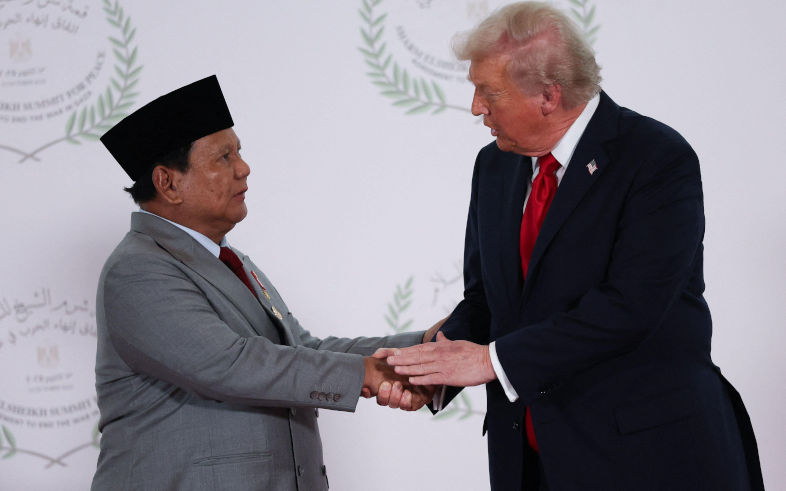
Trade agreements are usually sold as instruments of prosperity. The language is familiar: market access, investment certainty, supply-chain integration, mutual growth. Yet the United States–Indonesia Agreement on Reciprocal Trade (ART) belongs to a different category altogether. This is not merely a commercial pact. It is a structural redesign of the Indonesian state, negotiated under tariff pressure and wrapped in the vocabulary of partnership. The agreement was signed by the Presidents of Indonesia and the United States on 19 February 2026 and will enter into force 90 days after both countries submit written confirmation that all required domestic legal procedures—including consultations and ratification—have been completed.
At stake is not simply Indonesia’s export performance or tariff schedule. At stake is whether Southeast Asia’s largest economy will retain the sovereign right to determine how its minerals are processed, where its citizens’ data is stored, how halal standards are enforced, and whether industrial policy can still serve national development rather than foreign strategic priorities.
That is why the ART has triggered such an unusually visceral backlash in Jakarta. Nearly 80 civil society organisations and more than 65 academics have urged parliament to reject what they describe as a ‘shameful’ agreement that risks reducing Indonesia from a sovereign middle power into an economic subordinate within a US-designed system.
The scale of the asymmetry is striking. Under the agreement, Washington reduces tariffs on Indonesian exports from 32 per cent to 19 per cent, while granting zero-duty access to 1,819 Indonesian products, including palm oil, rubber, cocoa, coffee and spices. In return, Indonesia removes tariffs on more than 99 per cent of US imports and commits to purchasing roughly US$38.4 billion worth of American goods, including US$15 billion in energy commodities and US$4.5 billion in agricultural products.
But the most consequential provisions are not economic; they are constitutional. Indonesia would be required to dismantle local-content rules, weaken restrictions on foreign ownership, remove barriers to raw mineral exports, exempt US technology firms from digital service taxes, and permit Indonesian citizens’ personal data to flow offshore. The agreement also obliges Jakarta to accept American FDA and Department of Transportation standards, while waiving halal certification requirements for US imports.
For a nation built upon the doctrine of ‘bebas dan aktif‘ – independent and active foreign policy – these concessions land with unusual emotional force. Indonesia’s post-colonial political identity has long rested on resisting external domination while balancing major powers without submission to any. The ART cuts against that tradition.
The most politically explosive provision may be buried within the agreement’s strategic clauses. According to Reuters reporting cited in the treaty analysis, Indonesia would be expected to align with US trade restrictions against third countries by ensuring “equivalent restrictive effect”. In practice, that means Jakarta could find itself participating in economic containment strategies directed at China or other states, even where Indonesian national interests diverge.
This is not free trade in the classical liberal sense. It is a geoeconomic alignment. The timing makes the imbalance even more glaring. One day after the ART was signed, the US Supreme Court reportedly struck down the emergency tariff mechanism used to pressure Indonesia into negotiations. Yet Washington still retains unilateral authority to alter future tariff settings, meaning the central leverage underpinning the deal remains firmly in American hands. Indonesia carries the obligations. The United States keeps strategic flexibility.
That arrangement echoes an older historical pattern now re-emerging across global trade politics: the return of asymmetric bargaining under the language of reciprocity. Think tanks across Asia and Europe have increasingly warned that economic agreements are no longer primarily about tariffs. The Council on Foreign Relations has documented the rise of ‘weaponised interdependence’, where supply chains, data governance, critical minerals and technology standards become instruments of geopolitical influence. The ART sits squarely inside this evolving framework.
Indonesia’s mineral sector illustrates the stakes particularly clearly. Over the past decade, Jakarta pursued one of the developing world’s boldest industrial strategies by restricting raw nickel exports to force downstream processing and domestic manufacturing. The policy was controversial but transformative. Indonesia rapidly emerged as the centrepiece of the global electric vehicle battery supply chain, attracting billions in investment from China, South Korea and Europe.
Now, under ART provisions, many of those export restrictions would need to be dismantled. What Washington frames as ‘market access’ is viewed by many Indonesian economists as the unwinding of the country’s most successful industrial policy in decades. The digital dimension may prove even more consequential in the long run.
Indonesia is Southeast Asia’s largest digital economy. Control over data localisation rules, platform taxation and digital sovereignty therefore carries enormous strategic significance. Yet the ART effectively grants American technology firms exceptional freedom while limiting Jakarta’s ability to regulate data flows or compel local storage.
Around the world, governments are moving in precisely the opposite direction. India has tightened digital sovereignty frameworks. The European Union has built expansive data-protection regimes through General Data Protection Regulation. Even allies of Washington increasingly seek strategic autonomy in technology governance. Indonesia, meanwhile, is being asked to liberalise some of its most sensitive regulatory space at the exact moment digital control is becoming central to national power.
For Australia and regional policymakers, the implications extend well beyond Indonesia itself. ASEAN’s strategic stability depends heavily upon the perception that middle powers retain meaningful room for manoeuvre between Washington and Beijing. If Indonesia – ASEAN’s largest member and the symbolic anchor of Southeast Asian autonomy – comes to be seen as economically absorbed into a US-led strategic architecture, the region’s carefully maintained equilibrium could begin to fracture.
The irony is that the ART may ultimately weaken the very trust Washington seeks to build. Partnerships endure when they are perceived as mutually respectful; they unravel when they appear coercive. The language surrounding this agreement increasingly evokes not cooperation, but dependency – particularly because the United States retains the ability to revise tariffs while Indonesia undertakes irreversible structural concessions.
That perception matters profoundly in the Global South. Across Africa, Latin America and Southeast Asia, there is growing sensitivity to forms of economic statecraft that resemble the unequal bargains of an earlier era. The debate surrounding the ART is therefore not merely Indonesian. It touches a wider international anxiety about whether the emerging economic order will be genuinely rules-based or simply organised around the leverage of great powers.
Indonesia’s parliament now faces a historic decision before ratification enters into force. The question is no longer whether closer economic ties with the United States are desirable. They clearly are. The deeper question is whether a strategic partnership must come at the cost of sovereign agency itself.
Because once a nation surrenders control over its industrial policy, data governance, regulatory autonomy and strategic neutrality, what remains may still resemble independence on paper — while functioning very differently in practice.

Kurniawan Arif Maspul
Kurniawan Arif Maspul is a researcher and interdisciplinary writer focusing on Islamic diplomacy and Southeast Asian political thought. He holds an MEd in Advanced Teaching, an MBA and an MA in Islamic Studies and is currently pursuing a Master’s in Islamic Banking and Finance at Al-Madinah International University in Malaysia.